

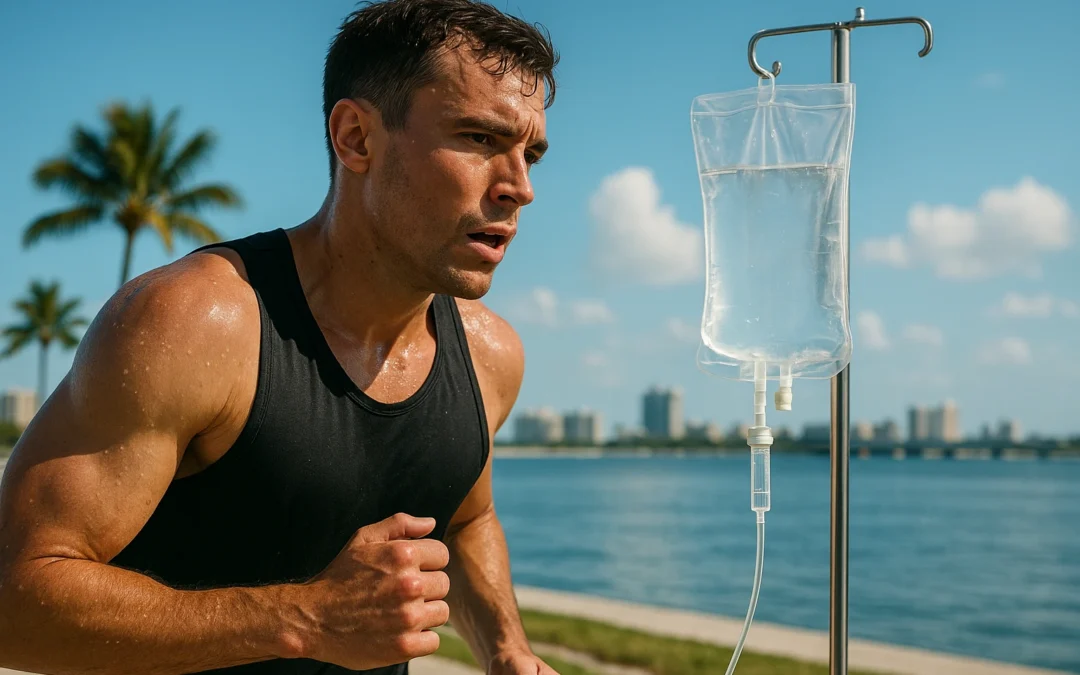
Imagine this: You’ve just crossed the finish line at the historic St. Anthony’s Triathlon, or perhaps you’re wrapping up the grueling Pass-a-Grille portion of the St. Petersburg Distance Classic. Your muscles are screaming, your jersey is soaked, and you know you need fluids. You grab a bottle of water or a sports drink, but instead of feeling refreshed, your stomach immediately churns.
You try to take another sip, and it just “sloshes” around in your gut. Nausea sets in.
If you train in St. Petersburg, Florida, you know that our extreme coastal heat and humidity push human physiology to its absolute limits. But what many athletes—from local CrossFit competitors to the legendary St. Pete Mad Dogs—don’t fully understand is why oral hydration often fails exactly when you need it most.
Let’s dive into the fascinating sports science of heat exertion, muscle recovery, and why clinical athletic recovery iv therapy is rapidly shifting from a luxury trend to a physiological necessity for local athletes.
The Crucible of St. Pete Running: Physics Meets Physiology
To understand recovery, we first have to understand what the St. Pete climate does to your body. In our coastal humidity, sweat cannot efficiently evaporate off your skin. Because evaporation is the body’s primary cooling mechanism, your core temperature rapidly rises.
To compensate, your body sweats more aggressively—often losing up to 2 liters of fluid per hour. This massive fluid loss causes your blood plasma volume to drop by 5.7% to 7.0%. When your blood physically thickens, your heart has to beat significantly faster (an extra 6 to 10 beats per minute) just to deliver oxygen to your working muscles.
It’s an incredible amount of stress. And it triggers a fascinating physiological defense mechanism.
The Physiology of the Shutdown: Why You Can’t Keep Fluids Down
When athletes search for answers to questions like where can i get an iv for dehydration, it’s usually because their digestive system has completely given up. In medical terms, this is called Splanchnic Hypoperfusion—but you might know it as the “Sluggish Gut.”
When you are pushing hard in high temperatures, your body has to make a choice: does it send blood to your stomach to digest that sports drink, or does it send blood to your skin and skeletal muscles to keep you moving and cool?
Survival always wins. During intense exertion, your body shunts up to 80% of your blood flow away from your gastrointestinal tract. This causes local hypoxia (lack of oxygen) in your gut.
This is the exact reason why oral rehydration powders (which are fantastic for daily training) often fail after a hard race. The gut is functionally shut down. It can take 90 minutes or more for blood flow to normalize so you can absorb fluids. Intravenous hydration bypasses the GI tract entirely, restoring plasma volume in 15 to 30 minutes.
Clinical Biochemistry of Recovery: Beyond the Saline Bag
Not all recovery protocols are created equal. Whether we are helping runners manage altitude with athlete recovery arvada protocols, or dealing with the St. Pete heat, the specific biochemistry of your recovery matters.
The Potassium-Magnesium Cramp Connection
We’ve all been told to eat a banana for potassium when our calves start cramping at mile 10 of the St. Pete Run Fest. But what if potassium alone isn’t enough?
Clinical kidney-physiology shows a crucial co-factor relationship: up to 40% of potassium-depleted athletes are also magnesium-depleted. Magnesium acts as the “lock” for the cellular sodium-potassium pump. If your magnesium levels are low, your body literally cannot retain potassium—no matter how much you consume. It simply excretes it. A properly formulated IV ensures magnesium is replenished first, allowing potassium to actually reach and repair the muscle.
The Vitamin C Paradox: Don’t Blunt Your VO2 Max
Antioxidants are generally great for wellness, but timing is everything in sports science. Many athletes mistakenly think a high-dose Vitamin C drip is the perfect pre-workout boost.
However, peer-reviewed sports medicine reveals a surprising truth: chronic, high-dose Vitamin C supplementation during an active training block can actually impair your VO2 max adaptations by up to 11%. It suppresses the adaptive mitochondrial signaling your body needs to get fitter.
The takeaway? High-dose Vitamin C shouldn’t be used as a daily training optimizer. It should be strictly reserved as a targeted post-race anti-inflammatory intervention.
Taurine for Deep Muscle Repair
If you want to mitigate Delayed Onset Muscle Soreness (DOMS), Taurine is a highly effective amino acid. Scientific meta-analyses confirm that Taurine significantly decreases markers of exercise-induced muscle damage, helping mitigate perceived muscle soreness for up to 96 hours post-exertion.
Timing is Everything: Pre-Workout vs. Post-Race Protocols
When should you actually schedule recovery?
Pre-Race (24-48 Hours Before):If you are anticipating high heat and want to “pre-load” your plasma volume, an IV 24 to 48 hours before the starting gun is ideal. This allows your kidneys to process the fluids, optimizes your intracellular hydration, and ensures you aren’t carrying excess water weight on race morning.
Post-Race (Within 1-4 Hours):This is the critical window to shut down systemic inflammation, flush lactic acid, and bypass the “Sluggish Gut.” This is also the best time to introduce amino acids and antioxidants.
The Competitive Athlete’s Safety & Compliance Checklist
When medical treatments and athletics mix, iv safety is the absolute top priority. This is why having treatments administered by critical care-trained nurses (like those from ICU or ER backgrounds) is non-negotiable.
If you are a competitive age-grouper, you must also be aware of the World Anti-Doping Agency (WADA) and USADA guidelines.
The 100mL Rule: WADA officially prohibits intravenous infusions or injections of more than 100mL per 12-hour period, both in-competition and out-of-competition, unless clinically necessary and authorized via a Therapeutic Use Exemption (TUE).
If you are competing for a podium spot under USADA sanctioning, you cannot simply get a 1-liter saline bag for a quick recovery without violating anti-doping rules. Education is your best defense.
Recognizing Medical Emergencies:Mobile IVs are incredibly effective, but they are not a replacement for the emergency room. If you experience tea-colored urine, profound and unusual muscle weakness, or a complete inability to urinate after a hot race, these are red flags for Rhabdomyolysis or severe acute kidney injury. In these instances, you don’t need a mobile nurse—you need immediate hospital care.
Frequently Asked Questions (FAQ)
Is IV therapy better than drinking a hydration powder like Liquid I.V.?
For everyday training, oral hydration powders utilizing the sodium-glucose co-transport pathway are highly effective. However, during acute heat stress, intense racing, or when experiencing post-workout nausea, the gut’s ability to absorb fluids drops drastically. IV therapy is superior in these specific scenarios because it delivers fluids and nutrients directly into the bloodstream with 100% bioavailability.
How much does athletic IV recovery usually run?
Pricing varies based on the specific nutrients and the volume of fluids required. For those researching nad iv therapy cost or comprehensive sports recovery drips, treatments generally range from $194 to $350, reflecting the premium clinical safety of having an ICU-level nurse come directly to your home or hotel.
Can IV therapy cure heat exhaustion?
If you are showing mild signs of heat stress and dehydration, prompt fluid replacement is vital. Utilizing iv fluids for heat exhaustion can rapidly cool the body internally and restore lost plasma volume. However, actual heat stroke is a life-threatening medical emergency requiring immediate 911 intervention.
Does getting an IV hurt?
When administered by highly trained critical care nurses, the process is generally very comfortable. You will feel a quick pinch similar to a standard blood draw, but the infusion itself is painless.
Ready to Optimize Your Training?
St. Petersburg offers one of the most vibrant, challenging, and rewarding athletic environments in the country. But to thrive in the heat, you have to treat your recovery with the same clinical precision as your training plan.
Whether you’re gearing up for your next waterfront triathlon, battling through a grueling CrossFit competition, or just trying to bounce back from a long Sunday run in the Florida sun, understanding the science of your body is the first step toward peak performance. Listen to your gut (literally), prioritize your cellular health, and respect the climate. Your muscles—and your race times—will thank you.