

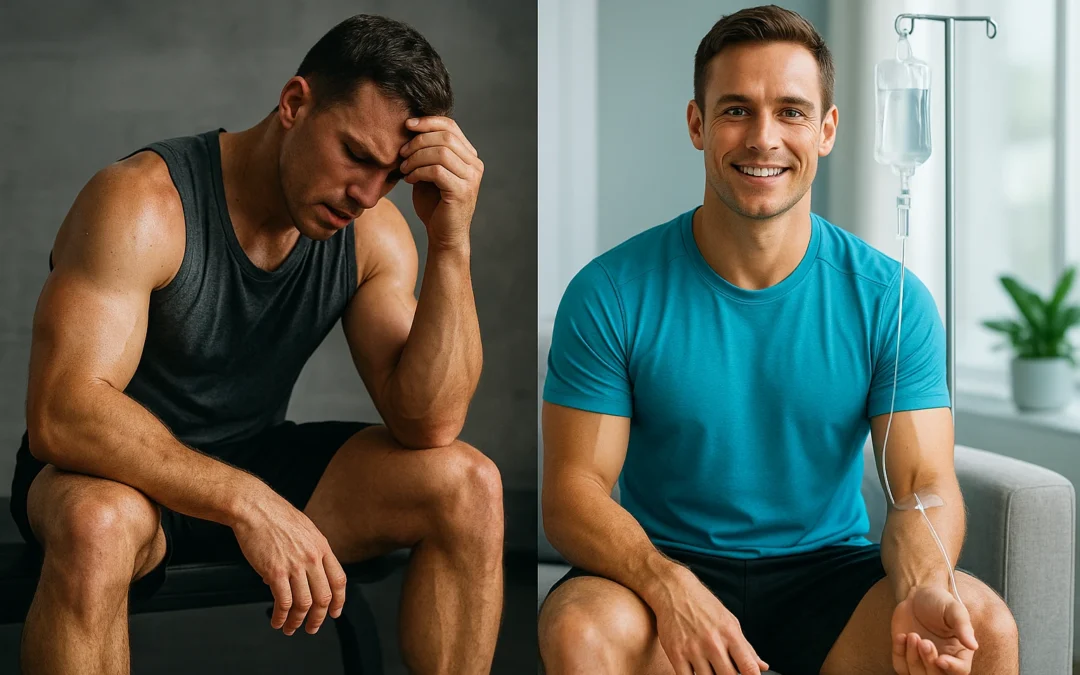
Picture this: You’ve just wrapped up a punishing leg day at the 24/7 Gold’s Gym in Thornton, or perhaps you pushed through a grueling HIIT session at VASA Fitness. You do everything by the book—you foam roll, chug a massive sports drink, and get eight hours of sleep.
Yet, 48 hours later, you can barely walk down the stairs. Your muscles are screaming, your brain feels foggy, and you’re hit with a profound sense of fatigue.
If this sounds familiar, you aren’t just experiencing normal soreness. You’ve hit the Thornton athlete’s “recovery wall”—a unique physiological collision of high altitude, deep cellular depletion, and digestive limits. Today, we’re looking past the colorful sports drinks and generic recovery advice to explore the actual biological mechanisms of athletic recovery, and why an athletic performance iv infusion is changing how local fitness enthusiasts rebuild their bodies.
The Biological Science of Post-Workout Depletion
To understand how to recover, we first need to look at what exactly happens to your body during intense exercise. It’s not just a matter of “sweating out water.” Heavy training causes a trio of physiological depletions:
- Intracellular Dehydration: Your cells lose their vital fluid volume.
- Glycogen Bankruptcy: Your muscles burn through their stored carbohydrate fuel.
- Myofibrillar Micro-tears: The tiny, physical damage to your muscle fibers that causes Delayed Onset Muscle Soreness (DOMS).
The Gut Shutdown: Why Chugging Water Fails
Have you ever chugged a liter of water immediately after a hard workout, only to feel bloated, nauseous, or experience “runner’s diarrhea”?
This happens because of a biological process called splanchnic vasoconstriction (or splanchnic ischemia). During heavy exercise, your body is incredibly smart. It realizes your working muscles need oxygen-rich blood, so it shunts blood away from your gastrointestinal tract to your limbs.
Immediately after a workout, your stomach and intestines are essentially “offline.” They lack the blood flow necessary to absorb massive amounts of fluids or nutrients. So, that hypertonic sports drink just sits in your sensitive gut, causing distress instead of driving recovery.
The Altitude Multiplier: Training at 5,300 Feet
Athletes in Thornton face a silent, compounding stressor: the air itself. At approximately 5,300 feet above sea level, the air is exceptionally dry and thin.
Every time you exhale during a heavy lifting set or a run around Margaret Carpenter Recreation Center, you are losing vital moisture through respiratory water loss. This subclinical dehydration thickens your blood slightly, forcing your heart to work harder and slowing down the transport of oxygen and nutrients to your repairing muscles. It’s an invisible tax on your recovery timeline.
The Bioavailability Highway: Oral vs. Intravenous
This brings us to a crucial concept: Bioavailability. This refers to the percentage of a nutrient that actually makes it into your bloodstream to be used by your cells.
When you swallow a vitamin pill or drink a recovery beverage, it enters the digestive “traffic jam.” It must pass through your stomach acid, cross the intestinal barrier, and be filtered by your liver (a process known as first-pass metabolism). By the time those nutrients reach your muscles, your body may have discarded 50% to 80% of them.
Intravenous (IV) delivery completely rewrites this timeline. By bypassing the digestive tract entirely, an IV drip offers 100% bioavailability. The nutrients take the “highway” directly into circulation, providing instant cellular uptake. For those looking for comprehensive athlete recovery denver and its northern suburbs, this mechanism is a game-changer.
Inside the ‘Peak Perform’ IV: A Masterclass in Cellular Recovery
Not all IVs are created equal. Formulations like the ‘Peak Perform’ IV are engineered specifically to reverse the exact biological depletions caused by heavy training. Let’s deconstruct the science behind the ingredients:
- Isotonic Fluid Base (Normal Saline or Lactated Ringer’s): Unlike sugary sports drinks that can aggravate the intestinal barrier, these fluids match human blood osmolarity perfectly. They instantly restore intravascular volume without causing bloating.
- Magnesium Chloride: This is the ultimate neuromuscular relaxant. Magnesium works at the neuromuscular junction to block calcium-driven excitability, effectively stopping muscle spasms and cramps in their tracks.
- B-Complex (B1, B2, B3, B5, B6) & Vitamin B12: These aren’t just for “energy.” They are essential coenzymes that kickstart the citric acid cycle inside your cells’ mitochondria, converting food into ATP (cellular energy) to erase deep neurological fatigue.
- Vitamin C (Ascorbic Acid): Heavy exercise generates a cascade of oxidative stress and free radicals. Vitamin C acts as a powerful antioxidant to neutralize this damage.
- Targeted Amino Acid Blend:
- Glutamine: Spares your hard-earned muscle tissue from breaking down (catabolism) and supports gut lining recovery.
- Arginine & Ornithine: These are the unsung heroes of the Urea Cycle. They rapidly accelerate the clearance of exercise-induced toxic byproducts, like ammonia and lactic acid, converting them into harmless urea so your body can eliminate them.
Navigating Safety and Athletic Regulations
As sports science evolves, athletes naturally have questions about the rules and safety of advanced recovery methods.
WADA & USADA Compliance Demystified
If you are a competitive athlete—perhaps a high school track star, a collegiate player, or participating in sanctioned powerlifting meets—you must navigate World Anti-Doping Agency (WADA) and USADA regulations.
Under current rules, competitive athletes are restricted to IV infusions of no more than 100mL per 12-hour period, unless administered under a therapeutic use exemption (TUE) or in a hospital setting for an acute medical intervention. Understanding this 100mL rule is vital for staying compliant while competing.
However, for recreational athletes, marathon runners, and fitness enthusiasts training at local gyms like Chuze Fitness or local adult sports leagues, standard IV therapy is fully accessible, compliant, and highly effective for routine recovery.
Clinical-Grade Safety in Your Living Room
A common question people have when searching for a mobile iv therapy near me is regarding safety.
The clinical standard for mobile IV therapy relies entirely on the expertise of the practitioner. The safest, most effective therapies are administered exclusively by Critical Care Registered Nurses (RNs)—professionals who have spent years in Intensive Care Units (ICU) or Emergency Departments (ED). This ensures that infection control, precise vein location, and fluid balancing are handled with hospital-level expertise, whether you are sitting on your couch or in a gym lounge.
Designing Your Post-Workout Protocol
If you’re ready to integrate cellular hydration into your routine, timing is everything. For maximum therapeutic benefit, the ideal window to receive an IV is within 2 to 24 hours post-workout.
The process is remarkably simple. You don’t need to drive to a clinic; a mobile nurse comes to you. You simply drink a small glass of water beforehand, find a comfortable spot to relax, and let the professionals handle the rest. Within minutes, you’ll typically feel a cooling sensation in your arm, followed by an almost immediate wave of rehydration and mental clarity.
Frequently Asked Questions (FAQ)
Why do my muscles hurt so bad 48 hours after a heavy leg day?
This is Delayed Onset Muscle Soreness (DOMS). It is caused by microscopic tears in your muscle fibers during eccentric movements (like lowering a heavy barbell). Your body responds with inflammation to heal these micro-tears. If you are dehydrated or lacking specific amino acids, this inflammatory phase is prolonged, making the pain peak around the 48-hour mark.
How does IV therapy differ from drinking electrolytes or Gatorade?
Digestive limitation is the main difference. When you are severely exhausted, your stomach cannot physically absorb fluids fast enough due to shunted blood flow (splanchnic ischemia). IV therapy bypasses the stomach entirely, offering 100% absorption directly into the bloodstream without sugar spikes or gastrointestinal distress.
Is mobile IV therapy safe to receive at home or in a gym parking lot?
Yes, provided it is administered by a highly trained medical professional. Premier providers utilize critical care RNs who follow strict aseptic (sterile) techniques, making the process just as safe in your living room as it is in a clinical setting.
What if I’m training in a neighboring city?
Mobile recovery services are highly adaptable. Whether you are hitting the weights in Thornton, exploring iv therapy broomfield after a long trail run, or needing recovery across the northern metro area, critical care nurses travel to where you are most comfortable.
If I feel a sudden illness or severe dehydration coming on, where can i get an iv for dehydration quickly?
Because mobile IV teams are dispatched directly to your location, they serve as excellent resources for rapid rehydration. If you find yourself asking where can i get an iv for dehydration, booking a mobile critical care nurse is often the fastest, most comfortable route to restoring your fluid balance without a trip to an urgent care waiting room.
Next Steps in Your Recovery Journey
Understanding the biology of your own recovery is the first step toward peak performance. You now know that pushing past the “recovery wall” requires more than just willpower—it requires recognizing the limitations of your digestive system, respecting the high-altitude environment of Colorado, and giving your cells exactly what they need to rebuild.
As you plan your next heavy training block, consider how you’re supporting your body behind the scenes. When you’re ready to bridge the gap between basic hydration and true cellular recovery, explore how clinical-grade, mobile IV therapy can help you train harder, recover faster, and reclaim your time.