

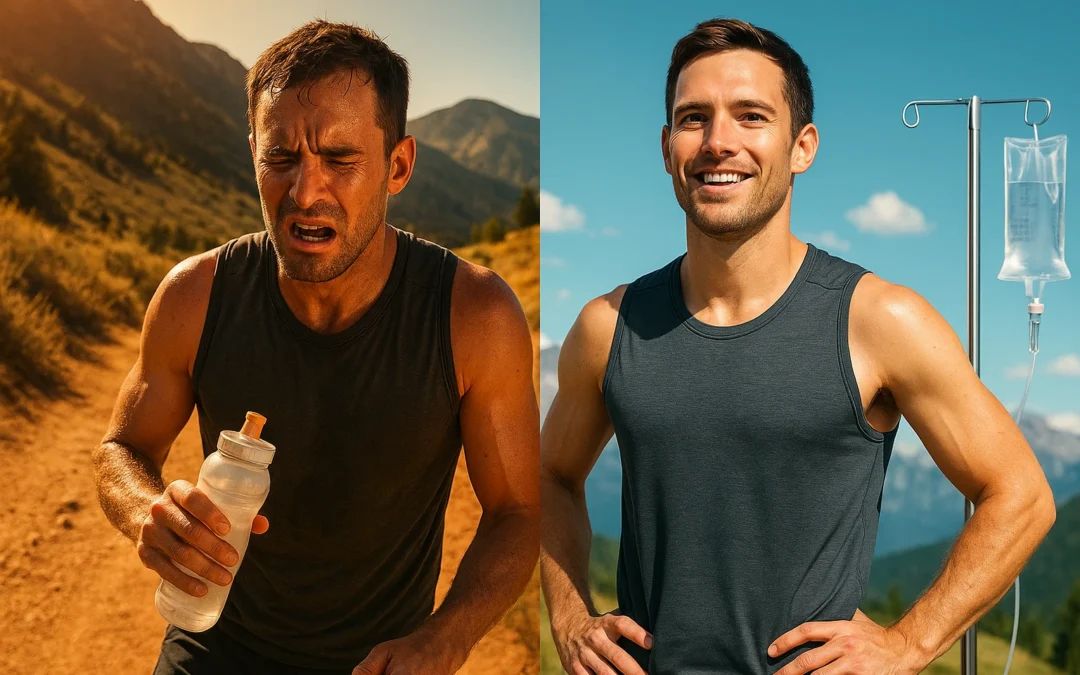
Imagine crossing the finish line of the Colfax Marathon, or grinding your way up a steep gravel climb just outside Boulder. Your heart is pounding, and despite having faithfully drained your hydration pack, your stomach is aggressively sloshing. Your calves are locking up, and you feel entirely depleted.
You followed the golden rule of endurance sports—you drank plenty of water—so why do you feel so terrible?
Welcome to the “Mile High Paradox.” Denver’s endurance sports ecosystem operates under a relentless physiological handicap: moderate-to-high altitude paired with a semi-arid, low-humidity climate. For runners, cyclists, and mountain bikers traversing the Front Range, sea-level hydration strategies simply do not work.
To truly optimize performance and recovery at 5,280 feet and beyond, we have to look past sports drinks and understand the fascinating, sometimes frustrating, environmental physiology of altitude dehydration.
The Environmental Physiology of Altitude Dehydration
When you train at altitude, your body goes through invisible but massive changes. Understanding these mechanisms is the first step to unlocking better performance.
Hypobaric Hypoxia & The Respiratory Water Sponge
At sea level, humans lose about 300 to 400 mL of water daily just through exhalation. But in Denver, the lower barometric pressure means there is less oxygen in every breath (hypobaric hypoxia). Your body’s immediate reflex is compensatory hyperventilation, or tachypnea. You start breathing faster and deeper.
Combined with Colorado’s incredibly low humidity (often under 20%), your lungs act like a sponge wringing out moisture. At rest, your respiratory water loss can spike to over 1,500 mL per day. Under the heavy workload of an endurance event, you are literally exhaling your hydration away.
The “Hemoconcentration Illusion”
Within 24 to 48 hours of arriving at altitude, your kidneys begin excreting bicarbonate and water to balance your blood pH—a process known as altitude diuresis. This causes your blood plasma volume to shrink by 10% to 20%.
Because there is less liquid in your blood, your red blood cell count appears higher (elevated hematocrit). Many athletes mistakenly believe this “thicker blood” is a good thing because it means more oxygen per drop of blood. In reality, this is the hemoconcentration illusion. Thicker, more viscous blood increases your cardiac workload, drops your stroke volume (the amount of blood pumped per beat), and makes it significantly harder for oxygen to reach your peripheral capillaries.
Blunted Osmoreceptors: Why Your Thirst Lies to You
To make matters worse, altitude resets your hypothalamus. The biological sensors that tell you when you are thirsty (osmoreceptors) become blunted. By the time you actually feel thirsty on a mountain trail, you are already operating at a severe physiological deficit.
The Gut Bottleneck: Why Drinking More Doesn’t Always Work
If you are losing so much fluid, shouldn’t you just drink gallons of water? Unfortunately, your gastrointestinal tract has a speed limit.
When you are pushing hard on a climb, your body enters a sympathetic “fight or flight” state. To keep your working muscles oxygenated, your body aggressively diverts blood flow away from your digestive organs—a phenomenon called splanchnic vasoconstriction or splanchnic hypoperfusion.
Because your gut lacks the blood flow needed to process fluids, oral rehydration becomes rate-limited to about 600–800 mL per hour. Drink any more than that, and the water just sits in your stomach. This creates a “digestive bottleneck” that leads to the dreaded gastric sloshing, cramping, and nausea that ruins so many races.
The Biomechanics of Circulation & The “Muscle Vascular Pump”
Endurance athletes rely heavily on the “calf muscle pump” (or skeletal muscle vascular pump). As your calf muscles contract during running or cycling, they literally squeeze your veins, pumping deoxygenated blood back up to your heart against gravity.
However, because altitude causes severe intravascular fluid loss (hypovolemia), there simply isn’t enough fluid volume to fill your heart properly between beats (decreased end-diastolic ventricular filling). When this happens, your calf muscle pump becomes mechanically less effective at maintaining cardiac output on steep Front Range gradients. You feel this as premature leg fatigue, heavy limbs, and a rapidly spiking heart rate.
Myth Busting & Clinical Safety Imperatives
When athletes search for ways to bypass the gut bottleneck and hydrate their muscles quickly, they occasionally stumble into incredibly dangerous misinformation on the internet.
The Lethal Fallacy of “Injecting Water Into Muscle”
Search data reveals alarming queries regarding “injecting water into muscle” or “injecting an air bubble into muscle.” This must be stated clearly: You can never safely inject fluids directly into skeletal muscle.
Intramuscular (IM) space cannot hold large volumes of liquid. Attempting to inject hydration into muscle tissue will cause severe localized tissue death (ischemic necrosis), compartment syndrome, or potentially lethal air embolisms. Clinical IV therapy involves intravascular delivery—using a sterile catheter placed safely inside a vein by a highly trained, critical-care medical professional.
Debunking “Gas Dehydration Training”
Another pseudo-scientific fad floating around obscure fitness forums is “gas dehydration training”—the idea that intentionally dehydrating yourself while training at altitude forces your body to adapt faster. This is entirely false. Deliberate dehydration severely impairs your aerobic capacity and damages your kidneys without generating any positive hematological (blood-building) adaptations.
Deconstructing the “Peak Perform” IV Formula: Cellular Mechanics
This is where clinical, targeted mobile iv therapy bridges the gap between environmental stress and recovery.
Unlike oral fluids, an intravenous isotonic crystalloid infusion (like 0.9% Normal Saline or Lactated Ringer’s) bypasses the compromised gut entirely. It achieves 100% bioavailability, restoring circulating plasma volume and cardiac preload in under 45 minutes. But a proper athletic IV is more than just saline. For example, the Peak Perform IV protocol is engineered specifically for cellular metabolic resynthesis:
- Crystalloid Fluid Base: Restores the plasma volume necessary for your calf muscle pump to function properly, clearing cellular waste like lactate and urea.
- B-Complex Vitamins (B1, B2, B3, B5, B6, B12): Essential coenzymes that drive the mitochondrial Krebs cycle, converting carbohydrates into usable ATP energy.
- Magnesium: Regulates neuromuscular depolarization. When magnesium depletes, the actin-myosin cross-bridges in your muscles lock up, leading to severe cramps.
- Taurine: A potent amino acid that acts as an osmoregulator, protecting cellular structural integrity during severe dehydration while shuttling fatty acids for energy.
- Glutathione: The body’s master antioxidant. High-altitude exertion creates a massive amount of Reactive Oxygen Species (ROS) and free radicals. Glutathione neutralizes this oxidative stress, reducing post-race systemic inflammation.
While hospitals often use a standard banana bag iv for general nutritional replenishment and dehydration, athletic formulas like Peak Perform are specifically titrated to combat the unique hypoxic muscle fatigue experienced by endurance athletes.
Playing Fair: WADA, USADA, and Clean Sport Regulations
For the recreational athlete recovering from a grueling weekend on the trails, IV therapy is an incredible wellness tool. However, for competitive amateurs, masters, and elite athletes, strict rules apply.
The World Anti-Doping Agency (WADA) and the U.S. Anti-Doping Agency (USADA) strictly prohibit IV infusions of more than 100 mL per 12-hour period, except for those legitimately received in the course of hospital treatments, surgical procedures, or clinical diagnostic investigations. (WADA S5 regulations).
Why? Because rapid plasma volume expansion can theoretically be used to alter biological passport parameters or flush out prohibited substances. Even if the IV bag contains nothing but legal vitamins and saline, receiving a standard 1,000 mL drip during a competition window is a strict doping violation unless you have an approved Therapeutic Use Exemption (TUE).
Always ensure your treatment schedule aligns with your competitive tier’s compliance guidelines.
Periodization & Practical Protocols for Denver Endurance Athletes
How should you integrate this science into your actual training calendar?
- Pre-Race Priming (The Week Before): Focus heavily on oral electrolyte strategies. You want to toe the starting line of the Leadville 100 or the Triple Bypass fully euhydrated.
- Acute Post-Exertion Recovery (The Days After): This is where IV therapy shines. After a massive mountain effort, your gut motility is compromised, your plasma volume is contracted, and systemic inflammation is high. A targeted IV protocol can rapidly restore your baseline, allowing you to return to light training days sooner rather than weeks later.
Whether you are seeking intravene wellness insights to elevate your trail running, or you are a visitor trying to survive a corporate retreat in the Rockies, understanding altitude physiology puts you back in the driver’s seat of your own health.
Frequently Asked Questions (FAQ)
What is the difference between oral hydration and IV hydration at altitude?
Oral hydration must pass through the gastrointestinal tract. At high altitudes and high exertion, blood is diverted from the gut (splanchnic vasoconstriction), limiting oral fluid absorption to roughly 600-800 mL/hr. IV hydration bypasses the gut, delivering fluids directly into the bloodstream with 100% bioavailability in a fraction of the time.
Does IV therapy cure altitude sickness?
While it is not a “cure” for Acute Mountain Sickness (which is primarily caused by low oxygen), IV therapy rapidly treats the severe, compounding dehydration that mimics and exacerbates altitude sickness symptoms (headaches, nausea, fatigue).
Are these treatments safe?
Yes, when administered by licensed medical professionals. While endurance athletes across the country—from those braving the Rockies to those relying on iv therapy in humid coastal climates—face unique challenges, the standard of care remains the same: treatments must be administered by highly trained, critical-care nurses to ensure sterility and clinical safety.
Can you use HSA for IV therapy?
In many cases, yes. Health Savings Accounts (HSA) and Flexible Spending Accounts (FSA) can often be used for IV therapy if it is recommended by a healthcare provider for a specific medical condition, such as severe dehydration or nutrient deficiencies. It is always recommended to check directly with your HSA/FSA administrator.
Next Steps for Your High-Altitude Journey
Endurance sports in Denver demand respect for the environment. You are not just fighting the gradient of the trail; you are fighting barometric pressure, respiratory water loss, and complex circulatory shifts.
By understanding the physiological hurdles of the Mile High City—and adopting advanced recovery tools when appropriate—you can stop fighting the altitude and start adapting to it. Focus on steady, daily hydration, respect your gut’s limits during high-intensity efforts, and when the mountain takes more out of you than you can drink back, explore clinical recovery options to get back on the trail.