

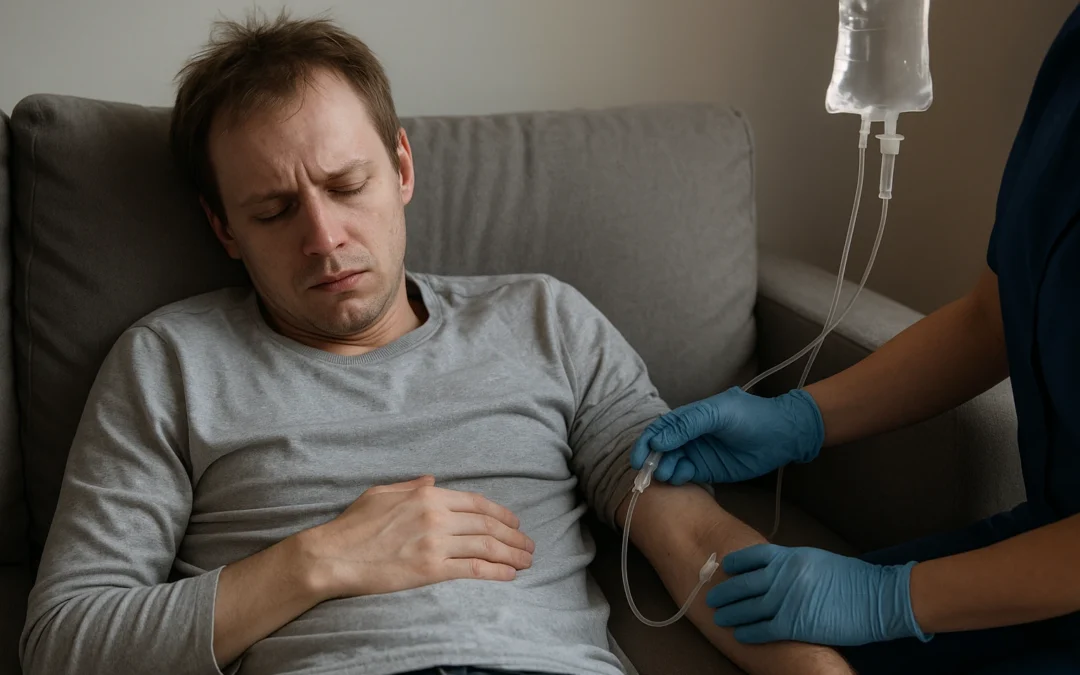
It’s a familiar, miserable scenario: you’re staring at a glass of water, desperately thirsty, but terrified to take a sip. Every time you try to rehydrate, your stomach aggressively rejects it.
When you’re caught in the throes of acute food poisoning, standard medical advice to “rest and sip fluids slowly” can feel woefully inadequate. If you can’t keep water down, how are you supposed to rehydrate?
Most online resources are split into two camps. Traditional health portals emphasize oral rehydration but offer little practical help for intractable vomiting. Meanwhile, commercial mobile IV sites promise instant cures without explaining the clinical “why” behind their treatments.
This guide bridges that gap. We’re going to explore the exact physiological mechanics of foodborne illness, explain why oral fluids sometimes fail, and outline how advanced acute care solutions—like in-home intravenous (IV) therapy administered by critical care nurses—can safely break the cycle of nausea and dehydration.
The Physiology of Food Poisoning: What’s Happening in Your Gut?
To understand how to stop the symptoms, you first have to understand the mechanics of the attack. Whether you’ve encountered a bacterial toxin (like Staph aureus or E. coli) or a viral agent (like Norovirus), your gastrointestinal tract treats the pathogen as an immediate threat that must be expelled.
The “Emetic Loop” and Why You Can’t Keep Water Down
When your stomach lining becomes inflamed by pathogens, it triggers the Chemoreceptor Trigger Zone (CTZ) in your brainstem. This creates a vicious cycle known as the “emetic loop.”
Because your gastric mucosa is swollen, even a small sip of water stretches the stomach lining. The CTZ registers this stretch as a threat and triggers a reflex to vomit. This is why oral rehydration fails during the acute phase of food poisoning: your body’s defense mechanism is actively preventing absorption.
The “Nausea Only” Anomaly
Many people wonder if it’s possible to have food poisoning without vomiting. The answer is yes, and the mechanics are fascinating. Pathogens cause massive fluid shifts in your gut, drawing water out of your bloodstream and sequestering it in the intestinal lumen (the hollow space inside your intestines).
Even if you aren’t throwing up, you are losing critical intravascular volume. This internal fluid loss is why you can experience severe cramping, dizziness, and profound nausea without active emesis.
If you’re wondering how long does food poisoning last, acute symptoms typically endure for 12 to 48 hours, but the resulting dehydration can leave you fatigued for days if not properly managed.
The Rehydration Spectrum: Oral vs. Intravenous
When combating dehydration, you have two primary avenues for fluid replacement. Understanding which to use depends entirely on your current symptom severity.
Level 1: Home Oral Rehydration Solutions (ORS)
If you can keep fluids down, oral rehydration is your first line of defense. However, plain water is not the answer. When you vomit or have diarrhea, you lose water alongside critical electrolytes (sodium, potassium, and chloride). Drinking pure water in large gulps can actually worsen a condition called hyponatremia (low sodium), making you feel more nauseous.
The Protocol: Use an ORS that follows the World Health Organization (WHO) formula, which contains a specific glucose-to-sodium ratio designed to maximize intestinal absorption. Take one small sip every five minutes.
Level 2: Intravenous (IV) Rehydration
When oral fluids are consistently rejected, the emetic loop must be bypassed. This is where iv therapy for food poisoning becomes a clinically sound intervention.
Instead of waiting 30 to 60 minutes for fluids to navigate a swollen, hostile stomach lining, IV therapy delivers balanced crystalloid solutions (like Lactated Ringer’s or Normal Saline) directly into the vascular space.
- Absorption Rate: 100% bioavailability.
- Speed of Action: Fluid volume and blood pressure begin stabilizing within 15 to 30 minutes.
- Gastric Bypass: Because the stomach is completely bypassed, the emetic loop is not triggered.
For adults suffering from severe, unyielding nausea, searching for dehydration iv fluids near me can connect you with mobile medical professionals who bring this hospital-level rehydration directly to your bedside.
Beyond Hydration: The Acute Care Toolset
Replacing fluids is only half the battle; stopping the symptoms is the other. Mobile IV therapies can be customized with specific medications that provide rapid relief.
Ondansetron (Zofran) for Severe Nausea
Over-the-counter nausea meds often fail because you throw them up before they can absorb. Ondansetron, delivered intravenously, works differently. It is a powerful 5-HT3 receptor antagonist that directly blocks the nausea signals in the brainstem. Delivered via IV, it begins working in just 5 to 10 minutes.
Toradol (Ketorolac) for Abdominal Cramping
Severe gastrointestinal cramping can be agonizing. Toradol is an intravenous, non-steroidal anti-inflammatory drug (NSAID) that provides potent pain relief. (Note: A skilled critical care nurse will always screen for gastrointestinal bleeding before administering Toradol).
Addressing Common Medication Myths
When desperate for relief, people often turn to their medicine cabinets. Here is what the science actually says about common household remedies:
- Does Pepcid help? Many patients wonder, does pepcid help with food poisoning? Pepcid (famotidine) is an H2 blocker designed to reduce stomach acid and treat heartburn. While pepcid for food poisoning might soothe minor acid reflux caused by vomiting, it does absolutely nothing to stop the central emetic loop or address the bacterial infection.
- The Imodium Danger: Anti-diarrheal medications like loperamide (Imodium) slow down gut motility. If you have a bacterial infection, taking Imodium traps the harmful toxins inside your body, potentially causing a much more severe infection.
- Probiotics: While excellent for rebuilding your gut microbiome after you’ve recovered, taking probiotics during the acute vomiting phase is essentially throwing good bacteria into a localized warzone. Save them for day three.
Curious about how other vitamins support cellular recovery once the acute phase passes? You can explore a full list of iv additives, including amino acids and antioxidants that help rebuild your immune system.
Special Populations: Pediatric Protocols and Safety Boundaries
It is terrifying when a child is relentlessly throwing up. However, the protocol for pediatric food poisoning differs significantly from adults.
Children are not miniature adults. Their fluid shifts happen much faster, and their weight-to-volume ratios require precise, mathematically calculated fluid replacement. Because of these strict clinical safety boundaries, ethical mobile IV providers generally restrict at-home IV therapies for young children.
Pediatric Red Flags: If your young child cannot keep fluids down for more than a few hours, exhibits a lack of tears when crying, has dry diapers, or becomes lethargic, do not seek mobile IV therapy—go straight to the pediatric ER.
Interactive Triage: Home Care, Mobile IV, or ER?
Unsure of your next step? Use this clinical triage baseline to make an informed decision:
Green Light for Home ORS (Sip Method)
- Vomiting occurs less than once every 2 hours.
- You can successfully keep down small sips of an electrolyte solution.
- Urine is dark yellow, but you are still producing it.
Candidate for Mobile IV Therapy
- Continuous vomiting; unable to keep any oral fluids down for 6+ hours.
- Severe nausea and dizziness upon standing.
- Looking for an at home iv therapy near me to avoid sitting in a waiting room while actively ill.
- You are an otherwise healthy adult without severe comorbidities.
Red Flags for Immediate Emergency Room Care
- Vomit or diarrhea contains blood or looks like “coffee grounds.”
- Fever exceeding 102°F (38.9°C).
- Severe, localized, stabbing abdominal pain (which could indicate appendicitis, not food poisoning).
- Signs of severe dehydration: confusion, inability to stand, rapid heart rate, or loss of consciousness.
- If you find yourself searching for an urgent care with iv fluids near me because you are experiencing chest pain or shortness of breath alongside vomiting.
Frequently Asked Questions (FAQ)
How is an IV for food poisoning different from a hangover IV?
While the base hydration (Lactated Ringer’s) and anti-nausea medications (Zofran) are similar, the goal differs. A hangover iv miami style treatment often focuses on clearing alcohol toxins and restoring B-vitamins depleted by diuretics. Food poisoning protocols focus heavily on acute anti-emetic management, halting gut spasms, and replacing massive gastrointestinal fluid losses.
Will IV therapy cure my food poisoning instantly?
No medical treatment “cures” food poisoning instantly; your body still has to clear the pathogen. However, an iv therapy for nausea rapidly eliminates the worst symptoms—the vomiting, cramping, and dehydration—allowing you to rest comfortably while your immune system does its job.
What should I eat after the vomiting stops?
Transition slowly. Start with the BRAT diet (Bananas, Rice, Applesauce, Toast). Once you tolerate these, you can look into amino acids to help repair tissue. For example, many wonder what does lysine do for the body after an illness; it’s an essential amino acid that plays a vital role in immune function and tissue repair during your recovery phase.
The Intravene Wellness Standard
When you are at your most vulnerable, the qualifications of your healthcare provider matter immensely. Finding just any service for “fluids” isn’t enough when you’re acutely ill.
Intravene wellness protocols are built on clinical excellence. By exclusively utilizing critical care nurses—professionals with extensive experience in ICUs and Emergency Departments—we ensure that every patient receives proper medical triage, accurate dosing, and safe administration in the comfort of their own home.
Next Steps for Relief
If you are currently trapped in the emetic loop, unable to hydrate, and safely outside of ER red-flag criteria, you don’t have to wait it out in misery. Reach out to a qualified critical care mobile IV provider to discuss your symptoms. By bypassing the stomach and delivering targeted hydration and medication intravenously, you can turn a multi-day ordeal into a manageable recovery.