

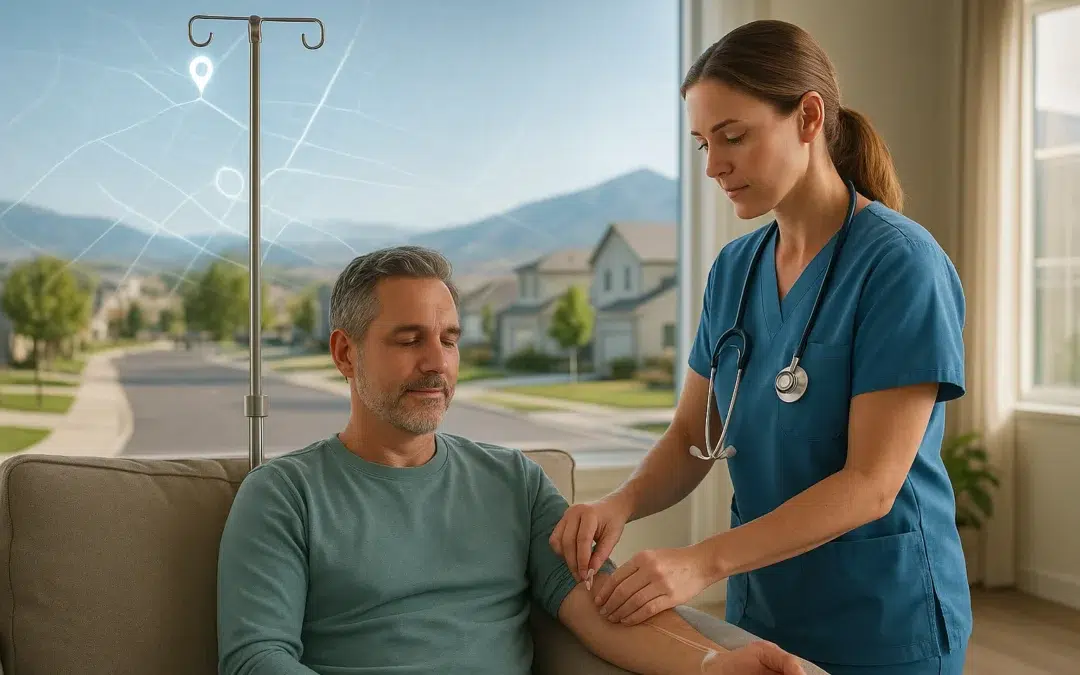
Living in Littleton comes with distinct perks—the proximity to the foothills, the expansive trails of Ken Caryl, and the strong community feel of neighborhoods like Sterling Ranch. But living at 5,351 feet also comes with a unique physiological tax. The dry air and altitude can accelerate dehydration faster than your body can signal thirst.
When you hit a wall—whether it’s a migraine that won’t quit, the sudden onset of flu symptoms, or the lingering effects of a celebration—the difference between a ruined weekend and a quick recovery often comes down to what emergency medicine professionals call the “Golden Hour.”
Most residents assume that getting medical-grade hydration requires a trip to urgent care or the ER. However, the landscape of local healthcare has shifted. We are seeing a rise in mobile IV services that function less like a medical appointment and more like a rapid-response logistical network.
This guide explores the mechanics of same-day IV therapy in Littleton, breaking down how response times work, why neighborhood logistics matter, and who exactly shows up at your door.
The Science of Speed: Why “Drinking Water” Sometimes Fails
To understand the urgency of same-day service, we have to look at biology. When you are severely dehydrated or battling an illness, your gastrointestinal (GI) tract often slows down or becomes compromised (especially if nausea is involved).
Here is the “aha moment” many people miss: Oral hydration only has about 20-30% absorption efficiency when your body is under stress. You might be drinking water, but your cells aren’t getting it fast enough.
Intravenous therapy bypasses the digestive system entirely, delivering fluids, electrolytes, and vitamins directly into the bloodstream for 100% bioavailability. This is why a treatment that takes 45 minutes can undo 24 hours of misery. But that effectiveness relies on one critical variable: how quickly the treatment arrives.
How the “Networked Dispatch” Works
A common misconception is that mobile IV nurses are dispatched from a central hospital or office in downtown Denver, fighting traffic on I-25 to get to you. If that were the case, “rapid response” would be impossible.
Instead, top-tier mobile IV providers utilize a decentralized, “pre-positioned” model. Think of it less like a pizza delivery and more like an ambulance network. Mobile nurse units are often stationed within specific zones throughout the suburbs.
When you book—whether through a digital portal or over the phone—the dispatch logic looks for the nearest Critical Care Nurse to your specific Littleton coordinates.
[]
Neighborhood Response Guide: The “Drive Time” Reality
Because Littleton geography is complex—spanning from the Platte River valley up into the hogbacks—response times vary based on road infrastructure like C-470 and Santa Fe Drive (US-85).
Here is a realistic breakdown of typical arrival windows based on neighborhood logistics:
| Neighborhood Zone | Typical Logistics | Est. Arrival Window |
|---|---|---|
| Ken Caryl Valley & North Ranch | Accessible via C-470; often serviced by nurses stationed near the foothills. | 45 – 60 Mins |
| Sterling Ranch | Further south; requires navigation down Santa Fe/Titan Rd. Dispatch usually routes from Highlands Ranch or Roxborough. | 60 – 90 Mins |
| Columbine & TrailMark | Central access points; high nurse density area due to proximity to Chatfield. | 30 – 45 Mins |
| Downtown Littleton / Bemis Park | Urban density allows for quick navigation, barring rush hour on Santa Fe. | 30 – 60 Mins |
Note: These are estimates based on standard traffic flows and nurse availability.
The Critical Distinction: Who Enters Your Home?
Perhaps the most important educational aspect of mobile IV therapy is understanding who is administering the treatment. In the world of on-demand services, there is a massive difference between a technician and a specialist.
Leading providers in the Littleton area exclusively employ Critical Care Nurses. These are Registered Nurses (RNs) with backgrounds in the ER or ICU.
Why Does This Matter?
You might think, “It’s just fluids, why do I need an ICU nurse?”
- Vascular Access: If you are severely dehydrated, your veins collapse. A nurse with critical care experience is an expert at difficult “sticks,” saving you from being poked multiple times.
- Fluid Dynamics: Rapidly introducing fluid into the body affects blood pressure and heart workload. An ER-trained nurse knows how to monitor your vitals to prevent fluid overload—a rare but serious risk that less experienced staff might miss.
- Triage Capability: A mobile nurse with high-level training can walk into a home, assess a patient, and determine if an IV is sufficient or if the situation actually requires a 911 call. This safety net is invaluable.
Integrating IV Therapy into the “Littleton Lifestyle”
The modern approach to wellness is about integration. It’s about fitting health recovery into the gaps of a busy suburban life.
We often see residents utilizing mobile IV therapy not just for emergencies, but as a bridge to maintain their schedule.
- The Saturday Reset: Parents with kids at Littleton Pediatric Medical Center or rushing to soccer games often can’t afford a “sick day.” An appointment can be scheduled to happen simultaneously with other household tasks.
- The Retail Bridge: It is not uncommon for residents to book a treatment to arrive shortly after they return from a grocery run at the Walmart Supercenter or a quick lunch at Qdoba.
- Altitude Adjustment: Friends visiting for a wedding at the Littleton Vineyard Church often struggle with the elevation. Pre-booking a Myers Cocktail for the bridal party is becoming a standard “welcome to Colorado” protocol.
Frequently Asked Questions
Is it faster to book online or call?
While online booking is convenient, calling can sometimes speed up the process during peak hours (like Sunday mornings). A phone dispatcher can instantly see real-time nurse locations and might find a gap in a schedule that an automated system misses. For a deeper dive on this, it’s worth exploring the nuances of booking logistics.
Can I get an IV if I have the stomach flu?
Yes, this is one of the most common use cases. Because the stomach flu prevents you from keeping liquids down, IV therapy is often the only way to rehydrate effectively. The nurse can also administer anti-nausea medication directly into the IV.
Does insurance cover mobile IVs?
Most mobile IV services are out-of-pocket due to the concierge nature of the travel. However, many clients successfully use their HSA (Health Savings Account) or FSA (Flexible Spending Account) cards to pay for the service, as it is a legitimate medical expense.
How much space do I need?
Very little. You just need a comfortable place to sit (a couch, bed, or recliner). The nurse brings all necessary equipment, including an IV pole, and handles all medical waste removal upon departure.
The Next Step in Your Health Toolkit
Understanding the availability of mobile IV therapy near me changes how you manage health setbacks. You no longer have to “wait it out” or endure hours in a clinical waiting room.
By recognizing the logistical map of Littleton—knowing that relief is often sitting just a neighborhood away in Ken Caryl or TrailMark—you can make faster, smarter decisions for your health. Whether you are recovering from a long hike, a long flight, or a long night, specialized care is closer than you think.
If you are interested in learning more about the specific blends available for energy, immunity, or recovery, Intravene Wellness Therapies offers a wealth of resources to help you choose the right protocol for your needs.