

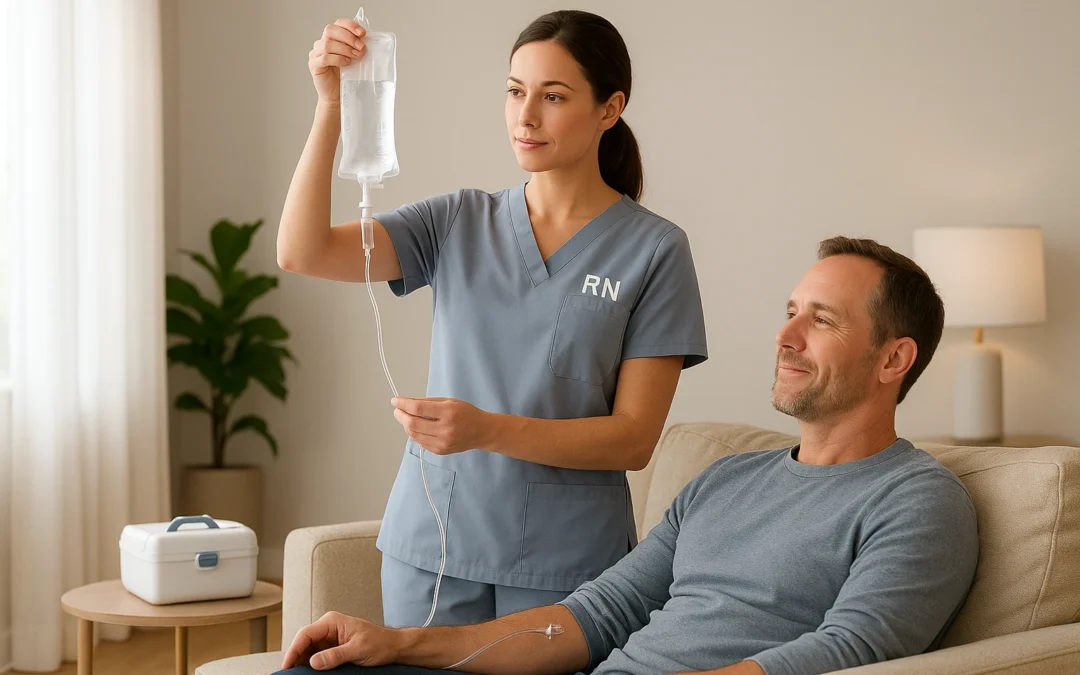
Imagine this: You’ve just wrapped up a long, sweltering weekend at the Gasparilla Pirate Festival, or maybe you’re feeling incredibly run-down after back-to-back business flights out of TPA. You pull out your smartphone, search for a quick recovery solution, and within minutes, you’ve booked a mobile IV hydration service to come straight to your living room.
In today’s on-demand world, ordering an IV infusion can feel just as casual as ordering food delivery. We’ve been conditioned by an “aesthetic wellness illusion” to view mobile IVs as a simple spa service.
But let’s pull back the curtain for a moment.
Receiving an IV is an invasive medical procedure. It introduces pharmaceutical compounds and fluids directly into your bloodstream with 100% bioavailability—meaning it bypasses your digestive system completely. While mobile IV therapy is an incredible tool for rapid rehydration, immune support, and wellness, the safety of your living room doesn’t automatically guarantee the safety of the procedure.
If you are considering mobile IV therapy in Tampa, St. Petersburg, or Clearwater, knowing how to vet a provider’s clinical credentials isn’t just helpful—it’s essential. Let’s explore exactly what you need to look for, the Florida-specific laws that protect you, and the critical questions you should ask before rolling up your sleeve.
The “Living Room Clinic” Paradigm
When you receive medical care in a hospital, you are surrounded by a massive, invisible safety net. There are “Code Blue” buttons on the wall, central oxygen lines, and a team of doctors down the hall.
When a nurse walks into your Tampa home or hotel room, that physical safety net disappears. Your living room couch doesn’t have an emergency call button. Because you are in an “uncontrolled environment,” the clinical expertise cannot be outsourced to a hospital building. It must reside entirely within the individual clinician’s head and the physical emergency kit they carry in their bag.
This is why the qualifications of the person knocking on your door matter more than anything else.
The Clinical Hierarchy: Who is Legally Qualified in Florida?
One of the most common misconceptions is that “a nurse is a nurse.” In reality, the state of Florida has strict guidelines regarding who can legally administer IV therapy, especially outside of a traditional clinic.
Medical Assistants (MAs)
The Rule: Medical Assistants cannot legally administer mobile IV therapy independently.The Reality: Unfortunately, some aggregator apps and pop-up wellness companies use unlicensed phlebotomists or Medical Assistants to cut costs. If an MA arrives to push a complex wellness cocktail into your vein without direct, on-site supervision, this is a major red flag.
Licensed Practical Nurses (LPNs)
The Rule: Under Florida Administrative Code (Rule 64B9-12), an LPN cannot initiate or manage complex IV wellness cocktails without a mandatory post-licensure 30-hour certification. Even then, they must work under the direct direction of a Registered Nurse (RN) or physician, and they are legally restricted from pushing certain medications.
Registered Nurses (RNs)
The Rule: An RN is the baseline standard for safe mobile IV therapy. However, as we’ll see next, having an RN badge is just the starting point. The type of RN experience is what truly separates a safe experience from a risky one.
The Critical Care Difference: Why ICU and ER Experience Matters
If you were driving down I-4 in a massive thunderstorm, would you rather be with a driver who only takes their car out on sunny Sundays, or a professional driver trained in extreme weather conditions?
The same logic applies to nursing.
General clinic or aesthetic nurses are wonderful at what they do, but administering IVs in an uncontrolled home environment requires a specific set of acute skills typically forged in Intensive Care Units (ICU) or Emergency Departments (ED).
Here is why that critical care background is vital for mobile IVs:
- First-Stick Accuracy: If you are booking an IV, you are likely dehydrated. Dehydration causes veins to shrink and hide. A critical care nurse has elite “vascular access mastery”—meaning they can find a tricky, constricted vein on the first try, saving you from painful, multiple needle pokes.
- Early Decompensation Detection: Fast fluid infusion can occasionally stress the cardiovascular system. An ICU or ER nurse is highly trained to spot subtle physiological cues—like basilar lung crackles (a sign of fluid overload), slight cutaneous flushing, or a drop in blood pressure—long before they become an emergency.
Medical Oversight and Pharmacy Standards
A nurse doesn’t act alone. Behind every legitimate IV bag is a rigorous medical and pharmaceutical protocol.
The Telehealth Good Faith Exam
An IV bag is a prescribed medical treatment. Companies that claim they have a “medical director” but never actually review your specific health history are cutting corners.
In Florida, legitimate mobile IV providers utilize a “Good Faith Exam.” This usually involves a telehealth clearance or a thorough review of your medical intake form by a qualified prescriber (like a Doctor of Medicine or Osteopathy) before a single drop of fluid is administered. This ensures the treatment is safe for your unique health profile, checking for hidden contraindications like kidney issues or heart conditions.
Demystifying Pharmacy Sourcing: 503A vs. 503B
Where do the vitamins in your IV come from? It’s a question few consumers think to ask, but it’s vital.
You want to ensure your provider sources their ingredients from highly regulated compounding pharmacies:
- 503A Pharmacies: These are traditional pharmacies that compound patient-specific medications in sterile environments.
- 503B Outsourcing Facilities: These are FDA-registered facilities equipped with USP <797> compliant cleanrooms that produce pre-mixed, highly sterile hospital-grade batches with verifiable lot numbers.
Beware of companies mixing bulk powders in non-sterile back rooms.
The 7-Question Vetting Checklist for Tampa Mobile IV Providers
Before you hand over your credit card or roll up your sleeve, put your provider to the test. A reputable company will be thrilled to answer these questions.
- “What is the full legal name and clinical background of the person coming to my home?”
- Acceptable: “You will be seen by Sarah, a Registered Nurse with 5 years of ER experience.”
- Unacceptable: “We just send whichever tech is available nearby.”
- “Do you require a Good Faith Exam or medical clearance before my treatment?”
- Acceptable: “Yes, a licensed prescriber will review your medical history first.”
- “Where do you source your IV vitamins and fluids?”
- Acceptable: “From FDA-registered 503A or 503B compounding pharmacies.”
- “Can the nurse provide lot numbers and compounding dates for my treatment?”
- Acceptable: “Yes, all our vials are strictly tracked.”
- “What emergency supplies does the nurse carry in their bag?”
- Acceptable: “They carry a full vital signs kit, epinephrine for allergic reactions, and are BLS/ACLS certified.”
- “What happens if the nurse can’t find my vein on the first or second try?”
- Acceptable: “Our critical care nurses have a strict two-stick limit to ensure your comfort, after which we pause and reassess.”
- “Who do I contact if I feel unwell a few hours after the nurse leaves?”
- Acceptable: “You will have direct access to our nursing team and medical director for any post-infusion questions.”
How to Verify a Nurse’s License in Florida (Step-by-Step)
Trust, but verify. The Florida Department of Health offers a free public portal to check any healthcare provider’s license status. Here is how to do it:
- Go to the Florida DOH Medical Quality Assurance (MQA) Search Portal at
mqa-internet.doh.state.fl.us. - Enter the nurse’s first and last name.
- Click “Search.”
- Look for the License Status.
- You want to see CLEAR/ACTIVE.
- Red flags include PROBATION, SUSPENDED, or DELINQUENT.
- You can also click on their profile to see if there are any past administrative disciplinary actions.
Frequently Asked Questions (FAQ)
Is mobile IV therapy safe at home?
Yes, it is highly safe when administered by a properly licensed, critical care-trained Registered Nurse who has cleared your medical history and carries proper emergency equipment.
Why do mobile IV companies require a doctor if only a nurse visits my house?
Because intravenous fluids and compounded vitamins are classified as medical treatments. A legitimate prescriber-patient relationship is legally required to authorize the treatment, ensuring it is safe for your specific physiology.
What happens if I have an allergic reaction during an IV at home?
While rare, allergic reactions can happen. This is why it is non-negotiable that your mobile IV nurse is trained in emergency response (BLS/ACLS certified) and carries an emergency “crash kit” containing epinephrine and antihistamines to immediately manage any adverse reactions.
How much does mobile IV therapy cost in Tampa?
Prices typically range from $194 to $350 depending on the specific formulation you choose (e.g., basic hydration vs. advanced NAD+ or immune cocktails). This premium pricing reflects the cost of having a highly trained clinical specialist travel to your location.
Your Health, Your Standards
Booking a mobile IV in Tampa should feel luxurious and convenient, but that convenience should never come at the expense of clinical excellence.
By understanding the difference between a general nurse and a critical care expert, verifying pharmacy standards, and asking the right questions, you transform yourself from a passive consumer into an empowered patient.
When you’re ready to experience the gold standard of mobile wellness—where hospital-level clinical expertise meets the comfort of your living room—make sure your chosen provider ticks every single box on this checklist. Your health deserves nothing less than the highest standard of care.