

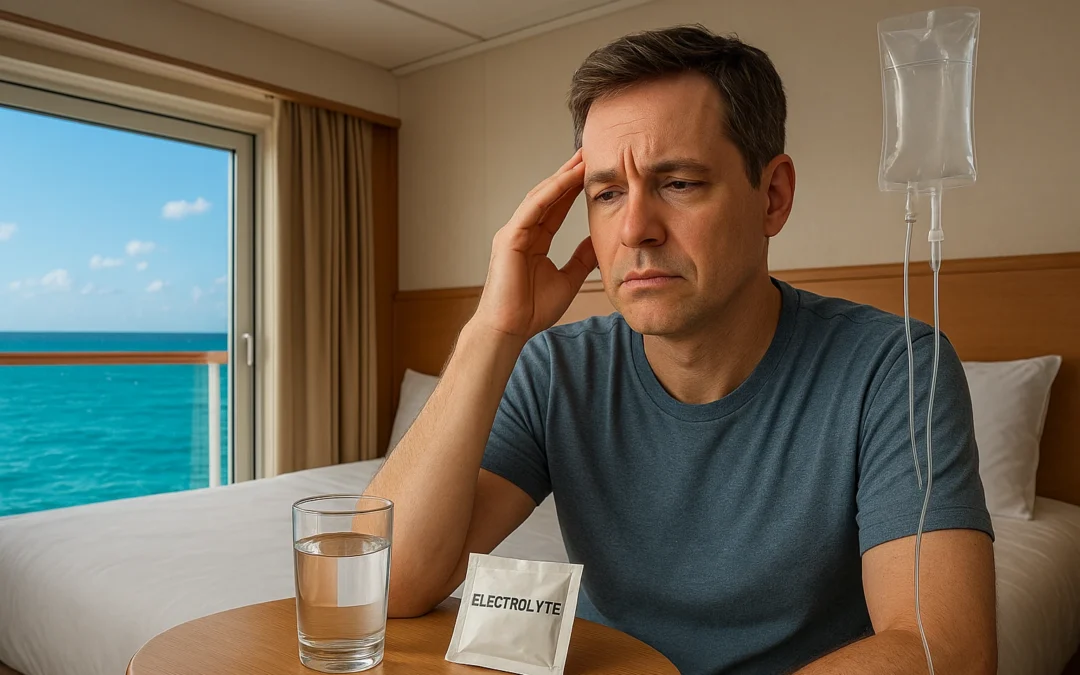
You wake up on day two of your long-awaited cruise vacation. Instead of feeling refreshed by the ocean breeze, you are greeted by a dull, throbbing headache directly behind your eyes. Your throat is scratchy, your lips are cracked, and you feel a profound sense of lethargy.
Most passengers instantly blame one of three things: seasickness, a few too many cocktails by the pool, or the dreaded “cruise flu” circulating the ship.
But if you haven’t been drinking heavily, have a strong stomach for motion, and have no actual fever, you are likely experiencing something entirely different. You are suffering from osmoregulatory whiplash caused by the extreme, artificial microclimate of your cruise cabin.
Welcome to the unseen desert at sea.
The Unseen Desert at Sea: Your Cruise Cabin HVAC Paradox
It sounds counterintuitive: you are surrounded by hundreds of miles of open ocean, often in tropical regions where the outdoor relative humidity hovers around 85%. Yet, inside your stateroom, the air is aggressively dry.
Modern luxury cruise liners are massive steel structures on the water. To prevent bulk-head condensation, rust, and the proliferation of black mold in confined corridors, ship engineers use industrial chillers and heavy-duty HVAC systems. These systems pull the moist ocean air inside and aggressively dehumidify it, stripping the ambient relative humidity down to 20% to 30%.
To put that into perspective, your 68°F cabin at 25% humidity has a lower absolute water vapor pressure than the Mojave Desert.
When you sleep in this environment for 8 to 10 hours, your body endures continuous desiccation. Every breath you exhale expels air that your body has perfectly humidified to 100% at 98.6°F. In return, you inhale bone-dry, conditioned air. Over a single night, this “insensible respiratory fluid loss” can silently drain 400 to 600 milliliters of water straight from your mucosal linings.
Demystifying “Cruise Sickness”: What is Actually Happening in Your Body?
Understanding why you feel unwell requires a quick look at the incredible physiological shifts happening under your skin when you transition between the ship’s microclimates.
The Meningeal Shift (Why Dehydration Manifests as a Headache)
That headache you feel isn’t necessarily the rocking of the ship. When you lose substantial fluid overnight without replacing it, your blood plasma osmolality climbs. To compensate, your body pulls fluid out of surrounding interstitial tissues.
This causes a fractional fluid shrinkage in your cellular volume, including a minor reduction in brain volume. This shifting pulls mechanically on the dura mater (the sensitive pain fibers in your meninges), resulting in the classic, intractable “dehydration headache.”
The Mucociliary Breakdown (The “Cruise Cabin Cough”)
Often blamed vaguely on recirculated germs, the dry, hacking cough many cruisers develop is actually mechanical. Dry cabin air strips the protective liquid layer covering your airway cilia. Without this moisture, your body’s natural “escalator” for clearing out dust and particulates grinds to a halt, exposing bare nerve endings and triggering a constant, non-productive cough.
Microclimate Whiplash
Imagine spending your afternoon on a sweltering 85°F port excursion. Your blood vessels are fully dilated, and you are sweating profusely. An hour later, you step back into your 68°F stateroom. Your peripheral vascular system rapidly constricts in the cold air, shunting blood back to your core and completely confounding your body’s standard thirst cues. You need hydration the most, but your brain stops telling you to drink.
The Plain Water Pitfall: Why Chugging Tap Water Fails
Once the headache sets in, the standard advice is to “drink 8 to 10 glasses of water.” However, chugging plain ship tap water or bottled water can actually make your symptoms worse.
This phenomenon is known as dilutional hyponatremia. Plain water is hypoosmolar (it lacks electrolytes). When you flood your system with plain water without proportional sodium and potassium, you dilute your serum sodium levels. Your kidneys recognize this imbalance, suppress certain hormones, and trigger rapid urination. You end up running to the bathroom constantly, while your actual cellular dehydration worsens.
To rehydrate your cells, water requires a biological escort system. You need the exact biological triad of electrolytes:
- Sodium: Maintains your extracellular fluid volume and vascular tone.
- Potassium: Prevents intracellular dehydration, cardiac irritability, and the muscle cramps you feel after climbing ship stairs.
- Magnesium: Modulates neuromuscular tension, helping prevent the vascular spasms that trigger tension headaches.
The Rehydration Spectrum: Oral Packets vs. Mobile IV Therapy
Depending on your level of depletion, there are distinct ways to restore your body’s fluid balance.
The Limits of Oral Rehydration Salts (ORS)
High-quality oral electrolyte powders leverage the sodium-glucose cotransporter (SGLT1) principle. Water cannot easily cross your intestinal wall without the precise chemical pairing of sodium and glucose working together to pull it through.
For mild, baseline deficits, ORS packets are excellent. However, your gut has an absorption limit—usually maxing out at around 800 to 1,000 mL per hour under resting conditions. If you are already experiencing travel stress, sluggish digestion from heavy cruise dining, or nausea, oral absorption slows to a crawl.
The Clinical Case for Intravenous Restoration
When you need to fundamentally change your vascular volume to resolve a dehydration headache, bypassing the gastrointestinal tract entirely is the fastest physiological route. This is where mobile iv therapy shines as an evidence-backed intervention.
By utilizing balanced isotonic crystalloid infusions (like Lactated Ringer’s or 0.9% Normal Saline), an IV delivers 100% bioavailability directly to your depleted central intravascular volume. It physically expands circulating plasma, quickly reversing the dural stretching in your brain and re-establishing microvascular flow. Often, relief is felt within 30 to 45 minutes.
Many proactive cruisers now schedule a premium wellness treatment—like a comprehensive banana bag iv packed with B-complex vitamins and essential minerals—either before embarkation to reset flight fatigue or immediately after disembarking to recover from travel exhaustion.
The Cruise Passenger’s Tactical Action Plan
You can protect your osmoregulatory balance from the moment you board with a few strategic habits.
1. Pre-Embarkation Priming
Don’t wait until you board the ship to start thinking about hydration. Travel days are inherently dehydrating. Whether you are traveling from high-altitude environments and relying on iv therapy colorado to prepare your body, or flying into major coastal hubs and seeking iv therapy miami before heading to the port, arriving with optimal vascular volume gives you a major head start against cabin desiccation.
2. Cabin HVAC Management Hacks
- Deflect the Airflow: Adjust the physical louvers on your ceiling AC vent so they point away from your headboard.
- Moderate the Temperature: Opt for 71–72°F rather than blasting the AC at 65°F. Warmer air demands slightly less intense moisture extraction from the ship’s compressor.
- Use the Shower Steam: Leave the bathroom door cracked after a hot shower to introduce some temporary ambient humidity back into your living space.
3. Chronobiological Hydration
Start your morning with an electrolyte-infused beverage before you hit the buffet (where high-sodium breakfast meats will further alter your fluid balance). Keep pacing your electrolyte intake throughout port excursions. If you are part of a large celebratory group—where daytime heat and evening drinks combine—looking into a bachelor party iv group booking before or after the trip is a popular way to ensure everyone bounces back safely.
Diagnostic Self-Assessment: Is It Dehydration, Seasickness, or a Bug?
Not sure what is causing your symptoms? Use this clinical matrix to decode your body’s signals:
- Cabin AC Dehydration: You have a generalized, dull ache or tension behind the eyes. Your throat is scratchy and dry, but you have no fever. You feel mildly lethargic, but your symptoms rapidly improve within an hour of drinking balanced electrolytes (or faster with an IV).
- Motion Sickness (Vestibular): You feel intense forehead pressure and spatial disorientation. Nausea is severe and persistent, often relieved by staring at the horizon. Fluids alone do not fix this; it requires vestibular adaptation or antiemetics.
- Viral “Cruise Flu”: You have a generalized throbbing headache accompanied by systemic muscle aches, chills, a productive cough, and a genuine fever.
Frequently Asked Questions (FAQ)
Why do I feel so bloated if I’m technically dehydrated?When you drink excessive plain water without electrolytes, or consume heavily salted cruise ship food without proper potassium balance, your body shifts water into your interstitial spaces (the spaces between your cells) rather than keeping it inside your blood vessels. You feel puffy and bloated, yet your cells are starving for hydration.
Are IV treatments just for hangovers?Absolutely not. While a hangover iv therapy texas style treatment is incredibly effective after a night of celebrating, IV hydration is fundamentally about restoring cellular fluid and delivering bioavailable micronutrients. It is heavily utilized as iv therapy for busy professionals combating burnout, athletes seeking performance recovery, and travelers fighting extreme microclimates.
How do I find a safe IV provider when traveling?Always look for providers that exclusively employ critical care-trained nurses (those with ICU or ER experience). Whether you are searching for a recovery iv near me after a long trip or setting up routine wellness care, the clinical expertise of the person administering your care is the most critical factor.
Can you use HSA for IV therapy?Many people wonder, “can you use hsa for iv therapy?” In many cases, if the IV therapy is prescribed to treat a specific medical condition (like severe dehydration or chronic fatigue) by a medical professional, it may be eligible for Health Savings Account (HSA) or Flexible Spending Account (FSA) reimbursement. However, it is always recommended to check with your specific plan administrator and obtain a Letter of Medical Necessity if required.
Navigating Your Next Voyage with Confidence
Cruising is one of the most spectacular ways to see the world, but your body isn’t naturally adapted to the environmental extremes of maritime HVAC systems. By understanding the biophysics of your stateroom—and acknowledging the deep physiological differences between plain water and balanced electrolytes—you can take control of your travel wellness.
Don’t let an artificial desert steal days of your vacation. Focus on true osmoregulatory balance, respect your body’s need for vital minerals, and consider proactive clinical hydration strategies so you can spend your time enjoying the ocean, not recovering from it.