

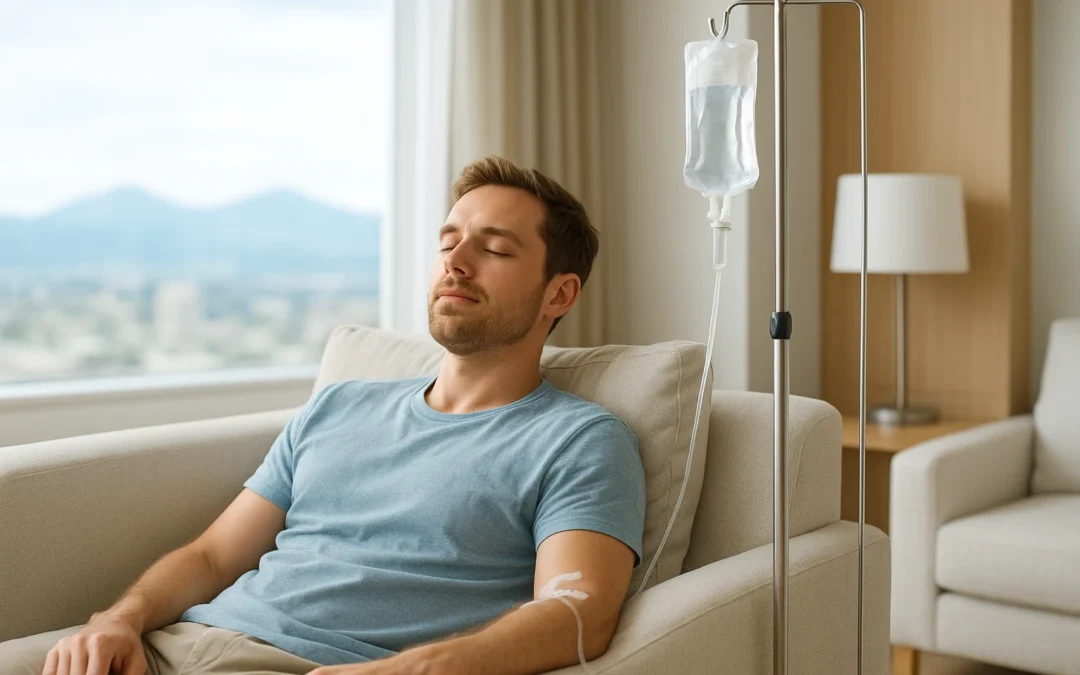
You know the feeling. You spent an unforgettable night dancing under the stars at Red Rocks Amphitheatre, cheering until you lost your voice at Ball Arena, or bouncing between breweries in RiNo. But the next morning, you wake up feeling less like you had a fun night out and more like you just ran a desert marathon without water.
Your head is pounding with a vicious migraine, your muscles are screaming, and the mere thought of drinking a glass of water makes your stomach churn.
If you’ve recently moved to Colorado or are just visiting for an epic weekend, you might be wondering: Why do two drinks in Denver feel like six drinks at sea level?
You aren’t imagining things. The “Altitude Hangover” is a very real, well-documented physiological phenomenon. Let’s pull back the curtain on the unique biology of celebrating at 5,280 feet, explore why traditional recovery methods often fail, and dive into the clinical science behind how modern mobile IV therapy fundamentally changes the recovery game.
The Biological Reality of Partying at 5,280+ Feet
To understand why a Denver hangover hits so differently, we have to look at the “Altitude Multiplier Equation.” When you combine high elevation, physical exertion, and alcohol, you create a perfect storm of cellular dehydration.
The Altitude Impact: Respiratory Alkalosis
At Denver’s elevation of 5,280 feet (and Red Rocks’ elevation of 6,450 feet), barometric pressure drops. This means the partial pressure of oxygen in the air is lower, so each breath delivers less oxygen to your blood.
Without you even realizing it, your body compensates by breathing slightly faster and deeper. This subtle hyperventilation causes you to exhale more carbon dioxide than normal, altering your blood’s pH levels in a process known as respiratory alkalosis. To fix this pH imbalance, your kidneys immediately start working overtime, flushing out massive amounts of water and essential electrolytes. Simply existing at this altitude increases your fluid loss through exhalation by 100% to 200% compared to sea level.
The Alcohol Impact: Unchecked Diuresis
Now, add alcohol to the mix. Ethanol suppresses the antidiuretic hormone (ADH), also known as vasopressin, in your pituitary gland. ADH is your body’s water-conservation hormone. When it’s turned off, your kidneys open the floodgates. For every 1 gram of alcohol you consume, your kidneys flush out about 10 milliliters of water.
Combined with altitude-induced fluid loss, your body enters severe hypovolemia (low blood volume). This causes your blood vessels to constrict (hello, pounding migraine) and leaves your liver without the necessary fluids to process toxic acetaldehyde—the chemical byproduct of alcohol that makes you feel poisoned.
Venue-Specific Stressors: Why Your Body Hits the Wall
Not all hangovers are created equal, and in Denver, where you celebrate plays a massive role in how you feel the next day.
Red Rocks Amphitheatre (6,450′)
Attending a concert at Red Rocks is a physical workout disguised as a party. Navigating the venue’s 380+ stone steps while dancing at over 6,000 feet forces your body into anaerobic metabolism, leading to a rapid buildup of lactic acid in your muscles. Combined with intense sun exposure during summer tailgates, your body is completely depleted of its sodium, potassium, and magnesium reserves before the headliner even takes the stage.
Ball Arena & Stadium Events
Sports fans endure a different kind of endurance test. Hours of drinking in crowded, highly energized environments combined with incredibly low indoor humidity accelerates insensible water loss (the fluid you lose through skin and breathing without noticing).
Downtown Nightlife (LoDo, RiNo, South Broadway)
Late-night bar crawls compound the issue. Layering varying types of alcohol on top of baseline altitude hypoxia over several hours creates a massive backlog of toxins that your liver simply cannot process quickly enough while dehydrated.
The Hydration Trap: Why Water and Sports Drinks Aren’t Enough
The most common advice for a hangover is “just drink water or a sports drink.” But if you’ve ever tried to chug a hydration multiplier after a rough night, you know it doesn’t always work—and sometimes, it comes right back up. Why?
The Bioavailability Gap and GI Sluggishness.
Heavy exertion (like those Red Rocks stairs) and alcohol severely irritate your stomach lining. In response, your body diverts blood flow away from the gastrointestinal (GI) tract to protect your vital organs. Your stomach essentially goes on strike, a condition known as gastric stasis.
When you drink fluids or take oral supplements in this state:
- Absorption is delayed by 2 to 4 hours.
- The efficiency of nutrient absorption drops to roughly 50%.
- If severe nausea triggers active vomiting, oral absorption drops to zero.
You can’t hydrate if your gut refuses to process the fluids.
Inside the Physiology of Rapid Recovery: The IV Advantage
This is where the science of intravenous (IV) therapy bridges the gap. By bypassing the irritated GI tract entirely, IV administration delivers 100% systemic bioavailability. Fluids and medications enter your bloodstream immediately, expanding intravascular volume, lowering your resting heart rate, and attaching to cellular receptors within minutes.
There’s a reason why search queries for iv hangover denver skyrocket on Sunday mornings. But it’s important to understand that a medical-grade IV isn’t just “expensive water.” Let’s break down the clinical pharmacology of a targeted recovery protocol, such as the Revive Hangover IV:
- 1,000 ml Isotonic Fluids (Normal Saline or Lactated Ringer’s): Immediately replaces lost blood volume and balances renal electrolytes, alleviating the cardiovascular strain of dehydration.
- Zofran (Ondansetron): A powerful anti-emetic that works by blocking the 5-HT3 serotonin receptors in your brain’s chemoreceptor trigger zone, shutting down nausea almost instantly.
- Toradol (Ketorolac): A highly effective non-steroidal anti-inflammatory drug (NSAID). It inhibits prostaglandin synthesis to eliminate pounding altitude headaches and muscle soreness without the use of narcotics.
- B-Complex Vitamins: Think of these as the spark plugs for your cells. B-vitamins act as essential enzymatic cofactors that restart the Krebs cycle, speeding up your body’s ability to clear out lactic acid and toxic acetaldehyde.
- Magnesium: A natural calcium channel blocker. Magnesium relaxes constricted cerebral blood vessels (easing tension) and soothes the cramped muscles you earned climbing those amphitheater stairs.
Safety, Logistics, and Making the Right Choice
As mobile IV therapy grows in popularity, understanding safety standards is crucial. IV therapy is a medical procedure, meaning the person administering it matters immensely.
When searching for a hangover iv near me, many people don’t realize that the industry is largely unregulated. Some providers use basic med-spa technicians or lightly trained staff. However, the highest standard of care relies exclusively on Critical Care Registered Nurses (RNs)—professionals whose daily background is in the ICU or ER. These nurses operate under strict Board-certified Medical Director oversight, ensuring sterile venipuncture and comprehensive pre-drip vital sign screenings right in the comfort of your home, hotel, or Airbnb.
Whether you’re recovering in a LoDo high-rise or looking for a mobile iv lakewood provider after a west-side concert, ensuring your provider uses critical care RNs guarantees you are getting hospital-level expertise without leaving your couch.
Frequently Asked Questions (FAQ)
Is a hangover IV a “cure”?
Medical transparency is important here: IV therapy is not a magical “cure” that reverses hepatic alcohol metabolism. It is rapid intravascular symptom management. It instantly fixes the hypovolemia (dehydration), stops the nausea chemically, and halts the inflammatory headache, allowing you to function perfectly while your liver naturally finishes processing the alcohol.
How long does a mobile IV therapy session take?
From the moment the Critical Care RN arrives at your location, the entire process—including vital sign checks, consultation, and the drip itself—typically takes between 45 to 60 minutes. Because the fluids bypass your gut, you often begin feeling relief within the first 15 minutes.
How do I know if I need oral hydration or an IV?
If you are mildly thirsty and can comfortably keep down fluids and a meal, oral electrolytes are likely sufficient. However, if you are experiencing severe nausea, vomiting, a pounding headache that limits your mobility, or if you simply cannot afford to lose a $500 vacation day or workday to recovery, an IV is the clinically efficient choice. For a detailed breakdown of what your body is telling you, reviewing common intravene protocols can help identify when you’ve crossed from standard dehydration into acute hypovolemia.
Is mobile IV therapy worth the cost?
When evaluating the $200–$350 cost of a premium mobile IV, it’s best viewed through the lens of time and opportunity cost. If an Altitude Hangover is keeping you bedridden, causing you to miss a day of skiing, a scheduled flight, or an important Monday meeting, the cost of the IV is often far less than the financial and experiential loss of a ruined day.
Reclaiming Your Mile High Weekends
Understanding the unique biology of Denver’s elevation empowers you to make smarter choices about how you celebrate—and how you recover. You don’t have to write off your entire Sunday just because you enjoyed an unforgettable Saturday night at Red Rocks.
By recognizing the limitations of your digestive system during an “Altitude Hangover” and understanding the clinical science behind intravenous hydration, you can bypass the misery, rapidly restore your cellular health, and get back to enjoying everything Colorado has to offer.