

Scroll through social media on any given weekend, and you’ll likely spot someone lounging on their couch, catching up on Netflix while receiving a mobile IV drip. In the Denver-Boulder Front Range, mobile IV therapy has been heavily marketed as a casual, spa-like wellness trend—a quick fix for a hangover, a bout of dehydration, or recovery after hiking the Flatirons.
But framing intravenous hydration as a mere “wellness day” ignores a fundamental physiological reality: introducing fluids directly into your bloodstream is a serious medical procedure.
When you strip away the trendy marketing, the conversation around mobile iv therapy must shift from convenience to clinical safety. Let’s pull back the curtain on the science of infusion fluid dynamics, the unique environmental challenges of living in Broomfield, and why having a Critical Care Nurse (ICU or ER-trained) at your side isn’t just a luxury—it’s a physiological necessity.
The Altitude and Dehydration Reality: Why Broomfield is Different
Living near the Rocky Mountains comes with breathtaking views and a uniquely challenging climate. Broomfield sits at roughly 5,400 feet above sea level. At this elevation, the air is thin, and oxygen levels are effectively lower, meaning your heart and lungs have to work significantly harder just to maintain baseline functioning.
Coupled with Colorado’s famously dry climate, this altitude creates an environment where you lose moisture rapidly through respiration—often without even realizing it. You breathe faster and deeper, exhaling vital water vapor with every breath. This phenomenon is why so many locals and visitors find themselves searching for iv therapy near boulder colorado race recovery after participating in outdoor events or endurance sports.
When you combine altitude-induced fluid loss with rapid IV hydration, your body undergoes significant hemodynamic (blood flow) shifts. This is not a situation for a casual approach.
Cardiovascular and Renal Reserve: The Science of Fluid Dynamics
To understand why who administers your IV matters, we need to talk about “reserves.” Specifically, your cardiovascular (heart) and renal (kidney) reserves.
Imagine your circulatory system as a highly regulated highway. When a practitioner infuses 1,000mL (one liter) of saline directly into your vein, they are instantly adding a massive volume of “traffic” to that highway.
- Cardiovascular Reserve: Your heart must suddenly pump this extra volume.
- Renal Reserve: Your kidneys must simultaneously filter it.
For a perfectly healthy 25-year-old, the body adapts quickly. But for someone with undiagnosed mild high blood pressure, a senior citizen, or an athlete whose system is already stressed from altitude and exertion, this sudden influx of fluid can overwhelm the system.
General nurses and basic paramedics are incredibly skilled professionals, but their training does not typically center on the highly nuanced, continuous cardiopulmonary assessments required to gauge these reserves accurately before and during a rapid infusion.
Infusion Safety: Recognizing the Red Flags
When an IV infusion is not properly monitored by someone with advanced critical care training, two primary risks emerge:
1. Speed Shock
Speed shock is a systemic reaction that occurs when a foreign substance is introduced into the bloodstream too rapidly. The body goes into a state of alarm, causing symptoms like a flushed face, a tight feeling in the chest, irregular pulse, or a sudden headache.
2. Pulmonary Congestion (Fluid Overload)
If the heart cannot pump the new fluid volume efficiently, that fluid has to go somewhere. Often, it begins to back up into the lungs—a condition known as pulmonary edema.
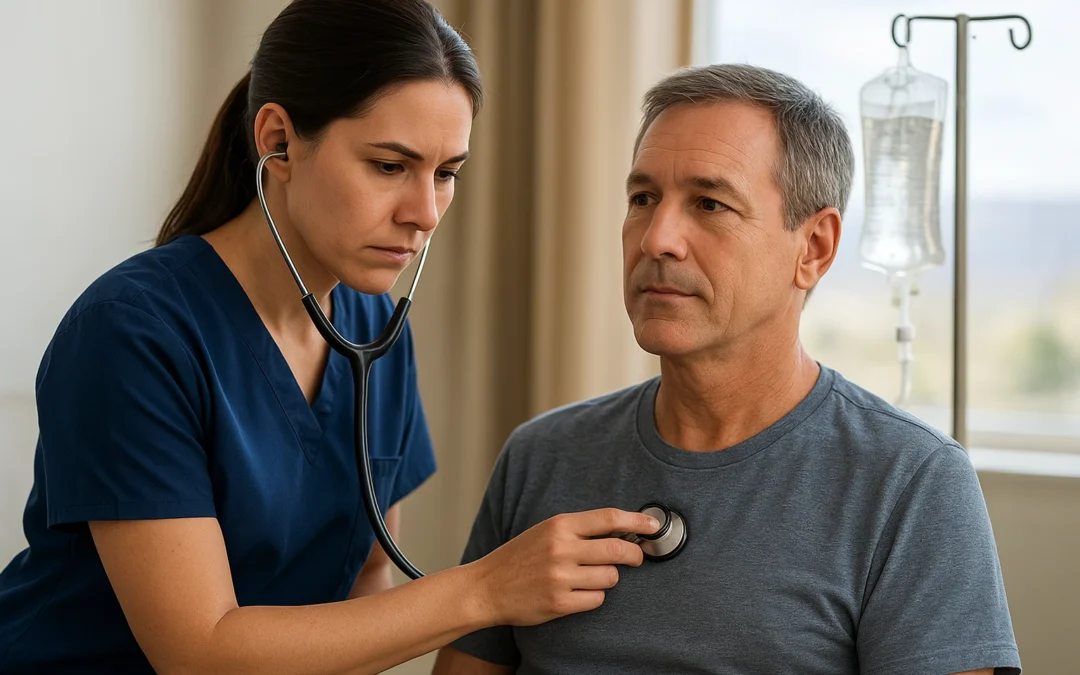
The Stethoscope Test: How do you catch fluid overload before it becomes dangerous? You listen. An ICU or ER-trained critical care nurse will always use a stethoscope to listen to the bilateral bases (the bottom) of your lungs before and during an infusion. They are listening for “crackles”—a faint popping sound that serves as an early warning sign of fluid backup. If standard providers merely hang a bag and check their phones, they miss this vital iv safety step entirely.
Critical Care Nurses vs. Basic Medics: The Gold Standard
Many mobile IV companies blend their staff qualifications together, using paramedics and registered nurses interchangeably. However, in the medical field, their scopes of practice are vastly different.
Paramedics are heroes of the field. Their training is built on rigid, protocol-driven emergency stabilization—keeping a patient alive during transport to a hospital.
Critical Care Nurses (ICU/ER RNs), on the other hand, spend thousands of clinical hours managing complex, continuous hemodynamic evaluation. They are masters of micro-dose pharmacology, airway monitoring, and independent clinical critical thinking. When evaluating mobile iv therapy denver providers, this distinction is paramount. Here is how that ICU expertise translates to your living room:
Dehydration Mimicry in Seniors
In Broomfield’s aging suburban communities, extreme dehydration often presents as acute confusion, dizziness, or a rapid heart rate. To an untrained eye, these symptoms closely mimic cognitive decline or a cardiac event. An ICU nurse’s advanced assessment skills allow them to differentiate between simple high-altitude dehydration and serious clinical red flags that require a hospital visit.
The Science of “Hard Sticks”
When you are severely dehydrated—especially in a dry mountain climate—your veins shrink and flatten out, a condition known as vascular collapse. Finding a vein becomes incredibly difficult. Critical care nurses spend their entire careers in ICUs dealing with patients in shock whose veins have virtually disappeared. They possess the tactile expertise to locate and access deep, fragile, or “rolling” veins on the first try, minimizing your discomfort.
Your Broomfield Resident’s Pre-IV Safety Checklist
Because mobile hydration is a medical procedure, you should interview your provider just as you would any healthcare professional. Before allowing anyone to start an IV in your home, ask these three non-negotiable questions:
- “Are you an ICU or ER-trained Critical Care Nurse?” Accept no substitutes. The practitioner should have extensive hospital-based critical care experience.
- “Will you physically listen to my lungs today?” If they don’t carry a stethoscope to check for pulmonary crackles, they cannot safely assess your cardiovascular reserve.
- “Do you stay in the room and monitor me continuously?” Your nurse should constantly evaluate your vital signs, the infusion rate, and your physical comfort.
The medical community is increasingly recognizing these boundaries. Just as we see international and national conversations demanding higher benchmarks—whether that’s analyzing safety criticals kent protocols or evaluating the safety of iv medication therapy auburn clinics—the standard for in-home care in Colorado must be elevated from a “spa day” to true clinical medicine.
Frequently Asked Questions
Is mobile IV therapy actually safe?
Yes, mobile IV therapy is highly safe—but only when administered by a properly credentialed medical professional. The safety relies entirely on the practitioner’s ability to assess your heart and lung health prior to the infusion and monitor you continuously for adverse reactions.
What is the difference between a paramedic and an RN for IV therapy?
Paramedics excel at trauma and emergency transport stabilization using strict field protocols. Critical Care Registered Nurses (ICU/ER) specialize in long-term, nuanced physiological monitoring, fluid dynamics, and advanced disease processes, making them better equipped to safely manage home-based wellness infusions.
Can mobile IV cause fluid overload or heart strain?
Yes. If your cardiovascular system or kidneys are compromised (even mildly due to age or underlying conditions), infusing a large volume of fluid rapidly can overwork the heart and cause fluid to back up into the lungs. This is exactly why a critical care assessment is vital before starting a drip.
How does high altitude (5,200+ ft) in Broomfield affect hydration?
High altitude features lower oxygen levels and drier air, which increases your respiratory rate. This means you lose significantly more water vapor just by breathing, accelerating dehydration. It also means your heart is naturally working harder to circulate oxygen, making proper medical screening crucial before receiving IV fluids.
***
Intravene Mobile IV Therapy is dedicated to elevating the standard of mobile medicine. By exclusively employing Critical Care Nurses, we ensure that every treatment is rooted in hospital-level safety, comprehensive physiological assessment, and unparalleled clinical expertise. Ready to learn more about how our clinical approach can support your wellness journey? Explore our full range of therapies and discover the critical care difference.