

If you’ve ever spent a Saturday morning pushing your limits on the Interurban Trail or grinding through a brutal hockey practice at the Kent Valley Ice Centre, you know the feeling. You finish your workout, drink your protein shake, spend twenty minutes religiously foam rolling, and stretch until your hamstrings beg for mercy.
Yet, two days later, Delayed Onset Muscle Soreness (DOMS) hits you like a freight train. Getting out of bed feels like a Herculean task.
For years, the fitness industry has sold us a standard recovery playbook: stretch, hydrate, and rest. But what if the science of muscle recovery has evolved right past us while we were busy touching our toes? Today, we’re pulling back the curtain on the mechanics of muscle repair to understand why traditional recovery methods often fall short, and how a cellular approach to healing is changing the game for Kent’s active community.
The Kent Athlete’s Dilemma: Why the Pacific Northwest Demands More
Training in Kent and the broader Pacific Northwest presents a unique set of physiological challenges. The combination of our rolling hill terrains, sudden climate shifts, and fluctuating humidity creates specific oxidative stress on the body. Whether you’re prepping for the Seattle Marathon, competing in local CrossFit events, or simply trying to stay active year-round, your body is constantly battling micro-traumas.
When you work out, you aren’t actually building muscle—you are tearing it down. Exercise creates microscopic tears in your muscle fibers. It’s during the recovery phase that your body repairs these tears, making the muscles stronger and more resilient.
But here is where the disconnect happens: we try to fix a chemical and cellular problem with purely mechanical solutions.
The Biology of the “Burn” and the Stretching Myth
Let’s address the elephant in the gym: the stretching myth.
For decades, coaches and trainers have preached that static stretching is the ultimate cure for DOMS. However, recent data published in deep scientific trials (like those found in PubMed Central) reveals a surprising truth: stretching does not significantly reduce delayed onset muscle soreness or accelerate the clearing of exercise-induced toxins.
Stretching is fantastic for flexibility and joint mobility, but it is not an “Internal Mechanic.” Muscle soreness is an inflammatory response to cellular damage. To truly recover, your body needs raw materials—specific fluids, amino acids, and vitamins—delivered directly to the cells.
The GI Barrier: Why Your Post-Workout Shake is Failing You
You might be thinking, “That’s why I drink my post-workout electrolyte and vitamin shake!”
Unfortunately, there’s a biological roadblock standing between your expensive supplements and your fatigued muscles: the Gastrointestinal (GI) Barrier. When you consume oral supplements, they must survive the harsh, highly acidic environment of your stomach and the intensive filtration of your liver before they ever reach your bloodstream.
In the medical and nutritional world, this is known as bioavailability. Because of the GI Barrier, up to 70% of the nutrients in oral supplements are literally wasted. You are only absorbing a fraction of what the label promises. This is why you can chug electrolyte water all day and still feel sluggish, cramp up, or experience brain fog.
The Muscle Recovery Mechanic Framework: The Era of Cellular Repair
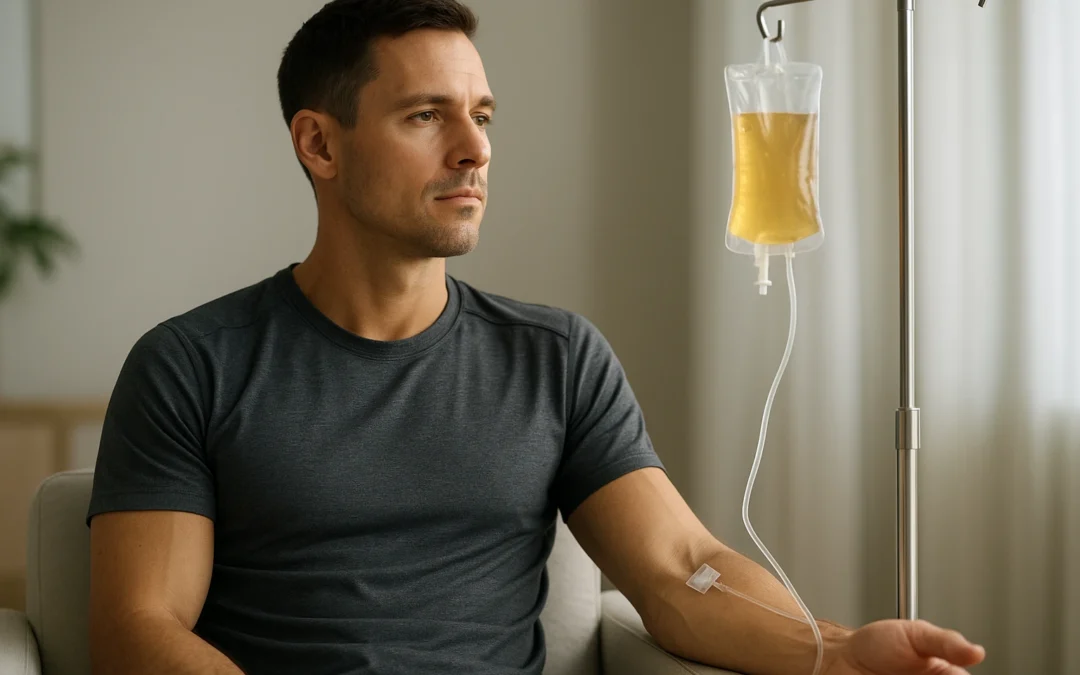
To bridge this gap, elite athletes and everyday fitness enthusiasts are turning to the peak of the recovery hierarchy: cellular repair through athletic recovery iv therapy.
By bypassing the digestive system entirely, intravenous delivery offers 100% bioavailability. The nutrients go directly into your bloodstream, arriving precisely where your damaged cells need them most. In fact, sports medicine research indicates that targeted IV nutrient therapy can result in up to 35% faster recovery times compared to traditional oral rehydration.
But what exactly is happening during this process? Let’s break down the mechanics of a high-level performance and recovery IV:
- Magnesium (The Neural Switch): Magnesium acts as a natural calcium blocker, helping muscle cells relax after contraction. It is the ultimate tool for preventing severe post-workout cramping and spasms.
- Glutathione (The Master Antioxidant): Intense exercise creates oxidative stress and free radicals. Glutathione acts like a cellular vacuum, clearing out workout-induced toxins and significantly reducing systemic inflammation.
- B-Complex (The Energy Synthesis Engine): B vitamins are crucial for converting proteins and carbohydrates into usable ATP (cellular energy), repairing tissue, and functioning as a potent brain fuel iv to restore mental clarity after a grueling session.
Professional Standards: Navigating WADA and USADA Regulations
As the popularity of mobile iv solutions grows, it’s critical to understand the rules of the road, especially if you are a competitive athlete.
The World Anti-Doping Agency (WADA) and the U.S. Anti-Doping Agency (USADA) have strict regulations regarding IV infusions. For competitive athletes subject to testing, IV infusions of more than 100mL per 12-hour period are prohibited unless the athlete has secured a Therapeutic Use Exemption (TUE) or is receiving treatment during a hospital admission.
Understanding these professional standards is what separates a true medical resource from a casual wellness fad. Whether you are subject to WADA testing or you’re an amateur runner aiming for a personal best, your recovery should always be overseen by highly trained medical professionals—specifically critical care nurses who understand complex physiology and compliance.
Action Plan: Integrating Advanced Recovery into Your Training Block
How do you apply these insights to your actual training schedule in Kent? Here is a practical approach:
- Time Your Cellular Repair: The optimal window for an athletic performance iv infusion is either 24 hours before a massive endurance event (pre-loading hydration and nutrients) or within 48 hours post-event (accelerating the clearing of lactic acid and reducing DOMS).
- Avoid the Common Hydration Mistake: A common error among local runners is drinking massive amounts of plain water without sufficient electrolytes after a hot summer run. This can dilute your blood’s sodium levels (hyponatremia) and actually slow down your recovery.
- Bolster Your Defenses: Intense training blocks naturally suppress your immune system, making you susceptible to post-race colds. Integrating an immune boost iv into your peak training weeks can keep you off the couch and on the trail.
Frequently Asked Questions About Performance Recovery
Is IV therapy actually better than drinking sports drinks?
Yes, due to bioavailability. Sports drinks are limited by how fast your stomach can empty and absorb fluids (the GI Barrier), plus they often contain high amounts of refined sugars. IV therapy delivers hydration and nutrients directly into the bloodstream for immediate, 100% absorption.
How often should active individuals utilize IV recovery?
It depends entirely on your training volume. High-level CrossFit competitors or marathon runners in peak training blocks might utilize it bi-weekly, while casual gym-goers might use it strictly as a “rescue” tool after a particularly grueling event or tournament.
Are these treatments safe?
When administered properly, yes. The key is the provider. You should always ensure that treatments are mixed and administered by critical care-trained nurses (such as those with ER or ICU experience). This ensures hospital-level safety and expertise, no matter where you are.
Does it hurt?
You will feel a tiny pinch when the needle is inserted, similar to a standard blood draw. After that, the treatment is typically painless, and many athletes use the 45-minute drip time to relax, meditate, or catch up on reading.
Next Steps on Your Recovery Journey
Optimizing your active lifestyle in Kent doesn’t mean you need to train harder; it means you need to recover smarter. By shifting your perspective from mechanical fixes (like endlessly stretching sore muscles) to cellular repair, you unlock a new tier of athletic potential.
If you’re tired of losing days to muscle fatigue and want to explore how customized hydration can transform your training, take the time to research the science of cellular recovery. Whether you are actively searching for iv therapy near me or just looking to educate yourself on the biology of fitness, remember that true wellness starts from the inside out.
To dive deeper into how clinical-grade recovery works, explore the resources available through intravene and discover how aligning your recovery with your biology can help you perform at your absolute peak.