

Picture this: You’ve just wrapped up an incredible, sun-soaked weekend in the Pacific Northwest. Maybe you spent Saturday hiking the steep trails of Mt. Pilchuck, followed by Sunday exploring the Sorticulture Garden and Arts Festival, or just enjoying a long, breezy afternoon at Jetty Island.
By Monday morning, however, the PNW lifestyle has caught up with you. You’re profoundly dehydrated, your energy has tanked, and you’re staring down a busy work week.
In the past, your options were limited. You could try to chug sports drinks and hope for the best, or if things were severe, you might consider a trip to Providence Regional Medical Center. But the reality of a 4-hour wait room and a $1,500+ emergency room bill is enough to keep anyone on the couch.
This is exactly why mobile iv therapy has quietly become the recovery secret of Everett residents. But if you’re new to the concept, inviting a medical professional into your living room to administer an IV can feel a little intimidating. Is it safe? Where do they hang the bag? What does it actually feel like?
If you’re considering booking your first session, here is your definitive roadmap to the at-home IV hydration experience—from doorbell to the post-drip “glow.”
The “Why Now” Factor: Moving the Clinic to the Couch
The biggest hurdle for first-time patients is wrapping their minds around the “medical legitimacy” of receiving treatment at home near Cascade High or the Everett Marina.
It helps to reframe how you view the service. When you book a premium mobile iv, you aren’t just ordering a delivery service; you are experiencing true concierge medical care. All treatments are administered by critical care and ICU-trained nurses operating under strict Washington State Nursing Board standards. Whether evaluating safety criticals kent or Snohomish County health protocols, maintaining hospital-grade hygiene and monitoring in a home environment is the foundational rule of this service.
For a flat rate typically ranging between $169 and $350, you bypass the waiting room entirely. It’s a localized, highly effective alternative to traditional clinical care.
Pre-Arrival Mastery: The “3-Step Prep”
You can actually control how smooth your appointment goes before the nurse even parks in your driveway. Here is the insider “3-Step Prep” for first-timers:
1. Leverage the “Plump Vein” Theory
It sounds counterintuitive to drink water when you’re getting an IV for hydration, but it’s the secret to a flawless experience. When you are dehydrated, your blood vessels constrict to conserve fluid. By drinking a large glass of water an hour before your appointment, you help “plump” your veins, making them easier to spot and ensuring a painless, one-stick application.
2. Have a Light Snack
Depending on your intravene symptom profile, receiving vitamins on a completely empty stomach can sometimes cause mild nausea. Eating a piece of toast or a banana stabilizes your blood sugar before the treatment begins.
3. Select Your “Drip Zone”
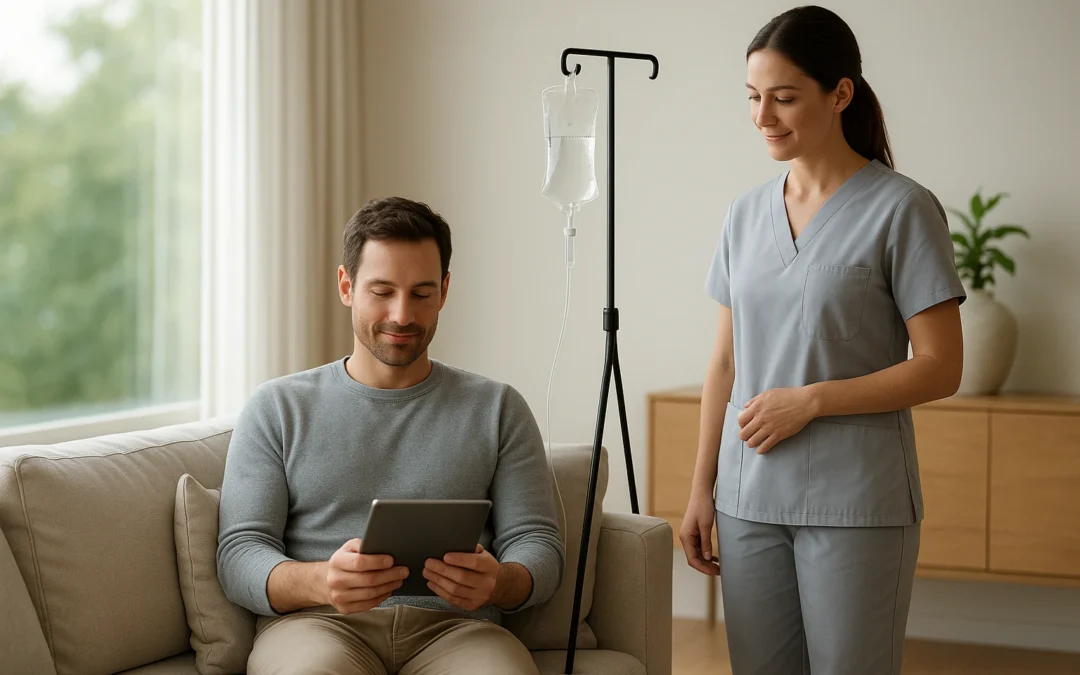
Where will this happen? Pick your coziest chair or corner of the sofa. Beginners often worry about their furniture or wonder, How does the nurse hang the IV bag without a bulky hospital pole? Mobile nurses are masters of logistical hacks. They come equipped with portable, collapsible tripods or simple over-the-door hangers that easily loop over a living room door frame without leaving a scratch.
The Doorbell Moment and the Sensory Journey
When your critical care nurse arrives, they will bring a compact, sterile medical kit. After reviewing your health history, taking your vitals (blood pressure, heart rate), and answering any questions, the process begins.
But what does it actually feel like? Let’s break down the sensory experience so there are no surprises:
The Pinch
Because mobile teams utilize ICU-trained nurses, the insertion process is incredibly fast. You will feel a standard, momentary pinch—similar to a standard blood draw—and then nothing. The needle is actually removed immediately, leaving only a tiny, flexible plastic micro-tube (a catheter) in the vein to deliver the fluids.
The “Internal Cooling” Sensation
This is the “aha moment” that nobody warns you about! The IV fluids are naturally at room temperature (around 70°F). When that fluid enters your 98.6°F body, you will feel a distinct, soothing cooling sensation traveling up your arm. Many patients find this incredibly refreshing, especially if they are recovering from a fever, a strenuous hike, or an overindulgent night.
The Metallic Taste
About ten minutes into the drip, you might suddenly taste a faint metallic or vitamin-like flavor in the back of your mouth. Don’t panic—this is entirely normal. It is your body’s sensory reaction to the B-vitamins (like B12) bypassing your digestive tract and entering your bloodstream.
The Nurse-Patient Dynamic: True Concierge Care
A common misconception is that the nurse hooks you up and leaves. In reality, your nurse stays by your side for the entire 45-to-60-minute duration of the drip.
This is your time to relax. You can work on your laptop, watch TV, or just chat with the nurse. They will continually monitor the drip rate and check in on how you’re feeling. They can even adjust the speed of the fluid delivery if the cooling sensation feels too chilly.
Post-Care & The “Glow”: What to Expect Later
Once the bag is empty, the nurse removes the flexible tube, applies a small bandage, and checks your vitals one last time.
The 2-Hour Window
In the spirit of radical transparency, expect to visit the restroom frequently over the next couple of hours. Your body is flushing out toxins and processing the direct hydration. You’ll likely notice your energy starting to surge and the “brain fog” lifting.
The 24-Hour Glow
By the next morning, the vitamins and hydration will have fully integrated at a cellular level. Most patients report a sustained “glow”—clearer skin, steady energy, and a massive reduction in whatever fatigue or soreness prompted the visit.
Whether you are shaking off an exhausting week, pre-hydrating before exploring the San Juan islands, or skipping a steep royal caribbean iv therapy cost before heading down to the Seattle cruise terminals, the after-effects are designed to get you back to your optimal baseline.
Frequently Asked Questions
Is mobile IV therapy safe in a home environment?
Yes. Mobile IV therapy is remarkably safe when administered by credentialed medical professionals. Premium services specifically employ critical care and ICU nurses who utilize sterile equipment and follow strict board guidelines for patient safety.
How much does an at-home IV cost compared to a clinic?
At-home sessions generally range from $169 to $350 depending on the vitamin formulation. Compared to an ER visit (often upwards of $1,000+) or the hidden costs of urgent care copays, it is an incredibly cost-effective way to receive high-level hydration.
Can I get an IV to recover from a hangover or party?
Absolutely. Whether you’re recovering from a bachelor party or a long weekend hosting an iv for boat party at the marina, specialized hangover blends include anti-nausea and anti-inflammatory medications that can resolve symptoms in under an hour.
Will it hurt?
The only pain is a quick, mild pinch at the very beginning. Because highly experienced nurses perform the placement, discomfort is minimal. Once the IV is set, you should feel no pain at all—just relaxation.
Taking the Next Step in Your Wellness Journey
Navigating your health and recovery shouldn’t require sitting under fluorescent hospital lights or disrupting your entire day. Understanding the patient experience demystifies the process, turning a medical procedure into a simple, luxurious addition to your wellness routine right here in Everett.
Ready to experience the profound difference of cellular-level hydration on your own terms? Your living room is waiting.