

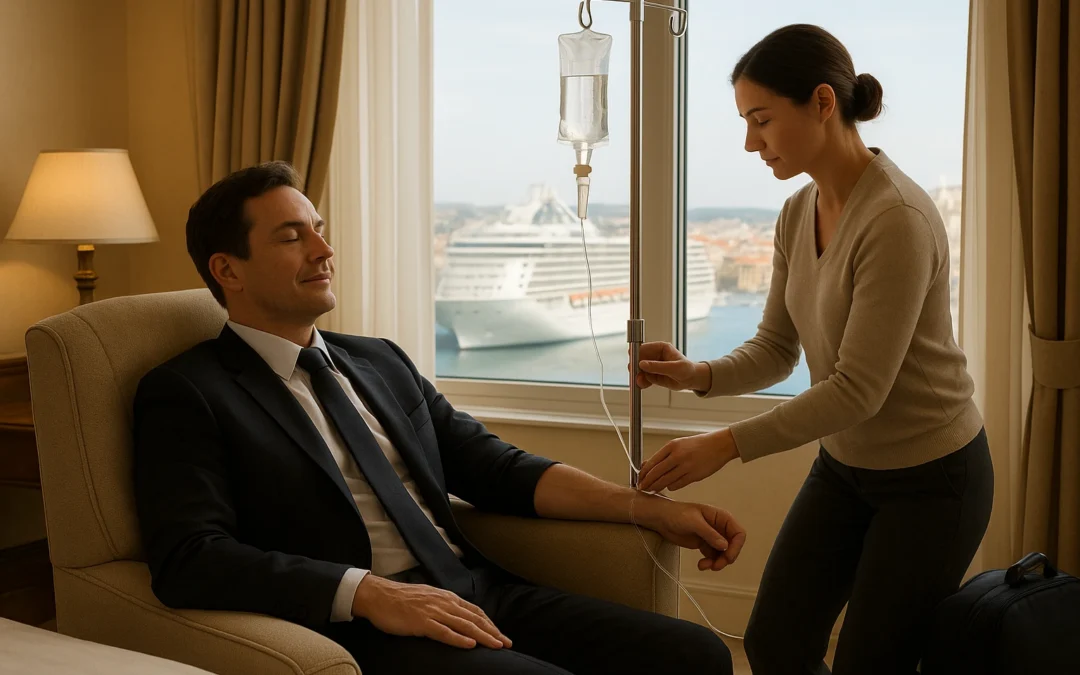
Imagine this: You’ve just invested tens of thousands of dollars in a premium cruise experience—perhaps the Celebrity Concierge Class, Royal Caribbean’s Royal Suite Class, or Disney Concierge. You are buying two highly specific commodities: frictionless luxury and uncompromising personal privacy.
But what happens when your family arrives at the port city battling severe flight dehydration, trans-meridian jet lag, or the lingering fatigue of a hectic executive schedule?
There is an acute operational blind spot in luxury travel that most family offices and executive assistants only discover when it’s too late. Shipboard medical centers and cruise hospitality concierges are structurally incapable of delivering discrete, off-the-record preventative wellness.
If you want to integrate hospital-grade clinical hydration into your embarkation logistics without ever compromising your family’s privacy, public exposure, or personal health information, this guide will walk you through exactly how to do it.
The “Two Concierges” Framework
High-profile travelers must understand that luxury sea travel actually requires two distinct concierge arms working in tandem.
The Shipboard Hospitality ConciergeWhen you read cruise blogs, they dominate the “concierge” conversation by itemizing physical amenities. They handle priority boarding, private dining reservations at the Coastal Kitchen, dedicated lounge access, and pillow menus. They are masters of logistics and hospitality.
The Discrete Medical ConciergeHowever, hospitality concierges cannot safeguard your biological health, immunity, or clinical privacy before you cross the gangway. That is the realm of a private medical concierge. While the shipboard team prepares your suite, a discrete mobile medical team ensures your body is biologically optimized to actually enjoy it.
The Privacy Reality Check: Cruise Infirmaries vs. Private Shore-Side Care
A common misconception is that a luxury cruise suite includes private, in-room medical care. In reality, visiting a shipboard doctor fundamentally compromises your privacy.
Cruise infirmaries are maritime facilities designed primarily for acute trauma and infectious disease containment (like norovirus isolation protocols under the CDC). If you or a family member needs basic rehydration or a wellness boost, you are forced to navigate public passenger corridors and wait in communal lower-deck medical waiting rooms.
Furthermore, any treatment received onboard is logged into maritime databases, with reporting duties directly to ship command. For high-net-worth individuals or public figures, this digital footprint and public exposure is entirely unacceptable.
By contrast, receiving private mobile medical care at your port-side hotel or villa before embarkation falls under strict onshore privacy laws. True discrete care involves absolute confidentiality, HIPAA-compliant encryption, non-disclosure agreements (NDAs), and unmarked medical transport—ensuring your wellness routine remains entirely off the record.
Navigating Maritime Regulations: Why Port-Side Preparation is Essential
You might be wondering, “Why can’t I just have a private nurse board the ship while it’s docked to treat my family in our suite?”
Many generic on-demand IV providers will vaguely promise to “meet you at the ship,” but this reveals a deep misunderstanding of maritime law. The Maritime Transportation Security Act (MTSA) and strict cruise line vendor restrictions prevent outside medical services from boarding passenger ships docked at commercial piers without specialized maritime security credentials (TWIC cards).
The optimal strategy—and the industry standard for executive protection—is the 48-Hour Pre-Embarkation Health Playbook:
- Flight Arrival: Your family arrives at a luxury hotel (like a Ritz-Carlton or Four Seasons) near major hubs.
- In-Suite Treatment: Whether you need iv therapy miami before a Caribbean voyage, iv therapy fort lauderdale for an Atlantic crossing, or are searching for a wellness iv near me in Seattle before an Alaskan glacier cruise, a critical care nurse arrives at your suite.
- VIP Gangway Embarkation: You board the ship fully hydrated, with fortified immunity, and zero maritime medical records.
The Science of Pre-Cruise Bio-Optimization
Why go through the effort of arranging intravenous (IV) therapy instead of just drinking water in your hotel room? It comes down to pharmacokinetics.
Under travel-induced stress, drinking oral water or electrolytes only achieves about 20–30% bioavailability, taking hours for your digestive tract to absorb. Alternatively, an IV drip bypasses the gut entirely, delivering 100% cellular absorption of vitamins, minerals, and hydration within 45 minutes.
Tailored formulations address specific travel stressors:
- The Immune Defense Protocol: High-dose Ascorbic Acid (Vitamin C), Zinc, and Glutathione administer a powerful immune shield before you enter the closed-air environment of a cruise ship.
- The Jet-Lag & Circadian Reset: B-Complex vitamins, Magnesium, and targeted medications quickly reset circadian rhythms and eliminate travel headaches.
- Intense Recovery: If your pre-cruise travels included heavy celebrating (such as needing a bachelor party iv recovery), a comprehensive banana bag iv delivers critical multivitamins and electrolytes to rapidly restore baseline health.
The Critical Care Difference: Discretion Meets Clinical Mastery
Not all mobile IV services are created equal, especially when catering to affluent families. Many local medspas employ technicians with limited clinical experience.
When discretion and comfort are paramount, the gold standard is relying exclusively on Intensive Care Unit (ICU) or Emergency Room (ER) Critical Care Registered Nurses. These professionals possess unmatched vascular access mastery. This means an effortless, single-stick insertion even for dehydrated veins, eliminating the visible bruising that can ruin a public appearance or formal dining night.
They also operate under strict physician direction, bringing hospital-grade sterility into your five-star suite with the quiet professionalism you expect from top-tier executive staff.
Executive Action Checkpoints: The “Privacy Standard” Checklist
If you are a family office director, executive assistant, or discerning traveler vetting a mobile medical service for a pre-cruise treatment—whether you are departing from the coasts or flying in from places requiring pre-travel care like iv therapy fort worth—ask these five non-negotiable questions:
- Are your clinicians exclusively ER/ICU critical care nurses?
- Do your teams operate with unmarked gear to prevent paparazzi or public exposure in hotel lobbies?
- Are your communication and booking platforms fully HIPAA-encrypted?
- Is your staff willing and accustomed to signing strict Non-Disclosure Agreements (NDAs)?
- Do you have established protocols for seamlessly coordinating with private drivers and luxury hotel concierges?
Frequently Asked Questions (FAQ)
What is the difference between a cruise concierge and a private medical concierge?
A cruise concierge handles hospitality and logistics (priority boarding, dining reservations, and suite amenities). A private medical concierge handles biological optimization and clinical privacy (hydration, immune boosting, and illness recovery) before you board the ship.
Why should I avoid the cruise ship infirmary for basic hydration or fatigue?
Cruise infirmaries are highly public, communal spaces designed for acute medical trauma and infectious disease containment. Seeking care there compromises your privacy, logs your health data into maritime databases, and can occasionally trigger administrative cruise line interventions, such as cabin isolation.
Can a mobile IV nurse treat me on the cruise ship before it sets sail?
No. Due to federal maritime security laws (MTSA) and strict cruise terminal regulations, outside medical personnel cannot legally board commercial passenger vessels. Pre-cruise clinical wellness must take place at your port-side hotel, private residence, or aviation terminal prior to embarkation.
Are these discrete medical treatments covered by health savings accounts?
Many executive travelers and family offices manage wellness expenses through specialized accounts, leading to the common question: can you use hsa for iv therapy? Yes, in many cases, IV therapy is an eligible expense under HSA and FSA guidelines if it is used to treat a specific medical condition (like dehydration or migraines) under the guidance of a medical professional. Always verify with your specific plan administrator.
How is my high-profile family’s privacy maintained during a hotel treatment?
Top-tier mobile IV providers utilize off-the-record wellness protocols. This includes nurses arriving in plain clothes with unmarked medical bags, mandatory NDA compliance, in-suite treatments away from public areas, and strict HIPAA-compliant digital security to ensure zero digital footprint.
Final Thoughts: Protecting Your Peace of Mind
True luxury travel is about the absence of friction. By understanding the structural boundaries of shipboard medical care and the strict realities of maritime logistics, high-profile travelers can take control of their health before they ever see the ocean.
Coordinating discrete, hospital-grade mobile IV therapy in your port-side suite isn’t just about feeling energetic for your first day at sea—it’s about protecting your privacy, your family’s well-being, and your ultimate peace of mind.