

You’ve likely felt it. That specific heaviness that hits you on the morning of Day 2 in Breckenridge.
You planned this trip for months. You booked the perfect lodge near Peak 8, bought the lift tickets, and perhaps even spent a few weeks on the Peloton preparing your legs. Yet, here you are—waking up with a dull headache, a dry mouth that no amount of tap water seems to fix, and legs that feel like lead.
It’s easy to blame the craft beers from Main Street last night or assume you’re just “out of shape.” But there is a biological reality happening inside your body that has nothing to do with your fitness level and everything to do with physics.
Welcome to the “9,600ft Wall.”
For visitors transitioning from sea level (or even from Denver’s 5,280ft) to Breckenridge’s base elevation, the body undergoes a massive physiological shift. This guide isn’t about selling you a cure; it’s about explaining the science of “Altitude Optimization.” Think of it as performance insurance for your vacation investment.
The Science of Pressure: Why “Thin Air” Is Only Half the Story
Most travelers understand that there is less oxygen available at high altitudes. However, the mechanism is often misunderstood. The percentage of oxygen in the air in Breckenridge is actually roughly the same as it is in Miami—about 21%.
The problem isn’t the percentage; it’s the pressure.
This phenomenon is known clinically as Hypobaric Hypoxia. At sea level, atmospheric pressure pushes oxygen molecules into your lungs and forces them into your bloodstream. At 9,600 feet, that pressure drops significantly. Your lungs can take in the air, but there isn’t enough pressure to drive the oxygen effectively into your blood cells.
This triggers a cascade of physiological responses: your heart rate increases, your respiration speeds up, and your body begins dumping fluids in an attempt to thicken the blood (hemoconcentration) to transport oxygen more efficiently. This fluid dump is the silent thief of your energy.
The Water Paradox: Why Chugging Water Can Make Headaches Worse
The most common advice you’ll hear in Summit County is, “Drink more water.” While well-intentioned, this advice can be dangerous if followed blindly.
When you consume massive amounts of plain water to combat dehydration, you risk flushing out the critical electrolytes (sodium, potassium, magnesium) that regulate your nerve and muscle function. In medical terms, this dilution is called Hyponatremia.
If you are chugging water but your headache is getting worse and you feel nauseous, you might not be dehydrated—you might be chemically diluted.
[]
To function at altitude, your cells function like a sponge. If a sponge is dried out and hard, pouring water over it just causes the liquid to run off. The sponge needs the right balance of minerals to soften and absorb the moisture. This is where the distinction between “drinking water” and “cellular hydration” becomes the difference between a great ski day and a day in bed.
The Bioavailability Breakthrough: IV vs. Oral Hydration
Why can’t you just drink a sports drink? You certainly can, and you should. But when your body is under the stress of altitude, your digestive system slows down. Blood is diverted away from the stomach to prioritize the heart, lungs, and brain.
This means the absorption rate (bioavailability) of oral fluids drops. You might drink a liter of electrolyte water, but only absorb a fraction of it effectively.
Intravenous (IV) Therapy bypasses the digestive system entirely. By delivering fluids, vitamins, and minerals directly into the bloodstream, you achieve 100% bioavailability. It creates an immediate increase in blood volume, which helps restore the pressure needed to circulate oxygen to your fatigued muscles.
This is why many athletes and seasoned travelers view iv therapy breckenridge not as a medical treatment for the sick, but as a strategic tool for maintaining peak performance.
The Breckenridge Recovery Map: Matching Activity to Ingredients
Not all recovery needs are the same. The biological demand of a leisure skier differs from a competitive trail runner. Here is how we map Breckenridge-specific activities to physiological needs.
1. The “Imperial Express” Skier (High Intensity/Adrenaline)
The Activity: You’re hitting the high alpine bowls on Peak 8 or tackling the Horseshoe Bowl. You are exerting short bursts of extreme energy in the coldest, windiest environments.The Biological Cost: High oxidative stress. The physical exertion releases free radicals—what we call “cellular rust”—that cause muscle inflammation and soreness (DOMS).The Solution: Glutathione. Known as the “master antioxidant,” Glutathione acts as a cellular detergent, scrubbing the free radicals from your muscles to reduce soreness and speed up recovery.
2. The “Breck Epic” Endurance Athlete
The Activity: You’re mountain biking the trail systems or skinning up the mountain before the lifts open.The Biological Cost: Glycogen depletion and lactic acid buildup. Your tank is empty.The Solution: Amino Acids and Taurine. These building blocks help repair micro-tears in the muscle tissue instantly, while magnesium helps relax the muscles to prevent cramping. For those pushing their limits, athlete recovery denver protocols suggest higher doses of B12 for energy metabolism.
3. The “Troll Trail” Explorer (Low Impact/High Altitude)
The Activity: You aren’t skiing, but you’re walking the snowy trail to see Isak Heartstone (the Troll) or shopping along Main Street.The Biological Cost: Even without skiing, your body is working overtime just to exist at this elevation. Travelers often experience “vacation fatigue” simply from the environmental shift.The Solution: The Myers Cocktail. A balanced blend of fluids, B-Vitamins, and Magnesium to reset your equilibrium and boost energy levels for dinner and social activities.
Safety Check: When to Call a Nurse vs. 911
It is vital to distinguish between standard altitude fatigue and acute altitude sickness. At Intravene, safety is paramount, which is why we utilize Critical Care Nurses—highly trained professionals with ICU or ER experience.
IV Therapy is appropriate for:
- Headaches and migraines
- Nausea and loss of appetite
- Muscle fatigue and general exhaustion
- Dehydration symptoms
- iv for altitude sickness (mild to moderate symptoms)
Seek Emergency Care (ER) immediately if you experience:
- Confusion or altered mental state (signs of HACE – High Altitude Cerebral Edema)
- Difficulty breathing while resting (signs of HAPE – High Altitude Pulmonary Edema)
- Chest pain
The Strategic Approach: Pre-Acclimation
The smartest travelers don’t wait until they crash to think about hydration. There is a growing trend of “Pre-Acclimation,” where visitors schedule a treatment immediately upon arrival—sometimes even stopping for mobile iv therapy in the foothills before making the final climb up I-70.
By front-loading your system with hydration and vitamins, you raise your physiological baseline. This makes the transition from 5,000 feet to 9,600 feet less of a shock to your system, allowing you to enjoy your first dinner in town rather than nursing a headache.
Frequently Asked Questions
Is IV therapy safe for teenagers?
Yes, generally. Many families visit Breckenridge with young athletes. However, minors require parental consent, and a medical screening is always conducted by the nurse to ensure the treatment is appropriate for the individual’s weight and health history.
Does this actually help with hangovers?
Yes, but perhaps not for the reason you think. A “slope hangover” is often 30% alcohol and 70% altitude dehydration. Alcohol inhibits the hormone that helps you retain water, doubling down on the dehydrating effects of the dry mountain air. Rehydrating intravenously addresses the root cause of the misery rapidly. If you are struggling, looking for mobile iv therapy near me can save your next ski day.
How long does the boost last?
Most clients report feeling significantly better within 30 to 45 minutes of the treatment. The hydration benefits typically last for 24 to 48 hours, depending on your physical activity level. For a week-long trip, many guests schedule a “mid-week boost” to maintain energy levels.
Does it hurt?
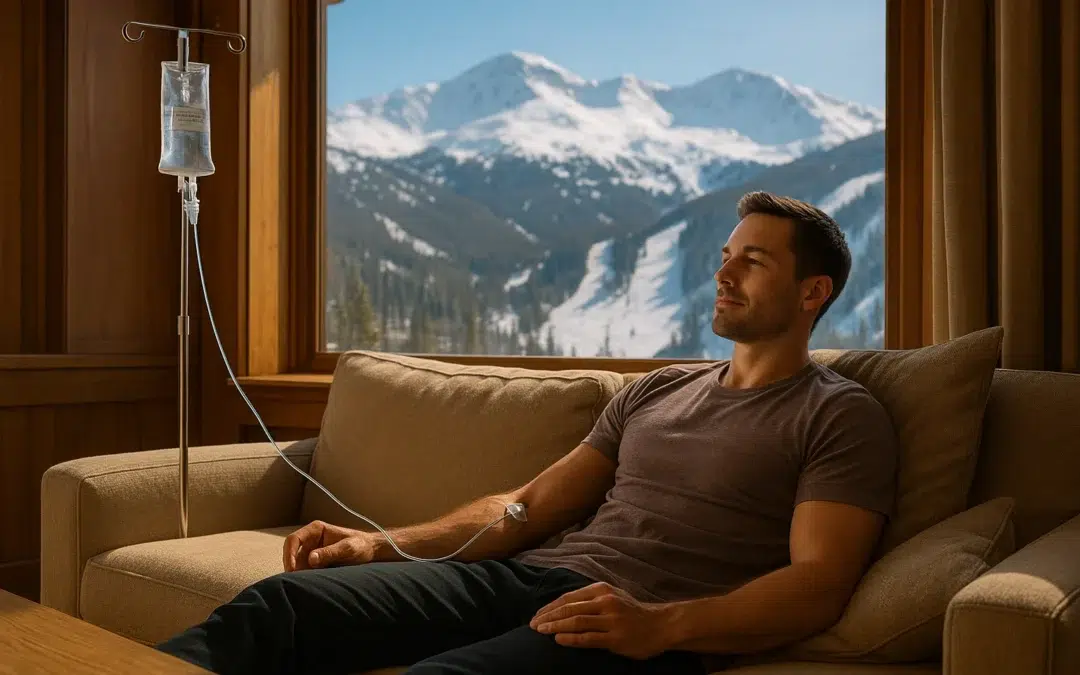
Our nurses are critical care experts who are masters at vascular access. Most clients feel a tiny pinch, followed by a cooling sensation as the fluids enter the bloodstream. It is generally a very comfortable experience that takes about 45 minutes—the perfect amount of time to relax on your couch after a day on the slopes.
Don’t let altitude dictate your vacation.Understanding your physiology is the first step to conquering the mountain. Whether you are here to crush double-black diamonds or simply enjoy the snowy ambiance, supporting your body with the right immunity iv therapy and hydration ensures you get the most out of every minute in Breckenridge.