

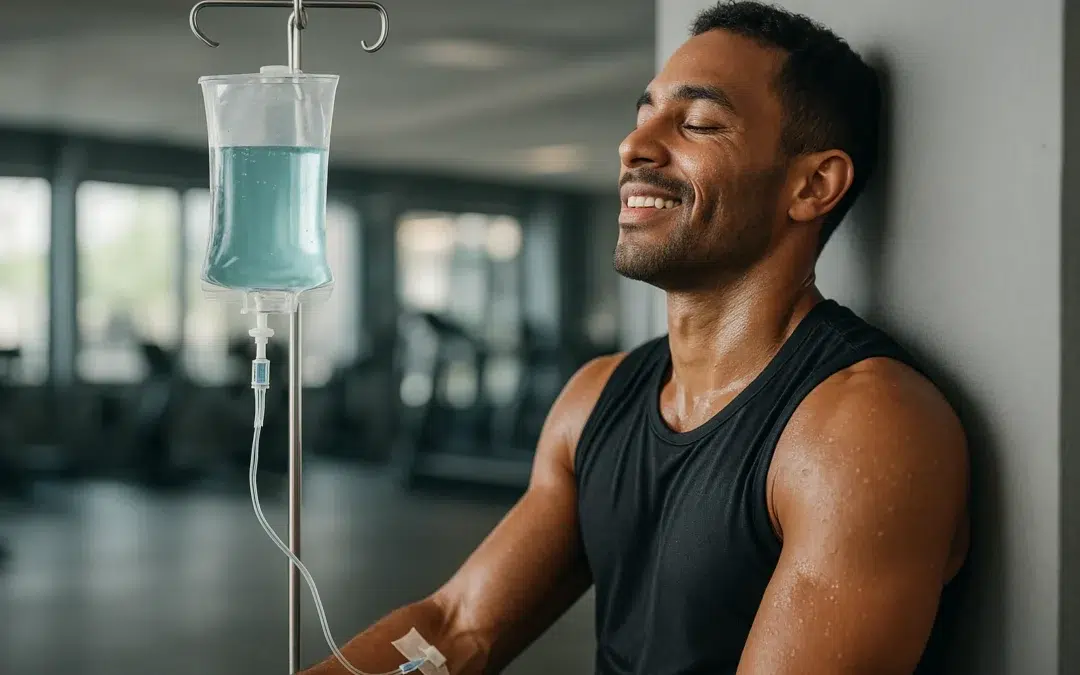
If you’ve ever walked out of a HIIT session at Crunch on Causeway Blvd or finished a heavy lift at a local CrossFit box, you know the feeling. You step out of the gym, and instead of cooling down, you’re hit with a wall of thick, humid air.
In most parts of the country, sweating is an efficient cooling mechanism. But here in Brandon, where humidity levels frequently hover above 80%, the rules of biology change. You aren’t just tired; you are likely battling a unique physiological phenomenon known as “non-productive sweat.”
For the dedicated fitness enthusiast, this creates a hidden obstacle. You might be drinking gallons of water, yet you still feel sluggish, sore, and mentally foggy 24 hours later. The problem isn’t your effort—it’s your recovery strategy.
This guide explores the science of athletic recovery in high-humidity environments and explains why a growing number of local athletes are looking beyond the water bottle to maximize their performance.
![Image of an athlete wiping sweat from their forehead, looking exhausted but determined, with a blurred gym background]
The “Humidity Trap”: Why Your Sweat Isn’t Working
To understand why traditional recovery methods often fall short in Florida, we have to look at thermodynamics.
When you exercise, your core temperature rises. Your body responds by sweating, expecting that sweat to evaporate and cool your skin. However, when the air is already saturated with moisture (high humidity), evaporation slows to a crawl.
This leads to non-productive sweat. Your body panics because it isn’t cooling down, so it sweats more. You lose water and vital electrolytes—sodium, potassium, and magnesium—at a rate up to 2x faster than athletes training in dry climates like Colorado or Arizona.
The Deficit You Can’t Drink Away
When you lose fluids that rapidly, you enter a state of hypohydration. You might try to chug water immediately after your workout, but the body has a limit on how fast it can absorb oral fluids.
- The Digestive Speed Limit: Your gastrointestinal tract can only process about 1 liter of fluid per hour.
- The Sweat Rate: In high intensity and high humidity, you can lose 2–3 liters of fluid per hour.
Do the math, and the problem becomes clear: You are losing fluids faster than your gut can replace them. This “recovery debt” is often the culprit behind lingering muscle cramps and that heavy-legged feeling during your next workout.
The Science of Bioavailability: Oral vs. Intravenous
This is where the conversation shifts from simple hydration to cellular efficiency.
When you take vitamins or electrolytes orally—whether through sports drinks, powders, or pills—they must pass through the digestive system. This journey is perilous for nutrients. Acids in the stomach and enzymes in the liver break down a significant portion of what you consume before it ever reaches your bloodstream. This is known as the “first-pass effect.”
Research suggests that oral absorption rates for certain vitamins can be as low as 20–50%.
Intravenous (IV) therapy bypasses the digestive system entirely.
- 100% Bioavailability: Nutrients are delivered directly into the bloodstream.
- Immediate Utilization: Your cells don’t have to wait for digestion; the uptake is instant.
- Systemic Saturation: You can achieve therapeutic levels of hydration and vitamins that are physically impossible to reach through drinking alone.
For the Brandon athlete, this means closing the “recovery debt” gap in 45 minutes rather than 24 hours.
![Infographic comparison showing the ‘Digestive Tax’ of oral vitamins vs. the direct route of IV therapy]
The 4 R’s of Recovery: Where IV Therapy Fits
Top-tier athletic trainers often use the “4 R’s” framework to build recovery plans. It’s a holistic way to look at what your body needs after stress.
- Refuel: Replenishing glycogen stores (carbs) and protein. This is done with food.
- Rest: Sleep and active recovery days.
- Rehydrate: restoring fluid balance.
- Repair: Fixing micro-tears in muscle tissue and reducing inflammation.
While food handles the “Refuel” stage, athletic recovery IV therapy is uniquely positioned to dominate the Rehydrate and Repair stages simultaneously.
By using a targeted IV drip—often referred to locally as a “Peak Perform” style treatment—you aren’t just adding water. You are introducing the raw materials your muscles need to rebuild.
The Ingredient “Cheat Sheet” for Muscles
If you are considering mobile IV therapy near me for recovery, here are the specific ingredients you should look for and why they matter:
- Magnesium: Often called the “relaxation mineral.” It helps prevent muscle cramps and relaxes blood vessels, improving circulation to sore tissues.
- Glutathione: The “master antioxidant.” Intense exercise creates oxidative stress (free radicals). Glutathione neutralizes these, reducing soreness and fatigue.
- B-Complex (B12, B6, etc.): These are crucial for energy metabolism. They help convert the food you eat into usable energy for your next session.
- Amino Acids: The building blocks of protein. Infusing these supports the physical repair of muscle fibers damaged during heavy lifts.
Safety and Standards: What You Need to Know
As IV therapy gains popularity in wellness circles, it is vital to remember that this is a medical procedure. Safety should always be your top priority.
In the Brandon area, standards vary. The highest standard of care is found with services that utilize Critical Care Nurses (RNs with ICU or ER experience). These professionals understand fluid dynamics, vein anatomy, and medical safety protocols far better than general staff.
Before booking a session, always ask:
- Who is administering the drip?
- What are their qualifications?
- Is the treatment customized to my specific activity level?
![Photo of a nurse preparing an IV bag, focusing on the medical equipment and professional setting]
The Mobile Advantage: Timing Your Recovery Window
Physiologists talk about the “metabolic window”—the critical period immediately post-workout where your body is most receptive to nutrients.
This is where mobile IV therapy offers a logistical advantage over brick-and-mortar clinics. After a grueling session at the gym, the last thing you want to do is drive to a clinic and sit in a waiting room.
With mobile service, the recovery comes to you—whether that’s your living room couch or your office. This allows you to enter a parasympathetic state (rest and digest) much faster, further accelerating the recovery process.
Frequently Asked Questions
Q: Is IV therapy considered “doping” for athletes?A: For recreational athletes, IV therapy is a safe wellness tool. However, if you are a competitive athlete under WADA or USADA regulations (such as professional fighters or collegiate athletes), there are strict rules regarding IV volume limits (usually capped at 100mL per 12 hours unless there is a medical exemption). Always check your specific governing body’s regulations.
Q: How often should I get an IV for recovery?A: It depends on your training volume. Many endurance athletes and heavy lifters find that one treatment per week or bi-weekly during peak training cycles helps maintain optimal hydration and performance levels.
Q: Does it hurt?A: Most clients report only a tiny pinch during the initial needle insertion. Once the IV is flowing, the experience is painless and often relaxing.
Q: Can’t I just take oral supplements?A: You can, and you should! IV therapy doesn’t replace a healthy diet and oral hydration; it supplements them. Think of oral intake as your daily maintenance and IV therapy as your high-performance deep clean, especially effective after those humid Florida workout sessions.
Bridging the Gap Between Effort and Results
You put the work in at the gym. You endure the heat. You push your limits. Don’t let the unique challenges of the Florida climate rob you of the results you’ve earned.
Understanding the science of hydration and the limitations of your own biology is the first step toward smarter training. Whether you are training for a marathon or just trying to keep up with a high-intensity class, ensuring your body has the resources to immune boost and repair itself is the key to longevity in fitness.
Next time you feel that post-workout drain that water just won’t fix, remember: it might not be fatigue. It might be simple biology waiting for the right solution.