

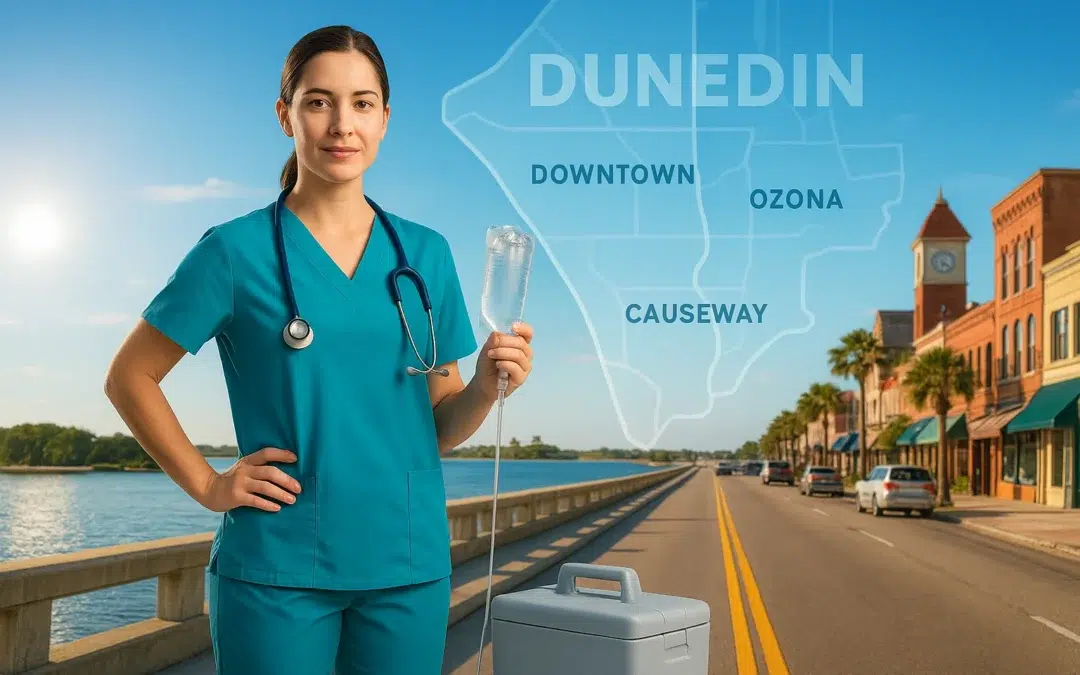
Imagine this: It’s 2:00 PM on a Saturday. You’ve just finished a long ride down the Pinellas Trail, or perhaps you spent a few too many hours under the sun at Honeymoon Island without an umbrella. The humidity is hovering near 90%, and suddenly, water isn’t cutting it. You feel that distinctive brain fog, a pounding headache, and the fatigue that signals deep dehydration.
In moments like this, speed matters. But in a city with Dunedin’s unique geography—defined by coastal waterways, islands, and singular traffic arteries—getting help quickly is a logistical challenge, not just a medical one.
For residents and visitors alike, understanding how mobile hydration works in our specific local environment is the difference between losing a day to recovery and bouncing back in an hour. This isn’t just about ordering a service; it’s about understanding the “logistics of wellness” in a coastal town.
The Physics of Speed: Why “Within an Hour” is Complicated
Most people assume mobile IV therapy works like a pizza delivery: you call, and a car appears. However, medical dispatch is far more complex, especially when dealing with critical care standards.
In Dunedin, “rapid response” is a function of two things: Geolocation Strategy and Traffic Triage.
When you are suffering from heat exhaustion or a severe hangover, the body is in a state of physiological stress. Oral hydration is only about 20-30% bioavailable, meaning your digestive system has to do heavy lifting to absorb fluids—work it often can’t handle when you are already nauseous. Intravenous therapy offers 100% absorption, bypassing the digestive tract entirely.
However, that medical advantage is lost if the provider is stuck in bumper-to-bumper traffic on Main Street during a festival. This is why Intravene utilizes a decentralized dispatch model. Instead of deploying nurses from a central office in Tampa or Clearwater, critical care nurses are positioned within specific zones, ready to navigate the unique bottlenecks of Dunedin.
[]
Neighborhood Logistics: A Granular Breakdown
To understand how quickly help can arrive, it helps to look at Dunedin not as one city, but as three distinct logistical zones. Here is what you need to know about requesting mobile iv therapy dunedin depending on where you are.
1. The Downtown & Patricia Avenue Corridor
The Landscape: This is the high-density heart of the city. Between the historic hotels, the breweries, and the residential grid near Highlander Park, this area sees the highest demand for recovery IVs.The Logistics: Speed here is generally fastest because of multiple access points (Alt 19, Skinner Blvd). However, during market days or parades, main thoroughfares become impassable.The Strategy: Experienced mobile nurses know to utilize parallel residential streets to bypass Main Street congestion, often arriving at hotels or homes in under 45 minutes.
2. The Ozona Loop
The Landscape: Known for its winding roads, golf cart culture, and waterfront homes, Ozona feels like a separate village.The Logistics: GPS often fails here, sending drivers to dead ends or private drives.The Strategy: Service to Ozona requires local knowledge. Nurses familiar with the area know specifically how to navigate the “loop” efficiently without relying solely on satellite mapping. Because it is further north, dispatch times rely on nurses pre-positioned near the Curlew Road artery.
3. The Causeway & Honeymoon Island Bottleneck
The Landscape: This is the most critical zone. On weekends, the Dunedin Causeway is a single lane in and out.The Logistics: If you are suffering from heatstroke on the island or near the causeway, a nurse coming from US-19 can get stuck in 20-minute delays crossing the bridges.The Strategy: This is where “Traffic Triage” comes in. We monitor bridge traffic in real-time. For calls to the islands or the immediate causeway condos, dispatch prioritizes nurses who are already “beach-side” or west of the trail to avoid the bridge bottleneck entirely whenever possible.
The “Cold Chain”: Maintaining Medical Standards in Florida Heat
One question often overlooked by those new to IV therapy is: “How do these vitamins survive the Florida heat?”
This is a critical educational point. Many vitamins, particularly B-Complex and Vitamin C (found in the popular Myers Cocktail), are heat-sensitive. If a mobile provider keeps their supplies in a standard trunk without climate control while driving around Dunedin in July, the potency of those treatments degrades rapidly.
Intravene mobile iv therapy adheres to strict “Cold Chain” logistics. This means:
- Temperature Control: Medications and fluids are stored in climate-controlled environments until the moment of dispatch.
- Medical Coolers: Nurses utilize medical-grade transport coolers, not standard ice chests, to maintain specific temperature ranges during transit.
- USP 797 Compliance: This is the federal standard for sterile compounding. It ensures that the IV you receive in your living room meets the same safety standards as one you would receive in a hospital.
[]
When Water Isn’t Enough: The Dunedin Hydration Index
Living in a coastal environment creates a unique physiological strain on the body. The humidity in Dunedin often pushes the “feels like” temperature well above 100°F. In these conditions, you lose electrolytes faster than you can drink them.
If you are debating whether you need urgent care iv fluids near me or just a glass of water, look for these signs of “red zone” dehydration:
- The Skin Test: If you pinch the skin on the back of your hand and it doesn’t snap back immediately (turgor), you are clinically dehydrated.
- Mental Acuity: Confusion, irritability, or “brain fog” suggests your brain is conserving fluid.
- Heart Rate: A resting heart rate that is higher than normal (tachycardia) is a sign your blood volume has dropped due to fluid loss.
In these scenarios, an IV drip provides the rapid volume expansion the body is craving, often resolving symptoms in 30 to 45 minutes.
Frequently Asked Questions
Q: Can mobile IV nurses come to my hotel room or Airbnb?A: Yes. This is standard practice. Whether you are staying at the Fenway or a rental in Ozona, nurses bring all necessary equipment (IV pole, fluids, medical supplies) to your door. You do not need to provide anything.
Q: Does insurance cover mobile IV therapy?A: Generally, mobile IV therapy is an out-of-pocket wellness service. While some Health Savings Accounts (HSA) may accept it, it is best to check with your provider. The benefit is bypassing the copays and long wait times associated with ERs or urgent cares.
Q: Is there a travel fee for areas like Ozona or the Islands?A: Transparency is key. High-quality providers usually include travel within their standard service area pricing, but it is always smart to ask about “remote” fees if you are on the far end of an island. Intravene prides itself on transparent pricing structures.
Q: How long does the appointment take?A: Once the nurse arrives, the setup takes about 5-10 minutes. The infusion itself usually lasts 30 to 45 minutes, depending on your vein size and hydration level.
The Takeaway
Navigating Dunedin is part of the charm of living here, but when you aren’t feeling well, that charm can turn into frustration. Understanding the logistics of mobile healthcare—how nurses bypass traffic, how cold chain storage protects your treatment, and which neighborhoods have unique access requirements—empowers you to make better decisions for your health.
Whether you are planning a wedding on the water, training for a marathon on the Pinellas Trail, or just recovering from a night out downtown, knowing that intravene wellness therapies utilizes critical care expertise to navigate these logistics ensures you get the care you need, exactly when you need it.