

You’ve just touched down at Miami International Airport (MIA). You’ve spent the last 9 to 14 hours in a pressurized aluminum tube, crossing multiple time zones from London, Dubai, or São Paulo. You have a dinner reservation in South Beach tonight or a crucial business presentation in Brickell tomorrow morning.
But right now, your body feels heavy. Your skin feels dry. Your mental focus is scattered.
Most travelers try to “power through” this phase with a double espresso or a nap that turns into an accidental 4-hour sleep, ruining their sleep schedule for the rest of the trip. But seasoned global travelers and wellness experts know that jet lag isn’t just about being tired—it is a physiological event involving hormonal misalignment and cellular dehydration.
The Miami travel wellness market is transitioning from simple luxury indulgence to essential travel optimization. Understanding the biology of flight recovery is the first step to reclaiming your time in the Magic City.
The Science of the Sky: Why You Feel Depleted
To solve the problem, we must first understand the environment you just left. The average aircraft cabin maintains a humidity level of approximately 10-20%. To put that in perspective, the Sahara Desert has an average relative humidity of 25%.
[]
During a long-haul flight, you aren’t just sitting still; your body is actively losing water through respiration and skin evaporation at a rate that oral hydration struggles to match. This creates a specific physiological deficit known as “cellular dehydration,” which leads to the brain fog and fatigue commonly associated with jet lag.
Furthermore, the “Cabin Science” gap often ignores the electrolyte shift. When you lose fluid, you also lose critical minerals like sodium, potassium, and magnesium. Drinking plain water helps, but without replacing these electrolytes, your body cannot retain the fluid effectively.
The Miami Humidity Shock
Arriving in Miami presents a unique secondary challenge: the humidity shock. Stepping from a super-dry cabin into Miami’s tropical climate requires your body to thermoregulate rapidly. For international travelers arriving from cooler or drier climates, this places an additional tax on an already stressed cardiovascular system.
The Biological Reset Button: How IV Therapy Works
While drinking water passes through the digestive system—where absorption can be slow and inefficient—intravenous (IV) therapy offers 100% bioavailability. This means vitamins, minerals, and fluids are delivered directly into your bloodstream, bypassing the gastrointestinal tract completely.
For the jet-lagged traveler, this isn’t just about hydration; it is about manipulating circadian biology to reset your internal clock.
Key Ingredients for Time-Zone Shifting
A scientifically formulated IV drip does more than hydrate. It utilizes specific nutrients to help the brain adjust:
- Magnesium: Known as nature’s relaxant, magnesium helps calm the nervous system and reduce muscle tension caused by cramped airline seats.
- B-Complex Vitamins: These are essential for cellular energy production. They provide a natural lift without the jitters associated with caffeine.
- Tryptophan & Melatonin Pathways: Certain formulations support the body’s natural production of melatonin, helping you sleep deeply at the correct local time, rather than when your body thinks it’s night back home.
Many travelers rely on the classic myers cocktail to cover these bases, as it blends hydration with a comprehensive micronutrient boost designed to reduce fatigue and enhance overall well-being.
The Logistics of Luxury: Integrating Recovery into Your Itinerary
One of the biggest questions travelers have is when to schedule recovery. Should it be pre-flight? Immediately upon landing? The morning after?
Based on clinical observation of international arrivals at MIA, we recommend “The Miami Protocol”—a recovery timeline designed to optimize your trip from the moment wheels touch the tarmac.
Hour 0: Arrival at MIA
Focus on movement. Walk through the terminal to stimulate circulation. Avoid heavy meals or alcohol immediately upon landing.
Hour 1: Hotel Check-In
Whether you are staying at the AC Hotel in Aventura, a boutique hotel in South Beach, or near Bayside Marketplace, this is your transition window. This is the time to contact a mobile iv provider.
Hour 2: The Wellness Drip
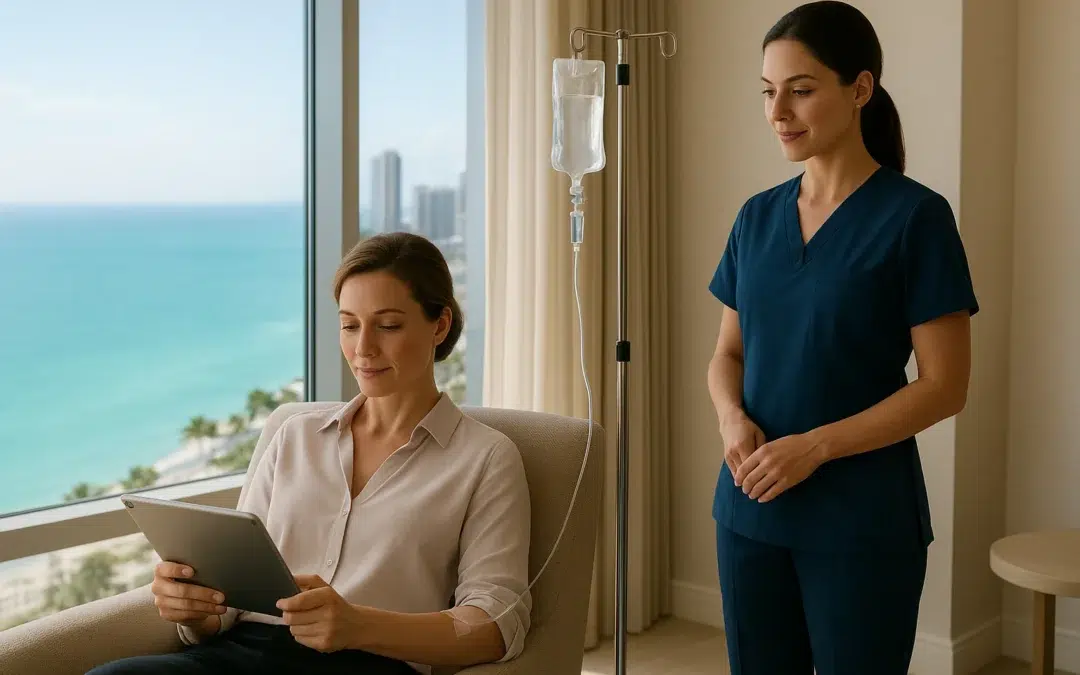
Instead of sleeping immediately (which anchors you to your old time zone), schedule a treatment in the comfort of your hotel room. A Registered Nurse administers the therapy while you unpack or answer emails. By the time the 45-minute session is complete, your cellular hydration is restored, and you are chemically primed to either stay awake until a normal local bedtime or rest deeply, depending on your arrival time.
Safety & Standards: The “Nurse-Only” Mandate
Perhaps the most critical educational gap for international travelers is the “Credentialing Gap.” Who is actually administering these treatments?
In the unregulated pockets of the wellness industry, some services use basic technicians. However, for true safety and clinical efficacy, the gold standard is a Critical Care Nurse.
[]
Top-tier intravene wellness providers exclusively employ Registered Nurses (RNs) with backgrounds in Emergency Rooms (ER) or Intensive Care Units (ICU). These professionals understand vein anatomy, sterile technique, and sign/symptom management far better than a general aesthetician.
When inviting a medical professional into your hotel room or private residence, always verify that they are a licensed nurse. This ensures hospital-level safety in a hospitality setting.
Specific Solutions for the Miami Traveler
Miami attracts a diverse range of visitors, and recovery needs vary by activity.
The Business Executive
If you are here for a conference or high-stakes meeting, brain fog is your enemy. A drip focused on NAD+ or heavy B12 saturation can help sharpen cognitive function.
The Event Attendee
For those in town for festivals, weddings, or the vibrant nightlife, the banana bag iv is a popular choice. Originally used in hospitals for patients with nutrient deficiencies, this bright yellow fluid is famous for rapid recovery from dehydration and exhaustion.
The International Family
Traveling with family often means ignored self-care. Mobile services allow for group treatments, ensuring parents have the energy to keep up with children at the beach or theme parks.
Frequently Asked Questions (FAQ)
Q: Can I get an IV drip directly at my hotel?A: Yes. Mobile IV therapy is designed for this exact purpose. Nurses carry all necessary equipment to turn your hotel room, office, or Airbnb into a private recovery suite.
Q: Is it safe to get an IV after a long flight?A: Generally, yes. In fact, it is often recommended to combat the clotting risks associated with dehydration and immobility. However, you should always disclose your medical history to the administering nurse.
Q: How long does the process take?A: The setup takes a few minutes, and the infusion itself typically lasts 45 to 60 minutes.
Q: Does it hurt?A: Most clients feel only a tiny pinch during the initial insertion. Experienced ER/ICU nurses are experts at making this process virtually painless.
Q: How quickly will I feel better?A: Because the fluids enter the bloodstream directly, many clients report feeling the effects of rehydration immediately during the treatment, with energy levels stabilizing over the following few hours.
Optimizing Your Stay
Don’t let the first two days of your Miami trip be defined by fatigue. By understanding the physiological impact of air travel and utilizing clinical tools like iv therapy miami, you can reset your biological clock and enjoy your stay from the moment you arrive.
Whether you are here to work, relax, or explore, prioritizing your physiological recovery is the smartest travel hack in your itinerary.