

If you’ve ever stepped off a plane at DIA and felt a sudden, inexplicable fatigue settle into your bones, or woke up in your LoDo apartment with a headache that three glasses of water couldn’t touch, you aren’t alone. You are experiencing the “Denver Hydration Gap.”
Living at 5,280 feet requires a physiological playbook that doesn’t exist at sea level. In the Mile High City, hydration isn’t just about drinking water; it’s about bioavailability, timing, and accessibility.
While many residents assume that feeling slightly “off” is just the price of admission for mountain living, the reality is that altitude-induced dehydration is a solvable biological puzzle. This guide explores why traditional hydration methods often fail in Denver’s unique climate and how localized mobile IV therapy is reshaping health and recovery from the suburbs of Aurora to the streets of Cherry Creek.
The Science of 5,280 Ft: Why Water Isn’t Always Enough
To understand why mobile IV therapy has exploded in popularity across the Front Range, you first have to understand the physics of our air. In Denver, the air is significantly thinner and drier than at sea level. This leads to insensible water loss—fluid leaving your body simply through breathing and skin evaporation—at a rate of nearly twice that of coastal cities.
The “Nausea Cycle” and Gastric Shutdown
Here is the critical piece of physiology that most people miss: When your body enters a state of acute dehydration or altitude stress, it often triggers a defense mechanism known as “gastric slowing.” Essentially, your stomach shuts down to preserve energy.
If you are suffering from altitude sickness denver visitors often face, or recovering from a stomach bug, drinking gallons of water can actually be counterproductive. If the gut isn’t moving, that water sits in the stomach, increasing nausea and leading to vomiting, which dehydrates you further.
The IV Advantage: Intravenous therapy bypasses the digestive system entirely. By delivering fluids, electrolytes, and vitamins directly into the bloodstream, you achieve 100% bioavailability. This breaks the nausea cycle immediately, rehydrating the organs without requiring the stomach to do the heavy lifting.
The Neighborhood Recovery Map
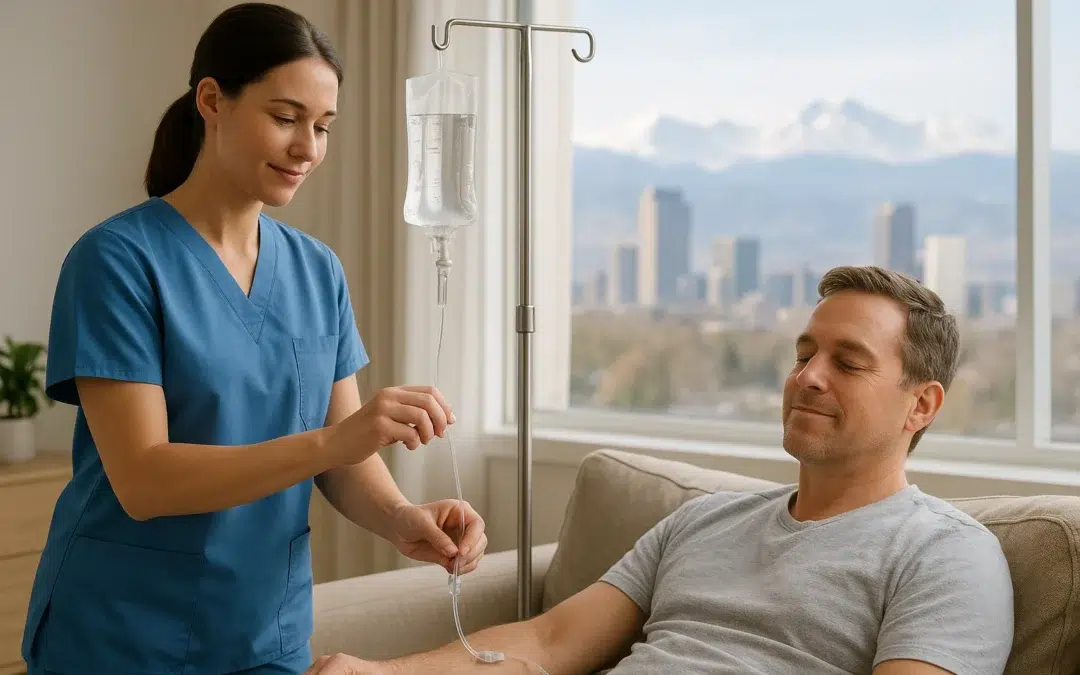
Intravene’s critical care nurses don’t just cover “Denver”—they operate within a hyper-localized network designed to meet the specific lifestyle needs of each neighborhood. Because when you feel terrible, waiting three hours in traffic isn’t an option.
Here is how mobile IV therapy serves the unique ecosystems of our city:
Cherry Creek: The Post-Op & Aesthetic Hub
Cherry Creek isn’t just known for high-end shopping; it is the epicenter of Denver’s cosmetic and elective surgery specialists.
Residents here often utilize mobile IV therapy not for hangovers, but for clinical recovery. After a procedure at a local surgery center, the body’s inflammatory response is high. Mobile nurses frequently assist clients in this area with iv therapy denver protocols focused on high-dose Vitamin C and Glutathione to support wound healing and reduce inflammation.
Recovering in the privacy of your own home, rather than a clinical waiting room, changes the entire healing trajectory.
Downtown & LoDo: The Traveler’s Oasis
Between business conventions at the Colorado Convention Center and weekends at Coors Field, Downtown Denver is high-energy. It is also ground zero for jet lag and altitude adjustment issues.
For business travelers, “brain fog” caused by dehydration can be a deal-breaker. Our Downtown response teams specialize in efficiency, often delivering treatments directly to hotel rooms to help professionals bounce back before their next meeting. This is “productivity hydration”—getting you back to baseline so you can perform at your peak.
Highlands & Wash Park: The Athlete’s Edge
If you live in the Highlands or near Washington Park, chances are your weekend involved a hike, a half-marathon, or a session at Red Rocks.
This demographic faces “exertional dehydration.” You’re sweating out electrolytes faster than sports drinks can replace them. The localized nurses in these neighborhoods often deploy treatments rich in amino acids and magnesium to support muscle recovery and prevent cramping, helping weekend warriors return to training by Monday morning.
The Suburbs: Aurora, Lakewood, and Beyond
In the sprawling suburbs, the need shifts toward family health and chronic care.
- Aurora: Families here often utilize iv therapy near me searches to find relief for cold and flu symptoms spreading through households. Keeping a sick family member at home and bringing the care to them prevents the exhaustion of an urgent care trip.
- Lakewood: With a growing population of seniors and those managing chronic conditions, mobile iv therapy in Lakewood provides a bridge between hospital care and home living, offering support for migraines or dehydration without the hospital admission.
- Northglenn & Thornton: As the metro area expands north, accessibility becomes key. Residents here previously had to drive into the city for premium wellness services. Now, mobile iv units are stationed locally, drastically reducing response times for acute needs.
Mobile IV vs. The “IV Bar” Experience
A common question for newcomers is: “Why shouldn’t I just go to a storefront IV clinic?”
There is a time and place for an iv bar denver social experience. However, when you are truly feeling unwell—whether from a migraine, food poisoning, or severe dehydration—the last thing you want to do is get in a car, find parking, and sit in a bright room with strangers.
Intravene brings the clinic to you. This offers three distinct advantages:
- Privacy: Discuss your health history in your own living room.
- Comfort: Receive treatment while lying in your own bed.
- Safety: You aren’t exposing yourself (or others) to germs in a public waiting area.
The Safety Protocol: Why Credentials Matter
Not all mobile IV services are created equal. In an unregulated market, it is vital to ask: Who is holding the needle?
At intravene, we adhere to a standard that exceeds industry norms. Our treatments are administered by Critical Care Nurses—RNs with backgrounds in the ER and ICU.
Why does this matter?A critical care nurse is trained to spot red flags that a less experienced provider might miss. They understand emergency protocols, medication interactions, and cardiovascular health. When a mobile nurse arrives at your door, they bring hospital-level clinical judgment with them.
Frequently Asked Questions
Is mobile IV therapy safe?
Yes, when performed by licensed medical professionals. Intravene operates under strict medical direction, and all nurses are highly trained in vascular access and patient safety.
How quickly can a nurse get to me?
Response times vary based on demand and location, but because our nurses are stationed throughout the Denver metro area (rather than dispatching from a single central office), we can often arrive within 1–2 hours.
Does insurance cover this?
Most mobile IV therapy is an out-of-pocket wellness service. However, many clients successfully use HSA (Health Savings Account) or FSA (Flexible Spending Account) cards to pay for treatments that are medically necessary for hydration and recovery.
What if I have hard-to-find veins?
This is where the “Critical Care” difference shines. Our nurses are experts at difficult vascular access, a skill honed in emergency rooms where dehydration often collapses veins.
Closing the Hydration Gap
Whether you are recovering from surgery in Cherry Creek, battling altitude sickness in a Downtown hotel, or looking to boost your immune system in Aurora, the solution is closer than you think.
Living in Denver shouldn’t mean living with chronic dehydration. By leveraging a network of localized, critical care nurses, you can access hospital-grade hydration without leaving your home.
Ready to feel better? Check availability in your neighborhood today.