

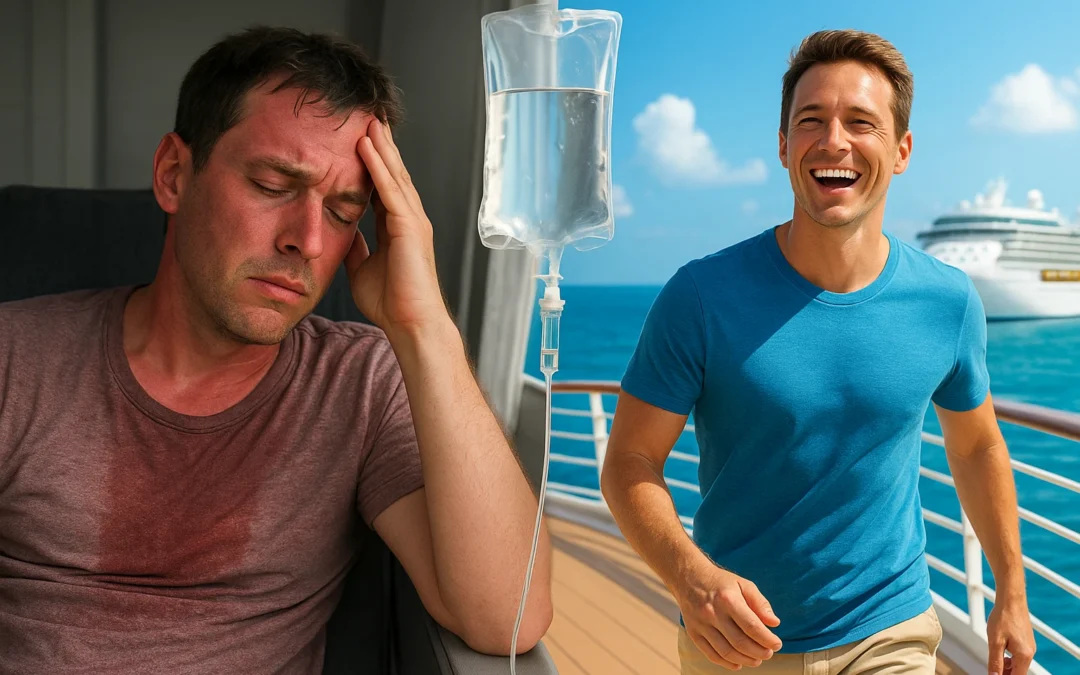
Picture this: It’s Day 3 of your highly anticipated Caribbean cruise. You packed your SPF 50, stayed in the shade when you could, and drank bottled water during your shore excursion. Yet, you wake up in your cabin feeling completely drained. Your skin is radiating heat, a dull headache throbs behind your eyes, and a wave of nausea hits you every time you try to stand up.
If this sounds familiar, you aren’t alone. Severe sun exposure and heat exhaustion are the hidden culprits that frequently derail tropical vacations. Millions of travelers try to bounce back using aloe vera and sports drinks, but often find themselves confined to their cabins while their families enjoy the pool deck.
To truly understand how to recover, we have to look past the surface-level remedies and explore the fascinating science of travel physiology. Let’s dive into why tropical cruises create the “perfect storm” for heat illness, and how clinical interventions like IV therapy can rescue your vacation.
The Tropical Cruise “Perfect Storm”
Why do sunburns and dehydration seem to hit so much harder at sea than they do at home? It comes down to three unique environmental stressors:
- Ocean UV Amplification: The ocean acts like a giant mirror. Water reflects and magnifies ultraviolet radiation, increasing your actual UV exposure by 10% to 15%.
- Insensible Fluid Loss in Your Cabin: Cruise ship cabins rely on heavily air-conditioned, recirculated air. This aggressively dry environment strips moisture from your body while you sleep—often up to 1.5 liters of water overnight—without you ever breaking a sweat. If you’ve been wondering [what’s the best way to stay hydrated on the cruise ship], understanding this overnight fluid loss is the critical first step.
- The Excursion Exertion: Combine the tropical heat index of ports in the Bahamas or Cozumel with physical shore excursions and vacation cocktails, and your body’s fluid reserves are depleted faster than you can naturally replace them.
The Science of Sunburns: The Vascular-Dermal Fluid Shift
Here is an “aha moment” that changes how most people view sunburns: a severe sunburn isn’t just a skin injury—it is a systemic dehydration event.
When intense UV rays inflict cellular damage on your epidermis, your body sounds the alarm. It releases inflammatory chemicals like histamines and prostaglandins. In response, your blood vessels dilate (widen) to rush healing nutrients to the damaged skin.
This causes a phenomenon known as the vascular-dermal fluid shift. Plasma fluid is actively redirected out of your internal cardiovascular system and shunted into your skin tissues, causing that tight, swollen, edematous feeling. Because all this fluid has rushed to your skin, your central circulatory system is suddenly left severely dehydrated (a state called internal hypovolemia). This is exactly why a bad sunburn makes you feel dizzy, deeply fatigued, and nauseated.
The Hydration Bottleneck: Why Drinking Water Isn’t Enough
When heat exhaustion and sunburn strike, the instinct is to chug liters of ice water. But you might have noticed that this often leads to a bloated stomach or even vomiting. Why?
It all comes down to your body’s biological absorption limit. Under normal conditions, your stomach can only process and absorb about 200 to 400 milliliters of fluid per hour. When you are suffering from thermal distress, your body enters a “fight or flight” state, pulling blood away from your digestive tract (splanchnic vasoconstriction) to cool your skin and protect your brain. This further slows your digestion.
Many travelers ask, [does liquid iv help sunburn] recovery? While oral electrolyte powders are excellent for mild daily maintenance, they are still limited by this exact stomach bottleneck. You simply cannot drink fluids fast enough to outpace severe internal dehydration.
Intravenous (IV) therapy bypasses the gastrointestinal tract entirely. Instead of waiting hours for your stomach to slowly absorb fluids, a specialized IV can safely deliver 1,000 milliliters of isotonic hydration directly into your bloodstream in just 30 to 45 minutes, immediately restoring your central blood pressure and relieving that dizzy, fatigued feeling.
Decoding the Rescue IV: What Actually Helps Your Body Recover
Not all hydration is created equal. A clinical-grade sunburn and [iv for heat exhaustion] recovery drip isn’t just saline; it is a highly specific matrix of compounds designed to address the biochemical damage caused by UV rays and high heat.
Here is a breakdown of what highly trained critical care nurses look for in a recovery formulation:
Base Isotonic Fluids (Lactated Ringer’s or Normal Saline)
These fluids perfectly match the concentration of your blood. They instantly re-expand your vascular volume, improving blood flow to your kidneys and restoring your body’s ability to sweat and cool itself.
Anti-Inflammatories (Toradol/Ketorolac)
This is a powerful, non-steroidal anti-inflammatory medication. It works by blocking the COX-1 and COX-2 enzymes, abruptly shutting down the body’s synthesis of prostaglandins. The result? The radiating heat, fever, and burning pain of a severe sunburn are significantly reduced almost immediately.
Master Antioxidants (Glutathione & Vitamin C)
UV radiation causes massive “oxidative stress,” depleting your skin’s natural defenses.
- Ascorbic Acid (Vitamin C) acts as an essential building block for collagen synthesis, helping your damaged skin begin to repair itself while neutralizing dangerous free radicals.
- Glutathione is the body’s master intracellular antioxidant. It actually inhibits an enzyme called tyrosinase, which can help prevent the long-term hyperpigmentation (dark spots) associated with severe sun damage.
Electrolytes & Anti-Nausea (Magnesium, Zinc, & Zofran)
- Magnesium and Zinc help calm muscle cramping associated with heat exhaustion and accelerate the healing of the epidermal skin layer.
- Ondansetron (Zofran) blocks the signals in your brain that cause nausea, allowing you to finally stomach a meal and get back to enjoying your cruise.
Navigating Mobile IVs on a Cruise: Logistics and Ports
One of the biggest areas of confusion for cruisers is how and where to access medical-grade IV hydration. Let’s clear up the maritime logistics.
1. The 72-Hour Pre-Embarkation Window
The best defense is a good offense. Many proactive travelers book an IV session 24 to 48 hours before boarding the ship at their departure port hotel (such as Miami, Fort Lauderdale, or Port Canaveral). Flooding your system with antioxidants like Vitamin C and Glutathione before setting sail “primes” your cells to handle the upcoming oxidative stress of ocean UV rays.
2. Port-of-Call Realities
Can a mobile nurse come directly to your cruise cabin while the ship is docked? Due to strict maritime security laws, customs regulations, and state nursing jurisdictions, outside medical personnel generally cannot board a commercial cruise ship. However, cruisers frequently arrange a [mobile iv boat dock] meeting or head to a nearby port hotel or local clinic in destinations like Nassau, San Juan, or Miami during their shore excursions to receive specialized care from locally licensed critical care nurses.
3. Onboard Options
If you are already out at sea, you have two main options. The ship’s medical center is equipped to handle severe dehydration, though this usually comes with high out-of-pocket costs and feels distinctly clinical. Alternatively, some modern cruise lines now feature wellness IV stations in their luxury spas. If you are comparing an outside medical service to [iv fluids ncl ships] or other onboard spas, remember that spa menus are often focused on general wellness (like B12 boosts) rather than targeted medical relief for acute heat illness using prescription non-steroidals or anti-nausea medications.
Emergency Triage: Heat Exhaustion vs. Heat Stroke
It is vital to know when a mobile IV or spa treatment is appropriate, and when you are facing a true medical emergency that requires the ship’s emergency medical team. Use this basic triage framework:
Heat Exhaustion (Treatable with Rest, Shade, and IV/Oral Hydration)
- Heavy sweating
- Cold, pale, or clammy skin
- Fast, weak pulse
- Nausea or vomiting
- Muscle cramps
- Dizziness and headaches
Heat Stroke (Medical Emergency – Call 911 or Ship’s Medical Center)
- No sweating (Skin is hot, red, and completely dry)
- Body temperature of 103°F (39.4°C) or higher
- Fast, strong pulse
- Confusion, slurred speech, or altered mental state
- Loss of consciousness
Note: If you suspect heat stroke, do not wait. Alert the cruise staff immediately.
Frequently Asked Questions (FAQ)
Can an IV cure my sunburn?No medical treatment can “cure” or reverse the DNA damage done to your skin cells by UV rays. However, targeted IV therapy rapidly eliminates the systemic dehydration caused by the sunburn, drastically reduces the burning inflammation, and provides the raw cellular building blocks your body needs to heal the skin faster.
Is IV therapy safe if I’ve been drinking alcohol on my cruise?Alcohol acts as a diuretic, further compounding vacation dehydration. Rehydrating is generally very safe and highly beneficial after drinking. However, a qualified critical care nurse will always assess your vital signs and recent alcohol intake before administering specific medications (like anti-inflammatories) to ensure your liver and kidneys can process them safely.
How long do the benefits of a recovery IV last?The immediate relief from dehydration and nausea is typically felt within the hour. The anti-inflammatory medications (like Toradol) actively suppress pain and fever for 6 to 8 hours, breaking the inflammatory cycle so you can sleep comfortably. The antioxidants will remain active in your system for several days, supporting ongoing tissue repair.
Keep Your Vacation Afloat
A tropical cruise should be remembered for breathtaking sunsets and pristine waters, not the days spent recovering in a dark cabin. Understanding how your body reacts to the “perfect storm” of cruise ship environmental factors empowers you to make smarter travel health decisions.
Whether you opt for a pre-cruise hydration primer to flood your body with antioxidants, or you find yourself needing rapid relief after a long day under the Caribbean sun, knowing the science behind your symptoms is the first step toward feeling your best. When surface-level remedies fall short, clinical-grade hydration overseen by experienced medical professionals can be the anchor that saves your hard-earned vacation.