
Imagine waking up with a debilitating migraine, intense food poisoning, or severe exhaustion after a grueling shift. The last thing you want to do is navigate traffic, find parking, and sit in a bright, crowded clinic waiting room. When you’re suffering, your environment is everything. You don’t just need relief; you need it brought directly to your living room.
This is the exact problem that high-quality mobile iv delivery solves. However, when people first begin searching for at-home medical support in a mid-sized, geographically diverse city like Tacoma, Washington, they run into a wall of logistical questions.
Will they come to my specific neighborhood? Can a nurse actually set up an IV safely in my 100-year-old Craftsman home? Who is actually showing up at my door?
Whether you’re in the historic North End, the bustling Proctor District, or the hills of Hilltop, understanding the operational mechanics of iv therapy tacoma can help you make informed, safe decisions about your wellness. Let’s look behind the curtain at how professional mobile medical dispatch actually works.
Overcoming “Geofriction”: Dispatching Medical Care to Your Street
When you urgently need hydration, you aren’t looking for vague city-wide promises. You want to know if a provider can navigate your exact street. In the mobile healthcare industry, overcoming “geofriction”—the barriers of local traffic, topography, and distance—is a science.
Tacoma’s unique layout requires strategic dispatching. Providers utilizing intelligent mapping track the flow of I-5, Pearl Street, and Schuster Parkway to optimize arrival times, usually reaching patients within a standard two-hour window.
But what about the physical delivery itself? Consider the distinct zones of Tacoma:
- The North End’s Historic Homes: Many homes in the North End feature narrow street parking, historic staircases, and unique floor plans. Top-tier providers arrive with completely self-contained, lightweight medical kits designed to be mobile and unobtrusive.
- Proctor District Apartments & Condos: For residents in secure-entry complexes or modern developments around Point Ruston, mobile nurses are trained to smoothly navigate concierge desks and elevators while maintaining the integrity of their clinical supplies.
- Hilltop’s Medical Corridors: Proximity to major medical centers like MultiCare Tacoma General means dispatchers frequently coordinate same-day appointments around the unpredictable schedules of local shift workers living in the area.
Creating a Sterile Clinical Environment on Your Couch
A common question beginners ask when researching home healthcare is: how do mobile iv drip services compare for safety? It’s a completely valid concern. How can a medical professional maintain a sterile clinical environment inside a bustling office or a cozy residential parlor?
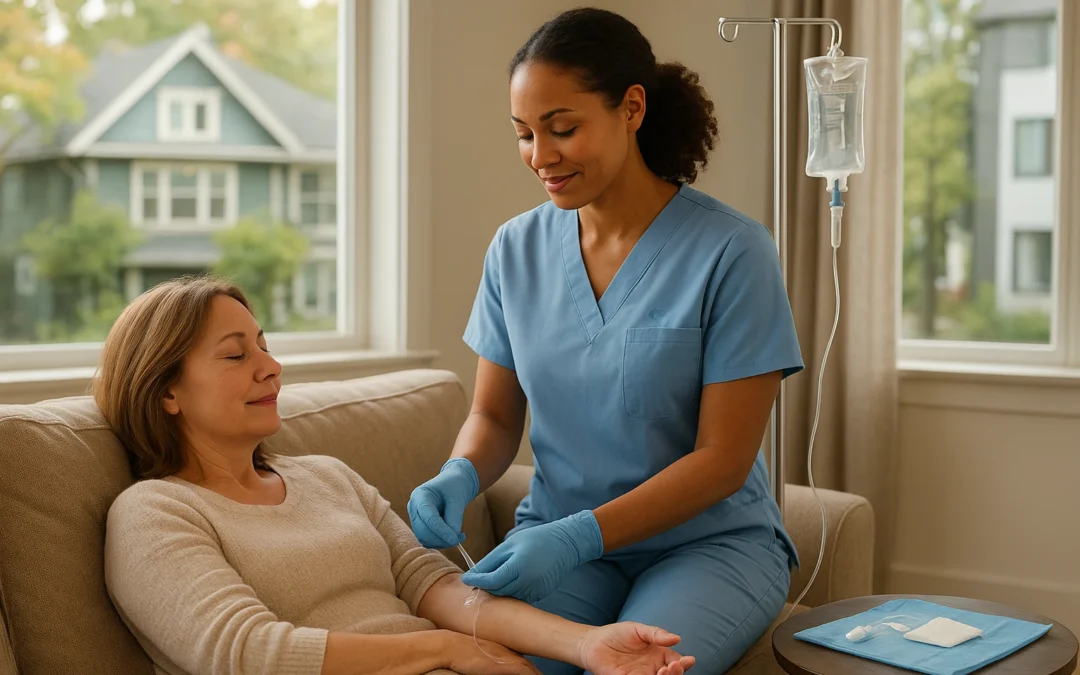
The secret lies in rigorous, standardized protocols. When a qualified ICU or ER critical care nurse arrives at your location, they perform a choreographed routine to turn any domestic space into a temporary sterile field:
- Sanitization: The immediate workspace (like a side table) is sanitized.
- Clinical Drape: A sterile drape is laid out to hold medical supplies.
- Single-Use Kits: All equipment used is individually packaged, sterile, and single-use, matching the exact safety standards of a clean hospital room.
From safety criticals kent to standardized protocols down through Tacoma and olympia iv therapy coverage areas, this uncompromising clinical rigor is what separates premium medical services from casual “spa-grade” aesthetics.
The Physiology of Dehydration and the “Difficult Stick”
When a body is severely dehydrated—whether from an aggressive stomach bug, altitude sickness, or running miles along Ruston Way—a physiological response occurs. Peripheral veins tend to constrict and “collapse,” retreating to preserve core blood volume.
This makes standard IV insertion incredibly difficult. Generalist injectors or those without acute care experience often struggle in these scenarios, leading to multiple painful punctures.
This is why the credentials of your mobile nurse matter immensely. Critical Care Registered Nurses (RNs with extensive Emergency Room or Intensive Care Unit experience) are masters of vascular access. They understand the science of the “difficult stick,” utilizing advanced techniques to ensure a painless, single-stick placement even when you are severely dehydrated.
Understanding Cold-Chain Medical Transport
Beyond the skill of the nurse, the integrity of the treatment itself is paramount. Delicate nutrients, such as Vitamin C and Glutathione, can rapidly degrade when exposed to heat and UV light. Professional mobile IV providers utilize “cold-chain” medical transport protocols. This means your pharmaceutical-grade formulations are kept temperature-controlled from the compounding pharmacy all the way to your living room, ensuring maximum efficacy upon delivery.
Neighborhood Use Cases: Why Tacoma is Calling
Different areas of the city lean on mobile hydration for entirely different reasons. Here is a look at the health profiles driving the demand in Tacoma’s key districts:
North End & Ruston Way: Athletic Recovery
Runners and cyclists pushing their limits along Point Defiance and Ruston Way often underestimate their sweat rate. When oral water intake can’t keep up with electrolyte depletion, lactic acid builds up, leading to severe cramping and exhaustion. Direct IV rehydration allows these athletes to bypass the digestive tract, instantly restoring cellular balance and speeding up muscle recovery.
Proctor District: Seasonal Wellness & Travel Preparation
In family-dense neighborhoods like Proctor, seasonal bugs spread fast. Furthermore, busy professionals frequently seek immune-boosting treatments (like High-Dose Vitamin C and Zinc) right before or immediately after grueling business travel to combat jet lag and airport exposure.
Hilltop: The Shift Worker’s Reset
Hilltop is the heart of Tacoma’s hospital district (Tacoma General and St. Joseph Medical Center). Shift workers here regularly face 12-hour overnight rotations, leading to adrenal fatigue and chronic dehydration. Being able to schedule a restorative IV drip between shifts is becoming a vital burnout-prevention tool for the city’s healthcare heroes.
Frequently Asked Questions About Home Clinical Care
Does it cost extra to have a nurse travel to my home?High-quality medical dispatch services value transparency. Typically, providers structure their pricing as a flat rate that covers the treatment, the dispatch, and the nurse’s expertise, meaning there are no hidden travel fees. If you’re comparing options, exploring standard mobile iv cost models can help set your baseline expectations.
Can I get an IV if I live in a hard-to-find apartment complex?Absolutely. Specialized nurses are highly accustomed to navigating secure entries, elevator banks, and complex apartment layouts. Simply provide clear entry instructions when booking.
Are the ingredients mixed on-site?For safety and sterility, premium providers utilize pharmaceutical-grade compounding. While the base hydration fluid is standardized, specific vitamins and medications are often drawn and integrated meticulously by your critical care nurse at your location, ensuring freshness and adherence to safety protocols (similar to the rigor found in iv medication therapy auburn).
Can they treat complex health conditions at home?While mobile IV therapy is excellent for rehydration, immunity, hangovers, migraines, and fatigue, it is not a replacement for emergency medical care. A specialized ER/ICU nurse will always conduct a thorough medical history check before your infusion to ensure that home therapy is the safest, most appropriate route for your specific physiological needs.
Taking the Next Step in Your Wellness Journey
Exploring mobile medical care for the first time can feel like learning a new language. But once you understand the logistics of dispatch, the safety of temporary sterile fields, and the critical importance of having an ICU or ER nurse managing your care, the process becomes incredibly reassuring.
You no longer have to accept that recovering from a severe migraine, athletic exhaustion, or an illness requires sitting in a waiting room. Hospital-grade care is more accessible than ever, safely navigating the streets of Tacoma to meet you exactly where you are most comfortable.
If you are curious about how these customized treatments can support your personal health goals, taking time to review the specific vitamin formulations available and discussing your symptoms with a registered clinical provider is an excellent next step. Wellness, after all, shouldn’t be a chore—it should come right to your door.