

You’ve planned the itinerary, packed your bags, and finally stepped onto the pool deck with a drink in hand. For most, a cruise is the ultimate escape. But between the endless buffets, the tropical heat, and the constant rolling of the ocean, a cruise ship can sometimes create a “perfect storm” for gastrointestinal distress.
When your stomach stages a sudden rebellion in the middle of a vacation, panic sets in. You might find yourself confined to a small cabin, or worse, struggling through your travel day home after disembarkation, desperately wondering how to get your body back to baseline.
If you’ve been scouring the internet for rapid recovery solutions, you’ve likely come across the term “Banana Bag.” But what actually is it? When is it the right choice compared to sipping electrolyte water, and how does your body process hydration when you’re dealing with a stomach bug?
Let’s bypass the medical jargon and dive into the fascinating biology of maritime gut recovery, so you can understand exactly what your body needs to bounce back.
The Maritime Gut Dilemma: Why Cruise Illness Strikes Hard and Fast
When you start experiencing nausea, cramping, or sudden fatigue during or immediately after a cruise, identifying the culprit is half the battle. Is it a food sensitivity from that rich seafood dinner? Is it a highly contagious viral bug? Or is your brain simply struggling to process the motion of the ocean?
The confusion surrounding these symptoms is exactly why standard recovery advice often falls short. Traditional clinical sites will often tell you to just sip water and wait it out, while commercial clinics might claim an IV cures everything from a virus to sea legs. The truth, as always, lies in the science of how your body reacts to different triggers—and how dehydration silently compounds every single symptom you experience.
Demystifying the Banana Bag IV: Chemical Composition & Mechanism
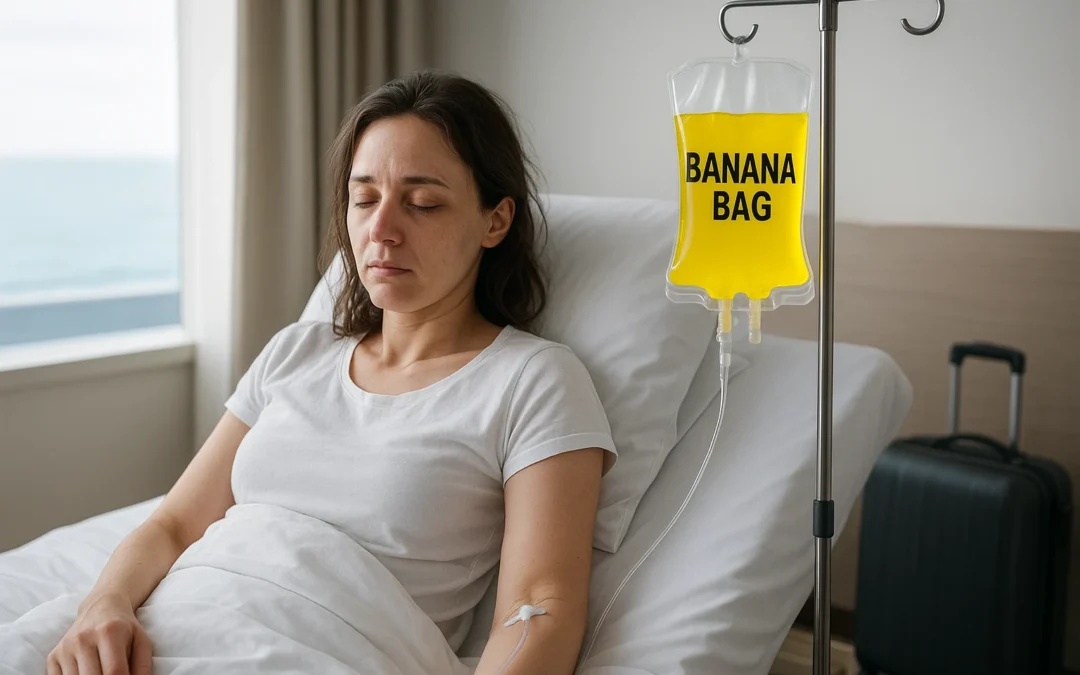
Let’s clear up a common misconception: a banana bag iv does not actually contain bananas, nor is the yellow color a sign of a “magic” cure for toxins.
Historically known in hospitals as a “Rally Pack,” the Banana Bag gets its signature neon yellow hue entirely from B-complex vitamins (specifically Riboflavin). The classic medical formulation consists of:
- Thiamine (Vitamin B1) & Folic Acid (Vitamin B9): Crucial for repairing cellular energy pathways and stabilizing nervous system signaling.
- Magnesium Sulfate: Helps relax smooth muscle tissue, which is incredibly helpful when your stomach is cramping.
- Multivitamin Ampule: A broad-spectrum nutrient boost.
- Normal Saline (0.9%): An isotonic fluid that perfectly matches your blood’s natural concentration to restore volume quickly.
The Modern Travel Medicine Upgrade
While the classic Banana Bag is excellent for basic depletion, modern mobile critical care nurses often upgrade this formulation for travelers. To stop severe stomach spasms and vomiting, specialized medications can be safely added to the fluid. This often includes anti-nausea medications like Zofran (Ondansetron) and targeted antacids like pepcid for food poisoning (Famotidine) to calm acute GI inflammation.
The 4-Front Maritime Sickness Diagnostic Matrix
To understand how to recover, you first need to identify what your body is fighting. Here is a breakdown of the four most common cruise-related illnesses:
1. Norovirus (Viral Gastroenteritis)
- The Threat: Rapid fluid loss. Norovirus is highly contagious and sweeps through enclosed environments quickly.
- The Mechanism: The virus inflames your stomach and intestines, causing violent vomiting and diarrhea.
- The Reality: Hydration is your primary defense. You aren’t just losing water; you are rapidly depleting essential electrolytes.
2. Food Poisoning & Food Sensitivity
- The Threat: Ingested enterotoxins (bacteria) or high histamine levels (often from slightly warm, improperly stored fish, known as scombroid poisoning).
- The Mechanism: Your body initiates an aggressive, acute inflammatory response to purge the toxin.
- The Reality: Unlike a multi-day virus, food poisoning is often a rapid, violent event. Once the toxin is purged, the secondary threat is the severe dehydration left in its wake.
3. Motion Sickness (Seasickness)
- The Threat: A vestibular-visual mismatch. Your inner ear feels movement, but your eyes see a stationary cabin.
- The Mechanism: This sensory conflict triggers central histamine and cholinergic responses in the brain, resulting in severe nausea.
- The Reality: While you might be searching for the best motion sickness medicine for cruise preparation, if seasickness causes prolonged vomiting, secondary dehydration will make the dizziness significantly worse.
4. Land Sickness (Mal de Débarquement Syndrome / MdDS)
- The Threat: Post-cruise neurological adaptation.
- The Mechanism: When you step off the ship, your brain is still compensating for the sway of the ocean. This creates a phantom rocking sensation, brain fog, and postural instability.
- The Reality: Patients frequently search online asking, “why am i so tired after a cruise?” Dehydration drastically worsens this syndrome. When your blood volume drops from travel exhaustion or alcohol consumption, your brain receives less oxygen, magnifying the dizziness and “sea legs.”
The Physiology of Recovery: Why Drinking Water Sometimes Isn’t Enough
If you’re dealing with a mild upset stomach, Oral Rehydration Salts (ORS)—like Pedialyte or Liquid I.V.—are highly effective. But many travelers reach a frustrating point where they drink a glass of water, only to immediately throw it back up. Why does this happen?
It comes down to a biological concept called the Absorption Threshold.
Inside your small intestine, there is a microscopic transport system called the Sodium-Glucose Cotransporter (SGLT1). Think of SGLT1 as a toll booth that moves water and salt from your gut into your bloodstream. When you are suffering from acute food poisoning or a severe stomach bug, the lining of your intestines becomes inflamed and damaged. The “toll booths” shut down.
At this point, oral absorption fails regardless of how much fluid you drink. The water simply sits in your irritated stomach until your body rejects it.
Intravenous (IV) vs. Oral Rehydration
This physiological roadblock is exactly why IV therapy is sometimes a necessity rather than a luxury.
- Time-to-Relief (Oral): If you can keep fluids down, it typically takes 24 to 72 hours for oral rehydration to fully restore cellular fluid balance.
- Time-to-Relief (IV): Intravenous delivery bypasses the GI tract entirely. Because it enters the hypertonic vascular space directly, you achieve 100% bioavailability. Antinausea medications take effect in 5 to 10 minutes, and complete systemic rehydration takes about 30 to 45 minutes.
This rapid turnaround is especially critical when you need an iv for boat party recovery or when you are facing a long flight home the same day you disembark.
Passenger Action Protocol: Triage & Next Steps
Knowing your options empowers you to make safe, effective health decisions while traveling. Here is a practical framework for managing maritime stomach issues.
When to Sip (Oral Rehydration)
If your symptoms are mild, you are not actively vomiting, and you can comfortably hold down 1–2 ounces of water every 15 minutes, standard Oral Rehydration Salts (ORS) are sufficient. Stick to bland foods and give your body rest.
When to Drip (Mobile IV Therapy)
If you have crossed the Absorption Threshold—meaning you cannot keep fluids or oral medications down for more than a few hours—IV therapy is the clinically appropriate next step. Many travelers schedule mobile IV treatments at their hotel or home immediately upon disembarkation to recover quickly. When booking, always look for providers who exclusively utilize critical care-trained nurses (like those with ICU or ER experience) to ensure hospital-level safety protocols.
When to Seek Emergency Care (Red Flags)
Mobile IV therapy is for dehydration and non-emergency symptom relief. You should skip the mobile IV and head straight to an emergency room or the ship’s medical center if you experience:
- A fever exceeding 102°F
- Bloody stool or vomit
- Inability to urinate for more than 12 hours
- Severe confusion, unresponsiveness, or lethargy
Frequently Asked Questions (FAQ)
How quickly does a Banana Bag IV work compared to drinking electrolytes?Because IV therapy bypasses a compromised digestive system, anti-nausea medications typically take effect within 10 minutes. The fluid volume expansion (rehydration) is usually complete within the 45-minute treatment window, compared to the 24+ hours it can take to rehydrate orally during an illness.
Does an IV cure “land legs” after getting off the ship?Many travelers wonder how long does it take to feel normal after getting off a cruise ship. While an IV cannot instantly recalibrate your inner ear’s vestibular system, restoring your body’s blood volume through IV hydration significantly reduces the brain fog, fatigue, and orthostatic dizziness that make “land sickness” feel so debilitating.
Can I get a mobile IV while still on the cruise ship?Commercial mobile IV companies cannot board cruise ships. If you require IV fluids while at sea, you must visit the ship’s onboard medical center. Mobile IV services are incredibly popular, however, for pre-cruise preparation (in your departure city) and post-cruise recovery (at your home or disembarkation hotel).
Continuing Your Wellness Journey
Experiencing a stomach bug or severe food sensitivity on a cruise can be incredibly jarring, but understanding the biology of your symptoms is the first step toward feeling better. By recognizing when your body’s natural oral absorption fails and knowing how targeted hydration works, you can take control of your recovery.
If you are a frequent traveler, cruise enthusiast, or simply someone who wants to understand more about optimizing their body’s hydration, the world of intravenous wellness has a lot to offer. From combating the physical toll of travel to supporting deep cellular energy, prioritizing your internal health ensures you’re always ready for your next adventure.