

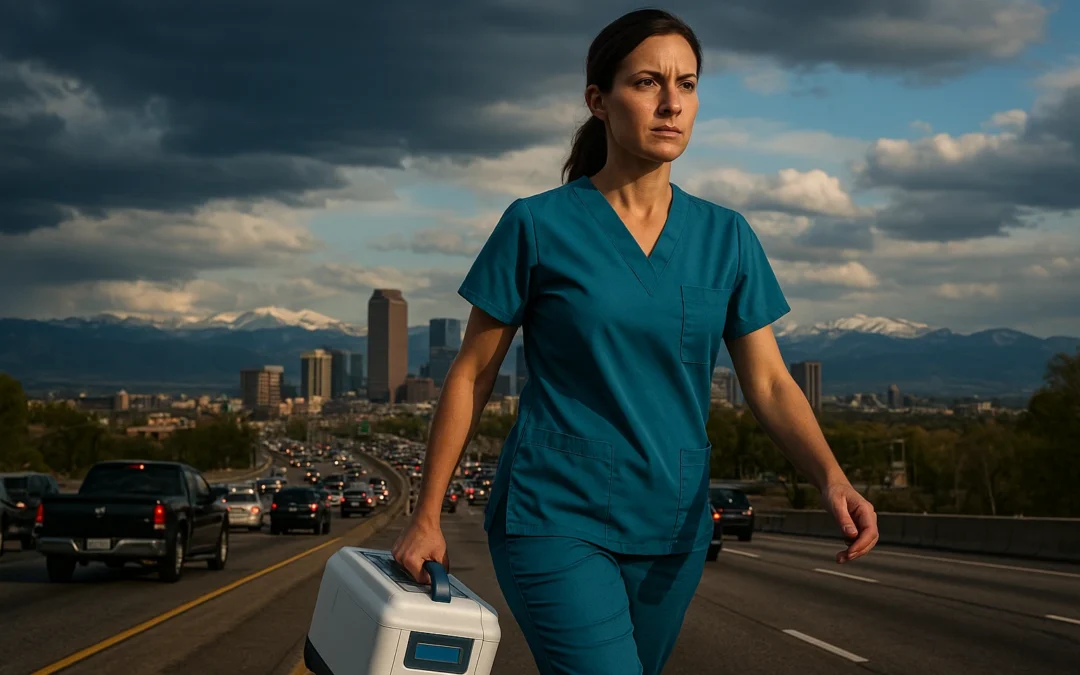
Imagine waking up in your downtown Denver high-rise, or perhaps a cozy home in the foothills. You’re battling severe altitude sickness, a debilitating migraine, or a harsh flu. You know you need rapid hydration, but the thought of driving to an urgent care clinic and sitting in a waiting room for four hours is unbearable.
You pull out your phone and request mobile IV therapy. But as you hit “book,” a question naturally pops into your head: How exactly is a nurse going to get to my couch in under an hour during Friday afternoon rush hour on I-25?
In the rapidly growing world of on-demand healthcare, the simple question of “How quickly can you get here?” masks a highly sophisticated operational puzzle. Delivering hospital-grade intravenous therapy to a client’s living room within a 45- to 60-minute window requires far more than open roads and a GPS app. It requires solving what we call the “Denver Logistics Trilemma”: extreme weather volatility, severe traffic bottlenecks, and stringent clinical safety mandates.
Let’s pull back the curtain on how elite mobile medical teams turn hours of agonizing waiting into rapid, in-home relief.
The Myth of the Single Clinic: Why Decentralized Staging Wins
If you order food delivery, the driver goes to a central restaurant, picks up your meal, and brings it to you. Many people assume mobile medicine works the same way—that nurses are sitting in a central office waiting to be dispatched.
In a sprawling metropolis like Denver, central dispatching is a fatal flaw.
If a nurse is dispatched from an office in Cherry Creek to a patient in Golden, they are already losing the race against time. To achieve true rapid-response care, leading mobile IV services utilize a decentralized “hub-and-spoke” staging architecture.
Rather than working from a single clinic, critical care nurses are pre-positioned in territorial zones across the metro area:
- Zone A (Urban Core): Downtown Denver, LoDo, RiNo, Cap Hill, and the Highlands.
- Zone B (South Metro): Cherry Creek, DTC, Greenwood Village, and Centennial.
- Zone C (West Metro & Foothills): Golden, Wheat Ridge, Arvada, and specialized mobile IV Lakewood deployments.
- Zone D (North & East Metro): Broomfield, Westminster, Stapleton/Central Park, and Aurora.
By dynamically staging nurses in these specific geographic pods, medical teams can shave 40 minutes or more off travel times. When peak regional surges happen—like concert season at Red Rocks or a massive influx of high-altitude tourists—mobile “float” nurses are deployed to back up the busiest zones.
Conquering the Denver Transit Trilemma
Getting a critical care nurse to your door requires mastering the physics of Denver’s unique transit corridors. Eight miles on a Sunday morning might take 12 minutes, but those same eight miles at 4:30 PM on a Friday can take nearly an hour.
The Physics of Denver Corridors
Our local road systems present distinct geographical challenges. The “I-25 Mousetrap” creates brutal North-South commuter bottlenecks. The I-70 West corridor is famous for its Friday westbound and Sunday eastbound ski traffic gridlock. Meanwhile, Foothills connectors like C-470 navigate drastic elevation changes, meaning a route that starts dry at 5,280 feet can quickly turn into freezing rain and blowing snow by the time it reaches 6,800 feet.
Winter Fleet Engineering and CDOT Compliance
So, what happens when a blizzard hits the Front Range? While standard delivery services might shut down, medical logistics must press on safely.
This requires strict adherence to the Colorado Department of Transportation (CDOT) Passenger Vehicle Traction Law (Code 15). Mobile medical fleets are engineered for these conditions, operating AWD/4WD vehicles equipped with All-Weather or Three-Peak Mountain Snowflake (3PMSF) rated tires boasting a minimum of 3/16″ tread depth.
Behind the scenes, dispatchers integrate live CDOT COTrip road camera feeds and algorithmic routing to navigate around black-ice hotspots—such as elevated flyovers or shaded, winding foothill roads.
Vertical Logistics in the Urban Core
Traffic isn’t the only hurdle. If you live in a high-density neighborhood like LoDo or RiNo, there is the “Last 100 Feet” to consider.
This is the “Curb-to-Couch” timeline. When a nurse arrives at a 30-story residential tower, they can’t just walk through the front door. They must navigate loading zone protocols, secure garage clearances, digital gate codes, front-desk concierge check-ins, and elevator transit times. Navigating these urban vertical logistics often requires an operational buffer of 8 to 10 extra minutes.
Clinical Cold-Chain Science: Protecting Your Treatment
Perhaps the most overlooked element of mobile medical logistics is the science of pharmacology preservation. It is one thing to transport a nurse; it is another entirely to transport sensitive medications through extreme temperatures safely.
The Winter Danger: Preventing Hypothermic Shock
Imagine infusing room-temperature IV fluids into a severely dehydrated body on a 15°F Colorado winter day. If crystalloid solutions like 0.9% Normal Saline or Lactated Ringer’s are left in a cold trunk, their temperature plummets. Infusing cold fluids causes the patient to shiver and their peripheral veins to constrict (vasoconstriction), making the treatment highly uncomfortable and sometimes causing veins to collapse.
The Summer Danger: Thermal Denaturation
Conversely, when Denver summer temperatures exceed 95°F, cabin heat can destroy delicate biological compounds. Sensitive antioxidants, peptides, and vitamins—like Glutathione, NAD+, Ascorbic Acid (Vitamin C), and B-Complex—will rapidly degrade and lose their efficacy if exposed to excessive heat.
To solve this, authoritative mobile providers maintain an unbroken “medical cold chain.” Utilizing validated, insulated thermal transport units with digital datalogging, medical teams ensure crystalloids stay at a stable, physiological comfort level (15°C–25°C), while delicate injectables remain perfectly chilled (2°C–8°C) from the depot right up until they enter your arm.
The “Call-to-Couch” Timeline: What Happens in 60 Minutes?
When you feel terrible and request an IV, every minute counts—especially at high altitude where “insensible water loss” and gastric shutdown (when your stomach refuses to absorb oral fluids) can make you feel worse by the second.
Here is the exact anatomy of a rapid-response dispatch:
- Minute 0–10 (Clinical Intake & Triage): Telephonic and digital intake clears your medical history. This is vital to ensure your symptoms are appropriate for elective IV therapy rather than an emergency 911 dispatch.
- Minute 10–15 (Geofenced Assignment): The system identifies the closest staged nurse based on dynamic routing.
- Minute 15–45 (Transit): The nurse navigates optimized routes avoiding CDOT-reported bottlenecks.
- Minute 45–55 (Vertical Navigation): The nurse parks, secures equipment, clears security, and travels to your specific unit.
- Minute 55–60 (On-Site Setup): The critical care RN assesses your vitals, preps the sterile field, and places the line on the first try.
Whether you are looking for IV therapy Littleton or downtown Denver, this finely tuned timeline is what separates premium medical care from standard delivery apps.
How You Can Help Ensure a Speedy Arrival
While routing algorithms and thermal science do the heavy lifting, clients play a massive role in ensuring the fastest possible arrival. Next time you request care, keep this simple playbook in mind:
- Provide detailed access instructions: Note your gate code, specific building entrances, and temporary parking/loading zone locations in your booking notes.
- Alert your front desk: If you live in a secure building, inform your concierge that a medical professional is on the way to prevent lobby delays.
- Secure pets: Ensure dogs and cats are in a separate room so the nurse can immediately establish a sterile environment upon entry.
- Don’t wait for rock bottom: Initiate your booking at the onset of severe symptoms (like early altitude sickness or migraine auras) rather than waiting until you are acutely exhausted.
Frequently Asked Questions (FAQ)
Do mobile IV services operate during Colorado snowstorms and blizzards?Yes. Reputable mobile IV providers operate fleets compliant with CDOT’s Passenger Vehicle Traction Law, utilizing AWD vehicles and specialized winter tires to safely navigate severe weather. However, in extreme emergency declarations, routes may be slightly delayed or rescheduled for safety.
How does a mobile IV nurse get to my home so fast?Leading services do not dispatch from a single central clinic. Instead, they pre-position highly trained critical care nurses in distinct geographical zones around the metro area. When you book, the closest available nurse in your specific zone is dispatched.
Can a mobile IV nurse come to my high-rise apartment in Downtown Denver, RiNo, or Cherry Creek?Absolutely. Mobile medical teams are trained in “vertical logistics.” As long as you provide clear instructions regarding parking, gate codes, and concierge access, they will bring the treatment directly to your apartment couch.
What is the difference between an emergency 911 dispatch and elective mobile IV therapy?Mobile IV therapy provides supportive hydration and micronutrients for non-emergent issues like altitude adjustment, basic illness recovery, and dehydration. It is not an emergency service. If you are experiencing chest pain, unstable vitals, or acute medical distress, you should always call 911 immediately.
Taking the Next Step in Your Wellness Journey
Understanding the logistics behind mobile healthcare transforms a seemingly simple service into a marvel of modern medicine. Delivering high-quality intravenous hydration isn’t just about driving a car; it’s a careful orchestration of clinical triage, high-level geography, cold-chain science, and critical care nursing expertise.
The next time you are feeling under the weather, battling the altitude, or just seeking a proactive wellness boost, you’ll know exactly what it takes to get relief to your door. When you inevitably search for mobile IV therapy near me, look for a provider that doesn’t just promise fast arrival, but has the operational infrastructure, winter-ready fleets, and critical care staff to safely deliver on that promise.