

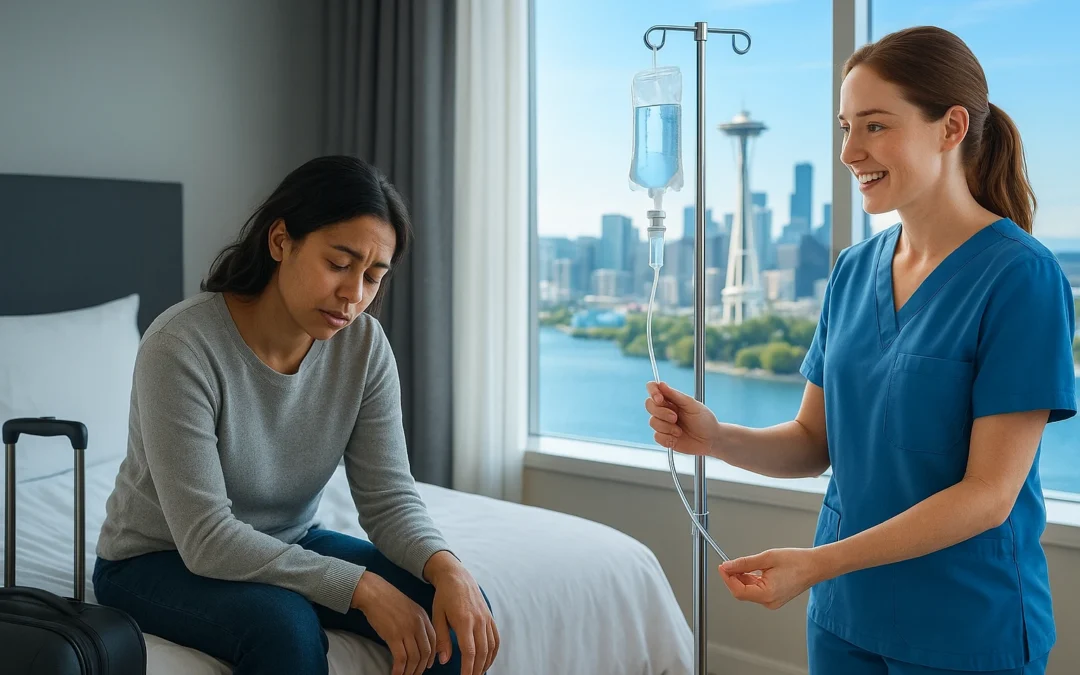
Picture this: You’ve finally landed at Seattle-Tacoma International Airport (Sea-Tac). You’ve navigated the baggage claim, braved the traffic up I-5, and finally dropped your bags in your hotel room in Belltown, Downtown, or South Lake Union.
You’re ready to explore Pike Place Market or grab a coffee at a local roastery, but your body has other plans. Your head is pounding, your skin feels like parchment paper, your muscles ache, and a heavy, inescapable brain fog has set in.
Most travelers chalk this up to simple “jet lag” and try to push through it. But what if the way you’ve been taught to handle post-flight exhaustion is completely wrong?
If you’ve ever found yourself asking, “do hydration drinks help with jet lag or travel fatigue?” while staring at a $9 bottle of water in the hotel lobby, you’re not alone. Let’s dive into the fascinating biology of what actually happens to your body at 35,000 feet, and how understanding the difference between travel fatigue and true jet lag can completely transform your Seattle trip.
The “Airplane Cabin Oasis” Myth: Why You Feel So Awful
When we fly, we tend to think of the airplane cabin as a comfortable, climate-controlled living room in the sky. In reality, your body experiences it quite differently.
Inside Your Body at 35,000 Feet
Commercial airliners circulate air that is incredibly dry. The relative humidity inside a cabin typically hovers around 10% to 15%. To put that into perspective, the Sahara Desert averages about 25% humidity.
With every breath you take on a long-haul flight into Seattle, your respiratory system is working overtime to humidify that bone-dry air, leading to massive “insensible water loss.” On a standard five-hour flight, you can easily lose up to 1.5 to 2 liters of water simply by breathing and existing in that environment.
Add to this the fact that airplane cabins are pressurized to an equivalent altitude of 6,000 to 8,000 feet. This lower atmospheric pressure means less oxygen is entering your bloodstream with each breath, leading to mild hypoxia. It’s exactly why your muscles feel tight, your stomach might feel bloated, and a dull headache starts creeping in right around the time the flight attendants prepare for descent.
Travel Fatigue vs. True Jet Lag: The Dual-Action Crash
Here is the biggest secret in the world of iv travel wellness: Jet lag and travel fatigue are not the same thing.
- Jet Lag is a neurological mismatch. Your brain’s master clock (the suprachiasmatic nucleus) is still operating on your home time zone, while the Seattle sun is telling it something else. Fixing this requires natural light exposure, properly timed sleep, and melatonin alignment.
- Travel Fatigue is a purely physiological strain. It is the systemic dehydration, muscle immobility, mild oxygen deprivation, and physical exhaustion caused by the flight itself.
Can an IV magically reset your brain’s genetic clock? No. Any clinic that tells you otherwise isn’t being honest.
However, travel fatigue acts like a massive roadblock to curing jet lag. You can’t properly adjust to a new time zone when you have a splitting dehydration headache and extreme physical exhaustion. By eliminating travel fatigue instantly, you give your body the physical stamina it needs to conquer jet lag naturally.
The Gut Bypass Advantage: Why Chugging Water Isn’t Enough
The instinct when you arrive dehydrated is to chug gallons of water. But have you ever noticed that drinking water after a long flight just makes you feel bloated and sloshy?
This happens because travel is inherently stressful. When your body is under stress (navigating crowded airports, dealing with turbulence, rushing to connections), your sympathetic nervous system kicks in and releases cortisol. This stress response intentionally slows down gastric emptying—meaning your digestive tract essentially goes on strike.
Water and oral supplements sit in your stomach instead of being absorbed into your bloodstream.
This is where direct vascular replenishment changes the game. By bypassing a sluggish gastrointestinal tract entirely, fluids and nutrients are delivered directly to your cells with 100% bioavailability. Within 30 to 45 minutes, your extracellular volume is restored.
What Your Post-Flight Recovery Actually Needs
When you look into iv therapy seattle options, you’ll notice various menus and ingredient lists. For post-flight recovery, a simple bag of saline is good, but a targeted nutrient synergy is much better:
- The Foundation (Normal Saline or Lactated Ringer’s): Instantly restores your blood volume, flushing out the headache and dry skin.
- B-Complex & B12: Rebuilds your cellular energy metabolism, clearing away the brain fog.
- Magnesium: This is the ultimate travel hack. Magnesium eases the muscle tension from sitting in cramped seats and supports restful, high-quality sleep on your first night in a new city.
- Vitamin C & Glutathione: Flying exposes you to cosmic radiation and recycled air full of airport pathogens. These powerful antioxidants mitigate that oxidative stress.
The Ultimate Seattle Tourist Post-Flight Protocol
Want to maximize your time in the Emerald City? Here is the ideal recovery timeline for travelers landing at Sea-Tac:
Hour 0 (Landing at Sea-Tac): Sip a light electrolyte beverage. Grab your bags and hop on the Light Rail or an Uber to your accommodation. Hour 1–2 (Hotel Check-In): This is the golden window. Rather than taking a disastrous afternoon nap, schedule an in-room session with a provider of intravene mobile iv therapy. Relax on your hotel bed for 45 minutes while your fluids are restored.Hour 3 (Circadian Reset): With your headache gone and energy back, walk outside. Take a stroll along Elliott Bay or through the Olympic Sculpture Park. Natural daylight exposure signals your brain to suppress melatonin, kicking off your true jet-lag recovery.Night 1 (Sleep Realignment): Thanks to the Magnesium from your earlier recovery session, you’ll find it much easier to wind down and sleep on local Pacific Standard Time.
Navigating Hotel Logistics: How In-Room Wellness Works
For first-timers, the idea of having a nurse come to a hotel room can feel unfamiliar. But in Seattle’s major hospitality hubs, it’s a seamless, highly professional process.
When you book, a registered nurse is dispatched to your location—whether you’re in a high-rise in Downtown Seattle, a boutique hotel in Capitol Hill, or an Airbnb in West Seattle.
A note on safety and standards: Not all providers are created equal. Because you are dealing with intravenous fluids, medical oversight is non-negotiable. The highest standard of care comes from services that employ exclusively ER and ICU-trained Registered Nurses. These professionals have thousands of hours of experience with complex vascular access and can properly screen for medical contraindications, like pre-existing heart or kidney conditions.
Hotel concierges are highly accustomed to these discrete wellness visits. The nurse simply arrives with a medical bag, checks in at the front desk if required, and brings the “clinic” entirely to you. You don’t have to spend your first precious hours of vacation sitting in a waiting room.
Frequently Asked Questions (FAQ)
Is mobile IV therapy safe to do right after a long flight?Yes, it is generally very safe and highly beneficial for most healthy adults. Rehydrating is one of the best things you can do post-flight. However, individuals with certain medical conditions (like congestive heart failure or severe kidney disease) should not receive large volumes of IV fluids. A qualified ICU/ER nurse will always perform a brief medical history check before your session.
Will hotel security allow a mobile IV nurse into my room?Absolutely. Mobile wellness is very common in Seattle. You simply let the front desk or concierge know you are expecting a wellness provider, or have the nurse call you from the lobby upon arrival. It is a completely discrete and professional process.
How long does the actual appointment take?The entire process from the time the nurse knocks on your door to the time they leave typically takes about 45 minutes to an hour. The fluid drip itself usually takes 30 to 45 minutes.
Can I use my HSA/FSA card to pay for this?In many cases, yes. While you should always verify with your specific plan administrator, many travelers use their Health Savings Account or Flexible Spending Account cards for hydration therapies, especially if it includes essential vitamins and minerals for wellness recovery.
How do I find a reputable provider when I arrive?When searching for an iv therapy near me, look specifically for providers that boldly advertise their clinical standards. Ensure their team consists of Critical Care (ER/ICU) Registered Nurses rather than basic technicians, and that they operate under the direction of a licensed medical director.
Your Next Steps Toward Better Travel
Travel doesn’t have to mean sacrificing the first two days of your trip to exhaustion and brain fog. By understanding the profound physical impact of cabin pressure, low humidity, and the resulting travel fatigue, you can take control of your recovery.
Before your next flight into Seattle, consider mapping out your recovery protocol in advance. Familiarize yourself with the physiological changes of flying, prioritize direct hydration, and give your body the exact tools it needs to bounce back. The beautiful Pacific Northwest is waiting outside your hotel window—make sure you have the energy to go out and enjoy it.