

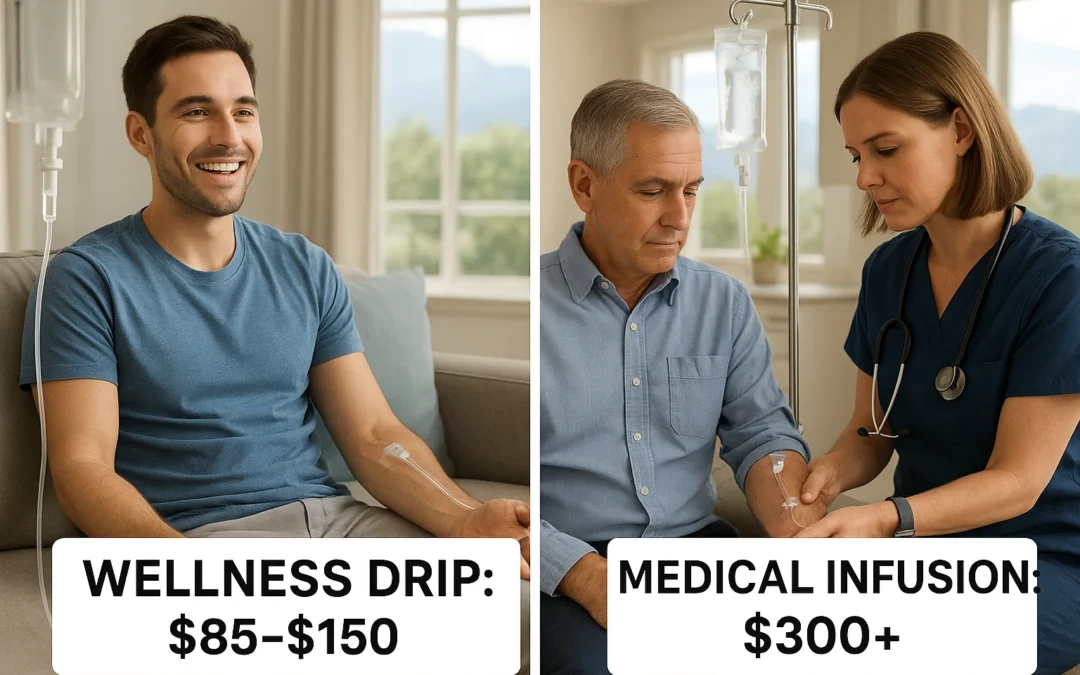
Picture this: You’re recovering from an exhausting weekend hiking the trails near Roxborough State Park, or perhaps you’re navigating the aftermath of an orthopedic joint surgery. You search for mobile IV therapy in Littleton to help you bounce back, and immediately, you’re hit with a wave of confusing numbers. One website advertises a quick drip for $85. Another service quotes $350.
If you’re scratching your head wondering how the exact same service can have a 300% price variance, you aren’t alone. It feels like comparing apples to medical-grade oranges.
The truth is, not all IV therapies are created equal, and understanding the hidden economics of the IV industry is the key to protecting both your wallet and your health. Today, we’re going to pull back the curtain on mobile IV therapy costs in Littleton, CO. We’ll explore the massive difference between a simple wellness drip and a clinical medical infusion, and help you determine exactly what level of care you actually need.
The Littleton Cost Landscape: Why the 300% Price Variance?
If you’ve spent any time looking at local “IV bars” or mobile wellness menus, you’ve likely seen flat-rate memberships or baseline hydration packages. These services are excellent for what they are: elective wellness.
However, a quiet revolution in home healthcare is happening right now, known as OPAT (Outpatient Parenteral Antimicrobial Therapy). OPAT allows patients to receive potent, prescription-grade IV medications—like complex antibiotics—in the comfort of their own homes.
The vast price difference you see online usually comes down to these two entirely different worlds:
- Wellness Hydration ($85–$300): Saline, basic vitamins, Myers’ Cocktails, or hangover recovery blends.
- Clinical Medical Infusions (Variable Cost): Physician-directed antibiotics, biologic infusions, and treatments requiring central line or PICC line access.
When you start looking at clinical infusions, you aren’t just paying for saline. You are paying for raw pharmaceutical costs, specialized medical equipment, and the highest tier of nursing expertise.
The Anatomy of Medical-Grade Costs: Demystifying the Numbers
When your primary care physician or orthopedic surgeon orders a course of home IV therapy, three major factors dictate the cost. Understanding these elements creates a massive “aha moment” for patients who are weighing their options.
1. The Antibiotic Breakdown
While standard vitamins are relatively inexpensive, clinical antibiotics have widely varying wholesale costs.
- Ancef (Cefazolin): This is a low-cost, highly effective workhorse antibiotic (around $15–$45 in raw drug cost per day). It is exceptionally common in Littleton’s active community for patients recovering from joint replacements or orthopedic sports surgeries.
- Rocephin (Ceftriaxone): A standard daily infusion (around $10–$25 drug cost) frequently used for severe UTIs, pneumonia, and Lyme disease.
- Ertapenem (Invanz): This is a broad-spectrum, incredibly potent antibiotic. A single daily vial carries a wholesale drug cost of $100 to $200. When you understand the sheer pharmaceutical cost of the medication itself, a $300 total package price suddenly reveals itself as highly transparent and fair, as it includes the drug, the supplies, travel, and the nurse’s time.
2. The Gear: Gravity vs. Electronic IV Pumps
Most retail IV lounges use a simple “gravity drip”—hanging a bag on a pole and letting gravity do the work. This is perfectly fine for basic saline.
However, potent medical infusions require precise delivery. If a powerful antibiotic enters your bloodstream too quickly, it can cause severe stress to your heart and kidneys. This requires a specialized electronic infusion pump. When researching care, you might wonder about the underlying IV pump cost. Renting or utilizing calibrated, hospital-grade electronic micro-infusion pumps is expensive (often a $50–$150 daily rental value in a traditional home health setting). Premium clinical mobile IV providers include this advanced equipment in their baseline rates to guarantee your safety.
3. The Credentials: Who is Holding the Needle?
This is arguably the most critical factor in mobile IV pricing. What does it actually take to administer an IV?
The basic IV therapy certification cost for a standard registered nurse or medic can be as low as $150 to $500 for a weekend course. But there is a monumental difference between a newly certified provider and an Intensive Care Unit (ICU) or Emergency Room (ER) nurse.
If you look at national medical benchmarks—from the safety criticals kent hospitals monitor to Littleton’s local health guidelines—clinical safety always comes down to who is managing your care. High-acuity ICU and ER nurses have thousands of hours of experience managing complex central lines, recognizing immediate signs of anaphylaxis, and preventing vein trauma. You aren’t just paying for someone to insert a needle; you are investing in a critical care expert who brings the safety of the hospital directly to your living room.
Cost-Benefit Analysis: Mobile OPAT vs. The Hospital
When you are prescribed a multi-day course of IV antibiotics, you generally have three choices: stay in the hospital, visit an outpatient clinic daily, or use mobile home infusions.
Let’s look at the hidden costs of a traditional clinic or hospital visit:
- The Obvious Costs: ER co-pays, hospital room board, and facility fees.
- The Hidden Costs: Taking time off work daily to commute, transportation expenses, and the physical exhaustion of traveling while sick.
- The Risk Factor: Increased exposure to hospital-acquired infections.
By transitioning to home medical IVs, patients routinely save an average of $1,500 to $4,000 per course of therapy compared to standard hospital outpatient infusion suites. Plus, you get to recover in your own bed.
Naturally, a major question that arises is navigating mobile iv insurance policies. While elective wellness drips (like a hangover cure) are generally out-of-pocket, prescribed OPAT antibiotics are often eligible for HSA/FSA funds, and many patients successfully submit superbills to their insurance for out-of-network reimbursement.
Practical Checkpoints: Are You Getting What You Pay For?
Before booking a mobile IV service, use this quick checklist to ensure you are receiving appropriate clinical value:
- Ask about the nurse’s background: “Do your nurses have active ICU or ER experience, or just a basic IV certification?”
- Ask about the equipment: “For my prescribed antibiotic, will you be using an electronic infusion pump or a gravity drip?”
- Ask about transparency: “Can you break down the cost of the medication versus the cost of the administration?”
Whether it’s active individuals seeking iv therapy broomfield recovery after a marathon, or snowbirds looking for reliable iv therapy st pete services during their winter travels, the standard of care should never waver. When researching intravene mobile iv therapy, you’ll find that deploying exclusive critical care nurses is the foundational standard for safe, clinical-grade home recovery.
Frequently Asked Questions (FAQ)
How much does a basic IV drip cost near me?
In the Littleton and greater Denver area, a standard wellness hydration drip typically ranges from $85 for basic saline to around $190-$250 for comprehensive vitamin blends like the Myers’ Cocktail.
Does insurance cover IV therapy?
It depends entirely on the type of therapy. Elective wellness drips for energy or hydration are rarely covered by standard insurance (though HSA/FSA cards are often accepted). However, if you are receiving physician-prescribed clinical infusions (like OPAT antibiotics), you can often submit a detailed receipt (superbill) to your insurance for reimbursement.
Why is mobile IV therapy so much more expensive than drinking water?
Drinking water relies on your gastrointestinal tract to absorb fluids and nutrients, which takes hours and loses significant efficacy along the way. IV therapy delivers 100% bioavailability directly into your bloodstream. The cost reflects the sterile medical supplies, the customized compounding of vitamins or medications, and the direct time of a highly specialized medical professional traveling to your location.
Can I safely get Ancef or Ertapenem administered at home?
Absolutely. Outpatient Parenteral Antimicrobial Therapy (OPAT) is a well-established medical practice. As long as the provider utilizes electronic IV pumps for safe delivery rates and employs high-acuity nurses capable of monitoring your vital responses, receiving complex antibiotics at home is both safe and highly cost-effective.
Your Next Steps on the Wellness Journey
Understanding the true cost and value of mobile IV therapy is the first step toward advocating for your own health. If you are preparing for an orthopedic surgery, recovering from a severe infection, or simply looking to optimize your wellness routine, you don’t have to navigate these choices alone.
We encourage you to speak with your Littleton primary care physician or surgeon about the possibility of home IV therapy for your next treatment. By demanding price transparency and requiring critical care nursing standards, you ensure that your road to recovery is as safe, comfortable, and efficient as possible.