

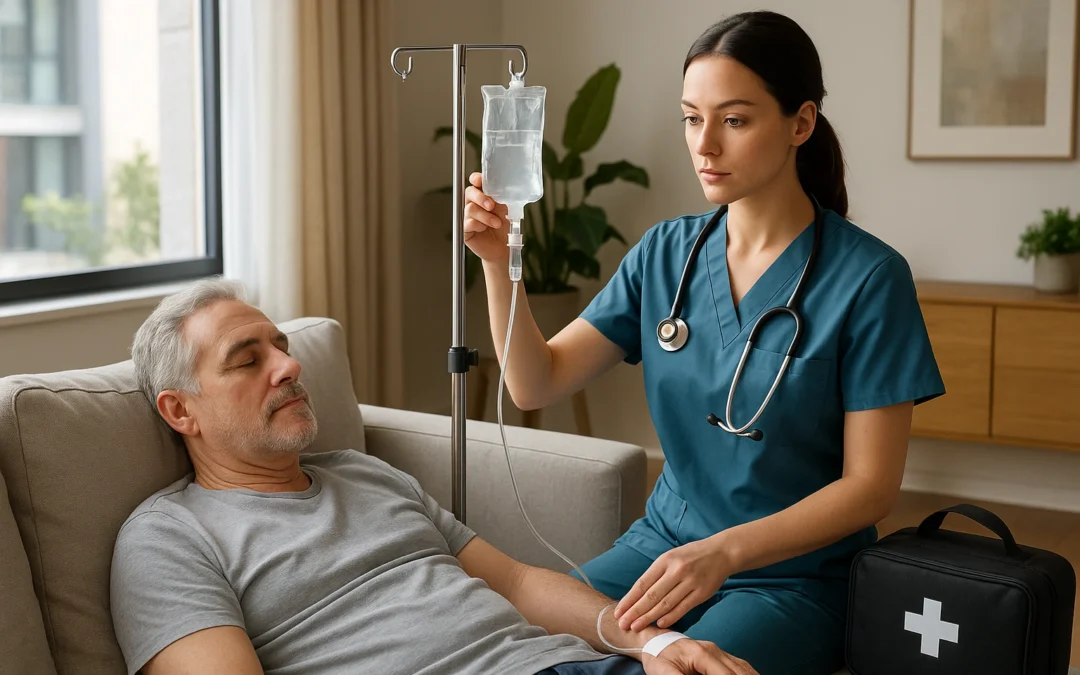
Picture this: You’re relaxing on your living room couch in Seattle, watching the rain tap against the window. You’ve just scheduled a mobile IV therapy session to bounce back from a long travel week or to gear up for marathon training. When the nurse arrives, it feels incredibly convenient—almost like a boutique spa treatment delivered right to your door.
But here is a truth that is rarely talked about in the wellness space: an intravenous drip is not a spa service. It is a real medical procedure.
When you introduce fluids, vitamins, or medications directly into your bloodstream, your body responds instantly. Most of the time, that response is a wave of refreshing relief. But what happens if something unexpected occurs? What if you feel faint, or your body doesn’t react well to a specific vitamin? Who is inserting that needle, and exactly how equipped are they to handle a medical complication in your living room?
Today, we’re pulling back the curtain on mobile IV safety. We’ll explore the critical emergency medical protocols, the advanced training required to administer IVs safely at home, and why having a critical care nurse by your side transforms natural anxiety into absolute clinical trust.
The “Clinical Eye”: Why 90% of Emergencies Never Happen
The most effective emergency response isn’t a dramatic, fast-paced intervention—it’s preventing the emergency before it ever starts.
When an Intensive Care Unit (ICU) or Emergency Department (ED) nurse walks into your home, they bring something standard providers don’t: the “clinical eye.” They have spent thousands of hours managing life-or-death instability in hospitals, which gives them a distinct ability to spot subtle warning signs.
Before a single drop of fluid is administered, critical care nurses at Intravene execute a Pre-Infusion Defense protocol. This includes:
- Organ-System Screening: A thorough review of your medical history, specifically looking at heart and kidney function, to ensure your body can safely process rapid hydration.
- Baseline Vital Sign Collection: Recording your blood pressure, heart rate, oxygen saturation ($SpO_2$), and respiratory rate. This provides a baseline so the nurse knows exactly what is “normal” for you.
- Master-Level Vein Selection: Using strict aseptic (sterile) techniques to select the right vein. This prevents infection and avoids infiltration (when fluid accidentally leaks into surrounding tissue instead of the vein).
By continuously observing your breathing depth, skin perfusion (color and warmth), and mental clarity, a critical care nurse can stop potential complications before you even realize something might be off.
BLS vs. ACLS: Decoding the Alphabet Soup of Nurse Credentials
If you’ve looked into healthcare credentials, you’ve probably seen acronyms like BLS and ACLS. In a hospital, there’s an entire team of doctors and specialists down the hall. In your living room, the nurse is the entire team. That makes these certifications non-negotiable.
Here is the difference and why it matters in a home care setting:
BLS (Basic Life Support) BLS is the foundational safety net. It ensures that a provider has immediate mastery of airway management, rescue breathing, high-quality CPR, and AED (defibrillator) operation. In a residential setting, BLS means the nurse can physically sustain your vital functions during a sudden cardiac or respiratory event.
ACLS (Advanced Cardiovascular Life Support) This is where critical care nurses truly separate themselves from the pack. ACLS enables advanced clinical judgment. An ACLS-certified ICU nurse doesn’t just react to a heart stopping; they recognize the subtle, early life-threatening dysrhythmias (irregular heartbeats) and sudden hemodynamic shifts (blood pressure drops) that happen before an emergency peaks. They know the exact timing for emergency medications and how to stabilize a patient autonomously.
Inside the Emergency Decision Matrix: Step-by-Step Protocols
So, what exactly is the clinical sequence if you experience a complication at home? Mobile IV providers shouldn’t hide behind vague “we have protocols” claims. Here is a transparent look at the exact algorithms critical care nurses follow for unexpected events.
Scenario 1: Vasovagal Syncope (Fainting)
Fainting at the sight of a needle or during an IV insertion is a common, usually harmless reflex. However, it requires immediate management to prevent injury.
- The Protocol: The nurse instantly pauses the infusion and retracts the needle if necessary. You are placed in a supine position (laying flat) with your legs elevated—a technique known as the Trendelenburg position—to rush blood flow back to your brain.
- The Follow-Up: The nurse applies a cold compress to your neck or forehead, continuously monitors your airway, and tracks your blood pressure until it fully recovers to your pre-infusion baseline.
Scenario 2: Severe Allergic Reaction (Anaphylaxis)
Though incredibly rare, a severe allergic reaction to a vitamin or medication requires immediate, decisive action.
- The Protocol: The nurse halts the infusion immediately. Their first priority is securing your airway positioning. Without waiting for remote authorization (the “Stop & Assess” rule), they will administer emergency protocol care, which may include epinephrine or antihistamines from their emergency kit.
- The Follow-Up: 911 is called immediately for emergency transport. The nurse remains by your side, recording vital signs every 3–5 minutes and maintaining your airway until EMS arrives.
Scenario 3: Fluid Overload
If a patient has underlying (sometimes unknown) heart or kidney issues, receiving fluids too quickly can stress the cardiopulmonary system.
- The Protocol: At the first sign of respiratory distress or fluid overload, the infusion is terminated. The nurse immediately moves you into a High-Fowler’s position (sitting completely upright) to ease the work of breathing.
- The Follow-Up: Respiratory support is provided, and depending on your vital signs, the nurse will activate EMS for patients whose cardiac or renal baselines become compromised.
The Seattle Handshake: Integrating with King County EMS
Seattle has some of the highest healthcare standards in the world, anchored by institutions like Harborview Medical Center and Seattle Children’s Hospital. A premier mobile IV service doesn’t operate in a vacuum; it operates as an extension of this elite medical ecosystem.
If an emergency escalates beyond home stabilization, Intravene nurses have a clear “Seattle Handshake” criteria. They know exactly when home care stops and when King County 911 and Seattle Fire Department protocols take over. Because critical care nurses speak the exact same clinical language as paramedics and ER doctors, the hand-off is seamless. The EMS team receives a precise medical breakdown of your baseline vitals, the volume of fluid administered, and the exact interventions taken—drastically reducing the time it takes to get you advanced hospital care.
The Seattle Patient Safety Checklist
Before you let anyone administer an IV in your home, you need to be your own biggest health advocate. Use this 5-question checklist to evaluate any mobile IV provider in the Pacific Northwest:
- Who exactly is administering my IV? (Are they a standard RN, a paramedic, or an ICU/ED critical care nurse?)
- Are your nurses BLS and ACLS certified? (Standard RNs are often not required to hold ACLS certifications).
- What is your pre-infusion screening process? (Do they ask about your kidney/heart history before booking?)
- What emergency supplies does the nurse physically carry in their bag?
- What is your exact protocol for escalating care to King County EMS?
Frequently Asked Questions (FAQ)
Is mobile IV therapy safe to do at home?Yes, mobile IV therapy is generally very safe when performed by highly qualified medical professionals. The key to safety is the pre-infusion screening process and the clinical expertise of the person administering the drip. When administered by critical care nurses trained in emergency protocols, the risks are heavily minimized.
What are the common risks or side effects of getting an IV drip at home?Most side effects are minor and temporary, such as slight bruising, redness, or a cooling sensation at the injection site. More severe risks, such as infiltration (fluid leaking outside the vein), fluid overload, or allergic reactions, are incredibly rare but underscore the importance of having an ICU-level nurse who can recognize and manage these complications instantly.
What is the difference between a regular RN and a critical care nurse for mobile IVs?While all Registered Nurses (RNs) are highly educated, critical care nurses (those who work in ICUs or Emergency Departments) spend their daily careers managing severe, unpredictable health shifts. They are uniquely trained in advanced hemodynamics, complex vein access, and autonomous emergency decision-making, providing hospital-grade safety in a home environment.
Will my mobile IV nurse have emergency supplies on hand?Top-tier mobile IV providers ensure their nurses carry comprehensive medical bags equipped for emergencies. This includes standard first-aid, but more importantly, emergency medications to treat allergic reactions, equipment to monitor blood pressure and oxygen, and the necessary tools to apply Basic and Advanced Cardiovascular Life Support protocols.
Next Steps on Your Wellness Journey
Exploring mobile IV therapy is a fantastic step toward optimizing your hydration, recovery, and overall wellness. But as you navigate the options available in Seattle, remember that your safety should never take a backseat to convenience.
Understanding the rigorous standards of critical care nursing empowers you to make informed decisions about your health. You don’t have to sacrifice clinical excellence just because you are receiving care on your living room couch. By knowing the right questions to ask and understanding the safety nets that should be in place, you can enjoy all the restorative benefits of mobile IV therapy with total peace of mind.