

Picture this: It’s 5:00 AM at the Walt Disney World Resort. The starting corrals are buzzing with excitement, but as you wait for the horn to sound, you notice something you wouldn’t feel in Boston or Denver. The air is already incredibly heavy.
Orlando is a global capital for endurance athletics, drawing tens of thousands of runners for events like the runDisney marathon weekends and the OUC Orlando Half Marathon. But Central Florida’s subtropical climate presents a brutal physical challenge that catches even veteran athletes off guard.
If you’ve ever crossed an Orlando finish line feeling completely depleted, nauseous, or locked up with cramps—even after religiously drinking your sports drinks—you aren’t alone. You’ve just experienced the biochemical reality of endurance racing in extreme humidity.
Here is the fascinating science behind what actually happens to your body during a Central Florida endurance event, and why modern athletic recovery is evolving far beyond the finish-line water tent.
The Central Florida Hydration Paradox: Why Drinking Isn’t Enough
Many runners assume that because they sweat more in Orlando, they simply need to drink more. But the reality is much more complex.
In dry climates, sweat evaporates off your skin, pulling heat away from your body. In Orlando, where morning relative humidity frequently sits above 85%, the air is already saturated with moisture. Your sweat cannot evaporate; it simply drips. Your body’s primary cooling mechanism fails, causing your core temperature to rise rapidly and your sweat rate to double.
This triggers a fascinating biological defense mechanism that changes how your body processes water.
The “Aha!” Moment: Gastrointestinal Shunting
Why can’t you just chug electrolyte drinks to replace the fluid you’re losing?
During intense aerobic exertion, your body makes a drastic decision: it diverts up to 80% of your splanchnic (gastrointestinal tract) blood flow away from your stomach and redirects it to your working skeletal muscles and skin to dissipate heat.
This creates a state known as exercise-induced GI ischemia. Your gut is temporarily shut down and highly inflamed. If you try to force down liters of fluid, your stomach simply can’t absorb it. The maximum gastrointestinal absorption rate post-race is only about 800ml per hour. The rest of the fluid just sits there, leading to the dreaded “sloshing,” severe nausea, and vomiting that so many runners experience.
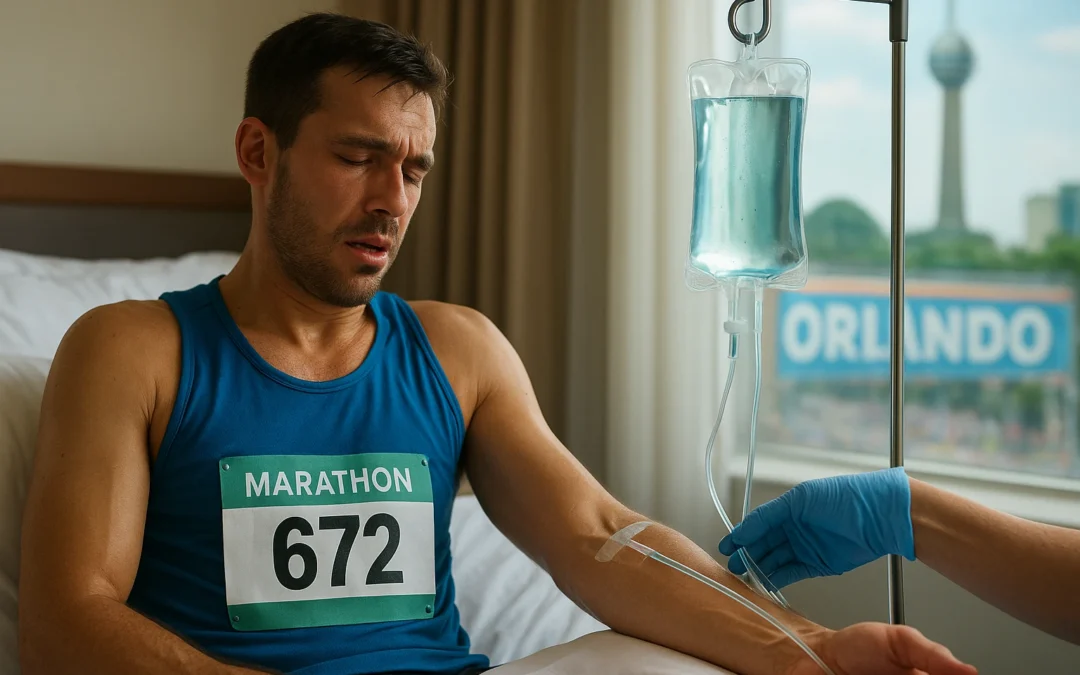
This biological bottleneck is exactly why athletic recovery iv therapy has become a non-negotiable tool for elite competitors. By bypassing the disabled digestive tract entirely, fluids and electrolytes are delivered directly to the vascular space, achieving 100% bioavailability instantly without stomach distress.
The Biochemistry of the Post-Race Collapse
Understanding what happens at Mile 26.2 is the first step to actively programming your recovery. When you push your body to its limits, three major physiological shifts occur.
1. Plasma Volume Depletion & The “EPO” Connection
Severe fluid loss causes a dramatic drop in your blood plasma volume. Your blood literally becomes thicker (hyperviscous), increasing cardiovascular strain as your heart struggles to pump oxygen-carrying red blood cells to exhausted tissues.
Many runners look into natural “EPO-Boost” supplements to increase their red blood cell count for better oxygen delivery. But here is the catch: having a high red blood cell count is useless if you are dehydrated. Sluggish, thick blood cannot navigate your microcirculation efficiently. Expanding your plasma volume through intravenous hydration instantly optimizes this circulation, allowing your cells to flow rapidly and maximize oxygen delivery to recovering muscles.
2. The Micro-Tear and Free Radical Storm
Every time your foot strikes the pavement, eccentric muscle contractions cause microscopic damage to your muscle fibers. This cellular damage, combined with extreme aerobic exertion, generates a cascade of free radicals, causing acute systemic inflammation.
3. The Science of Cramping: The Calcium-Magnesium Pump
Most runners believe cramping is solely a lack of salt. In reality, it largely comes down to the Calcium-Magnesium Pump. Magnesium acts as a natural calcium blocker in your cells. When your magnesium is depleted through heavy, humid sweat, calcium floods the muscle cells, causing continuous, painful contractions. Introducing intravenous magnesium restores the cellular pump almost instantly, allowing hyper-contracted muscle fibers to finally relax.
Mastering Multi-Day Challenges: The runDisney Blueprint
If you are tackling a multi-day event—like runDisney’s Dopey Challenge, which requires running a 5K, 10K, Half Marathon, and Full Marathon on four consecutive days—standard recovery timelines go out the window.
We can look to Olympic heptathletes, like Louise Hazel, for the blueprint. Athletes who have to recover across multiple events in 48 hours cannot wait a full day for digestion to process nutrients. Modern coaching platforms, such as Ascend Athlete and Ace Athlete protocols, treat recovery as an active, programmed training phase rather than just “resting.”
To achieve this overnight biochemical reset, runners utilize targeted formulations like the Peak Perform IV or specialized Athletic Recovery IV Drips. These protocols deliver B-complex vitamins, high-dose Vitamin C, amino acids (like L-arginine and L-glutamine to accelerate micro-tear repair), and glutathione to flush lactic acid and restore cellular ATP before the next morning’s alarm goes off. Some athletes even incorporate a biotin iv infusion to support cellular repair and combat the oxidative stress of prolonged exposure to the intense Florida sun.
Cardiovascular Safety: Why Who Holds the Needle Matters
As iv therapy orlando becomes more popular, runners often make the mistake of visiting boutique spas for their post-race recovery. But a post-marathon body is in a highly sensitive clinical state.
Research presented at advanced medical symposiums, such as the C3 Cardiovascular Conference in Orlando, highlights the intense post-endurance cardiovascular state of marathoners. Running 26.2 miles causes transient cardiac stress (temporary elevations in heart strain markers) and acute kidney stress due to prolonged dehydration.
Infusing high-volume fluids into a biochemically volatile, exhausted body requires precise medical screening. This is why Intravene exclusively employs Critical Care Nurses drawn from Intensive Care Units (ICU) and Emergency Departments (ER). Before any specialized sports recovery iv is administered, an ICU-trained nurse performs pre-infusion vitals, lung sound assessments, and personalized medical screening. They understand complex fluid dynamics and can safely customize the drip rate to your exact cardiac and renal state.
Your Orlando Marathon Recovery Checklist
Planning your recovery is just as important as planning your race pace. Here is how to map out your post-race window:
- Immediate Post-Race (0-2 Hours): Focus on active cooling, light walking to prevent blood pooling, and assessing your ability to keep small sips of fluid down.
- The Rehydration Window (2-6 Hours): This is the optimal time to bypass the GI tract. Instead of constantly searching for “mobile iv therapy near me” while exhausted, pre-schedule a critical care nurse to arrive directly at your Orlando hotel, whether you’re staying in Lake Nona, Downtown, or a Walt Disney World resort room.
- Deep Restoration (24-48 Hours): Focus on sleep, light mobility work, and high-quality protein intake now that your GI tract has had its blood flow restored and can properly digest food.
Frequently Asked Questions
Why can’t I just drink sports drinks like Liquid I.V. or Gatorade after a marathon in Orlando?
While great for light exercise, oral sports drinks rely on your gastrointestinal tract for absorption. After running in Orlando’s heat and humidity, up to 80% of blood flow has been diverted away from your stomach, making it incredibly difficult to absorb large amounts of fluid quickly without experiencing nausea or vomiting.
Is it better to get an IV drip before or after a marathon?
Both serve distinct purposes, but post-race is generally considered vital for acute recovery. Pre-race priming (24-48 hours before) helps maximize cellular hydration and glycogen storage cofactors. Post-race (2-6 hours after) is critical for restoring plasma volume, flushing free radicals, and halting delayed-onset muscle soreness (DOMS).
How safe is mobile IV therapy, and who administers it?
Safety depends entirely on the provider. Because your heart and kidneys are under transient stress after a marathon, it is crucial that your IV is administered by a highly trained medical professional. Premier providers like Intravene only use ICU and ER Critical Care Nurses who can assess your hemodynamics and monitor your body’s response safely.
What is the difference between standard hydration and an athletic recovery drip?
Standard hydration is typically just saline or Lactated Ringer’s. A targeted athletic recovery drip, like the Peak Perform IV, is a complex biochemical tool. It includes amino acids to repair muscle tissue, high-dose magnesium to stop cramps, and potent antioxidants like glutathione to clear the oxidative stress generated by running 26.2 miles.
The Finish Line is Just the Beginning
Running an endurance event in Central Florida is a monumental achievement that demands respect—not just during your training blocks, but in how you treat your body after crossing the finish line.
By understanding the physiological hurdles of humidity, gastrointestinal shunting, and cellular depletion, you can shift your mindset from simply “resting” to actively recovering. When you give your body exactly what it needs, precisely when it needs it, you don’t just recover faster—you come back stronger for the next starting line.