

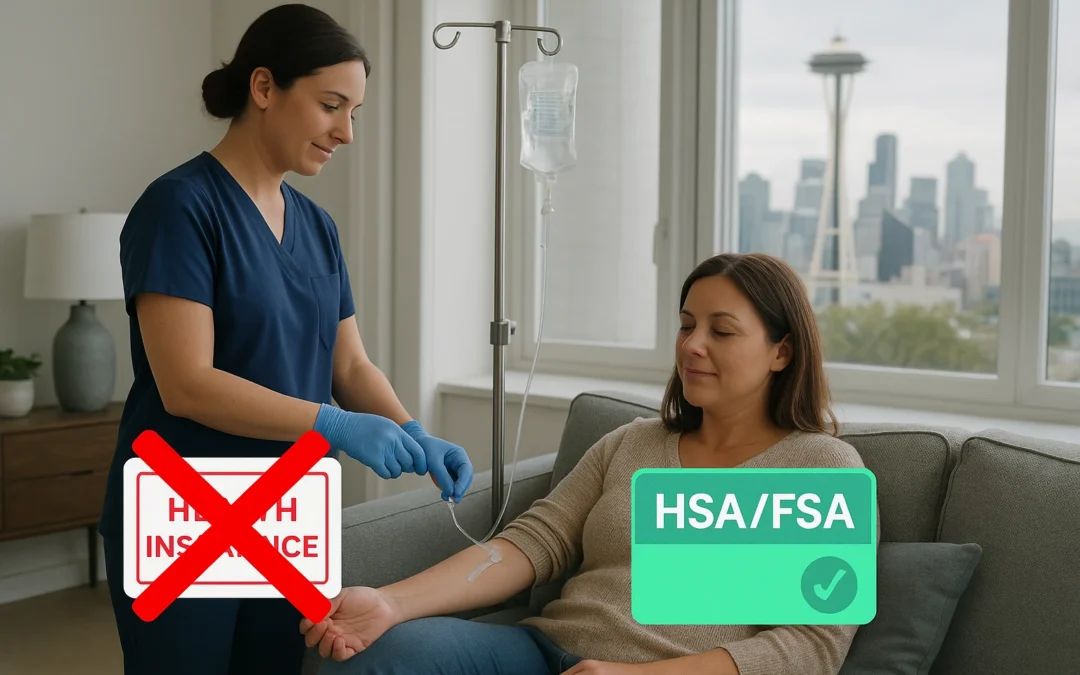
Imagine waking up in Seattle feeling completely depleted. Whether you’re battling a severe bout of the flu, recovering from a marathon, managing a chronic condition like POTS, or dealing with intense morning sickness, you know that intravenous hydration would bring rapid relief.
You pull up your phone and search for mobile iv seattle options that can come directly to your home. But before you book, a critical question arises: Will my Premera, Regence, or Kaiser health insurance pay for this?
If you’re confused by the intersection of healthcare, mobile wellness, and insurance billing, you are not alone. Navigating the world of iv therapy insurance is surprisingly complex. Let’s demystify exactly how health insurance works for in-home IV drips, why over 95% of these services operate on a cash-pay basis, and how you can legally maximize your HSA or FSA benefits to offset the costs.
Medical Necessity vs. Elective Wellness: The Washington State Standard
To understand why a mobile IV nurse can’t simply swipe your commercial insurance card like your primary care doctor does, we have to look at how insurance companies define “medical necessity.”
In Washington State, health insurance providers categorize IV therapy into three distinct tiers:
Tier 1: Pure Elective Wellness (0% Insurance Coverage)
Treatments chosen for hangover relief, jet lag, general energy boosting, anti-aging, or beauty (like Biotin or glutathione pushes) are considered elective. Because these are preventative or wellness-based rather than treatments for an acute, diagnosed medical illness, commercial insurance will not cover them. These are strictly self-pay.
Tier 2: Medically Necessary Home Infusion (Covered with Prior Authorization)
If you require specialty pharmaceuticals—such as IV antibiotics for an infection, chemotherapy, or parenteral nutrition—this is handled by licensed Home Health Agencies. These treatments require a physician’s prescription, intense prior authorization, and are generally covered by your plan.
Tier 3: The Grey Zone (Out-of-Network and Chronic Conditions)
This is where the confusion usually lies. What if you have severe dehydration from a stomach bug? What if you need an iv therapy pregnancy treatment for Hyperemesis Gravidarum (severe morning sickness)? What if you suffer from Postural Orthostatic Tachycardia Syndrome (POTS)?
While the fluid itself might be medically necessary, insurance companies often deny mobile IV claims due to something called the Place of Service (POS) Rule.
The “Aha Moment”: The Place of Service (POS) Disconnect
Here is the biggest secret in healthcare billing: Insurance companies don’t just pay for the treatment; they pay for where the treatment happens.
If you walk into a hospital ER or an Urgent Care clinic and receive a bag of normal saline, the medical biller uses POS Code 19 or 22 (Off Campus-Outpatient Hospital). Because the hospital has a massive in-network facility contract with your insurer, the IV is covered (minus your deductible).
However, when a highly-trained critical care nurse brings that exact same bag of saline to your living room, the billing code changes to POS 12 (Home). Traditional health insurance plans rarely have contracts with mobile wellness providers for POS 12 hydration. Therefore, even if you desperately need the fluids, the claim is automatically flagged as an out-of-network, non-covered facility expense.
This is exactly why most mobile IV providers operate on a direct cash-pay model—the traditional insurance framework simply hasn’t caught up to the convenience of modern, in-home care.
Demystifying HSA, FSA, and Superbills
Just because direct health insurance won’t cover a mobile IV doesn’t mean you have to pay entirely out of pocket. Many patients successfully utilize their Health Savings Accounts (HSA) or Flexible Spending Accounts (FSA).
Swiping Your HSA/FSA Card
You can often use your HSA or FSA card to pay for mobile IV therapy, but there is a crucial catch: A successful card swipe does not mean the IRS automatically approves the medical expense.
To pass a potential HSA administrator audit, the treatment must treat a specific medical condition (like clinical dehydration). To ensure compliance, it is highly recommended to obtain a Letter of Medical Necessity (LMN) from your primary care doctor. An LMN is a simple document stating that your home hydration is prescribed to manage a specific condition.
The Reality of Superbills
Some mobile IV clients attempt to get reimbursed by submitting a “Superbill” to their out-of-network insurance benefits. A Superbill is an itemized receipt that contains five mandatory elements:
- The Provider’s NPI (National Provider Identifier) Number
- The Provider’s Tax ID
- The Place of Service (POS) Code (Usually 12)
- The ICD-10 Diagnosis Code (e.g., E86.0 for Dehydration, O21.0 for Hyperemesis Gravidarum, or G90.A for POTS)
- The CPT Procedure Code (e.g., 96360 for the first hour of IV hydration, and 96361 for additional hours).
While having these codes is empowering, you should know that the rejection rate for out-of-network POS 12 Superbills is high. It’s best to view any reimbursement you get from a Superbill as a pleasant surprise rather than a guarantee.
Actionable Financial Guide: Seattle Mobile IV Cost Benchmarks
Because mobile IVs are typically direct-pay, understanding local pricing is essential. So, what is the average mobile iv therapy cost in the Seattle metropolitan area?
- Baseline Hydration ($85 – $150): Simple saline or Lactated Ringer’s without added vitamins.
- Targeted Wellness Drips ($195 – $250): The most popular tier, which includes Hangover IVs, Immune Boosts (like the Myers’ Cocktail), and athletic recovery blends.
- Specialty Infusions ($300 – $999+): Advanced cellular therapies like NAD+ (Nicotinamide Adenine Dinucleotide) or high-dose IV Iron.
While a $200 out-of-pocket expense for a targeted wellness drip might seem steep at first glance, it is helpful to compare it to the alternative. A trip to a Seattle emergency room for non-emergency dehydration can easily result in a $1,500+ deductible bill, hours of waiting in a room full of sick people, and exposure to hospital-acquired infections. In contrast, premium services like intravene mobile iv therapy send critical-care-trained nurses directly to your couch within hours.
Frequently Asked Questions
Does health insurance pay for mobile IV therapy in Seattle?Generally, no. Commercial insurance providers like Premera, Regence, and Kaiser typically do not cover in-home elective wellness IVs or acute hydration due to place-of-service (POS) facility coding rules.
Can my doctor prescribe home IV therapy for POTS or morning sickness?Yes. Your doctor can write a Letter of Medical Necessity (LMN) for these chronic conditions. While this won’t force commercial insurance to pay a mobile IV provider directly, it will allow you to legally use your HSA/FSA tax-advantaged funds to pay for the treatments.
Why don’t boutique mobile IV providers accept health insurance?The administrative overhead, low reimbursement rates, and high likelihood of claim denials for in-home (POS 12) visits make it economically impossible for mobile IV companies to accept insurance while still paying top-tier wages to critical care nurses. The cash-pay model ensures you get rapid, high-quality care without the red tape.
Next Steps for Your Wellness Journey
Navigating healthcare costs is never simple, but understanding the rules puts the power back in your hands. While standard health insurance might not cover your mobile IV drip in Seattle, leveraging your HSA/FSA with a Letter of Medical Necessity can make regular wellness hydration incredibly accessible.
When you’re ready to experience the profound relief and cellular support of hospital-grade hydration in the comfort of your own home, prioritize providers who exclusively employ ICU and ER-trained nurses. Your health, comfort, and safety are always worth the investment.