

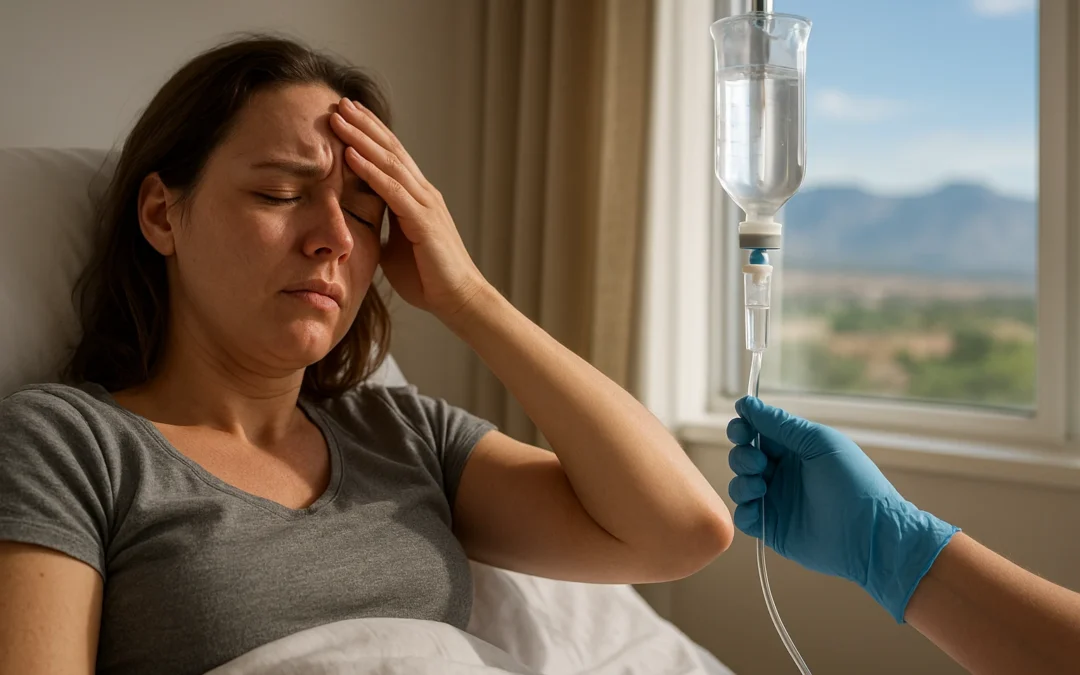
You’ve just experienced a perfect Western Slope weekend. Maybe you spent your Saturday exploring the renowned Palisade Fruit and Wine Byway, or perhaps you joined the Friday Night Beer Crawl, sampling the heavy, unfiltered ales at Grand Junction Brewing Co. and oak-aged spirits at Peach Street Distillers.
It was an incredible experience—until you woke up the next morning.
Suddenly, your head is throbbing, your body feels drained of all energy, and the idea of getting out of bed feels insurmountable. You might be wondering: Why are my hangovers so much worse in Grand Junction than they are at sea level? And more importantly, why isn’t chugging water making a difference?
If you’ve been searching for a reliable hangover iv to salvage your weekend, you aren’t alone. Recovering from a night out in the high desert is a unique physiological challenge. Let’s pull back the curtain on the science of high-altitude hydration, how craft beverages impact your body at a cellular level, and how targeted medical recovery actually works.
The Grand Junction Double-Whammy: Altitude Meets Alcohol
To understand why a night out in Western Colorado hits differently, we have to look at the physics of your environment. Grand Junction sits at an elevation of 4,586 feet above sea level. At this altitude, atmospheric pressure drops, the air is incredibly dry, and your body naturally increases its respiratory rate to maintain oxygen levels.
This leads to what scientists call insensible water loss—meaning you are literally exhaling your body’s moisture with every breath, even if you don’t feel yourself sweating.
Now, introduce alcohol into this high-altitude equation. Alcohol is a diuretic that actively blocks your pituitary gland from releasing Vasopressin, also known as antidiuretic hormone (ADH). For every single gram of alcohol you consume, your kidneys excrete about 10mL of urine.
When you combine altitude-induced respiratory water loss with alcohol-induced ADH inhibition, you get “altitude-hangover synergy.” Your blood plasma volume plummets rapidly. Your brain tissue actually shrinks slightly due to fluid loss, pulling on the protective dural membranes surrounding your skull—which is exactly what causes that blinding, throbbing morning-after headache. This severe dehydration overlap is why an iv for altitude sickness is often structurally similar to hangover recovery treatments.
The Chemistry of Craft Beverages: Why That Local IPA Lingers
Not all alcohol is processed the same way by your body. Craft beers and barrel-aged spirits—like the artisanal selections you’ll find across Grand Junction and Palisade—are packed with complex flavors, deep colors, and high concentrations of congeners.
Congeners are toxic metabolic byproducts of the fermentation and aging process. They include substances like methanol, tannins, and acetone. When you drink, your liver prioritizes the clearance of ethanol first because it’s the most immediate threat. This leaves the toxic congeners to circulate in your bloodstream for hours, triggering a massive inflammatory response.
To clear these congeners, your liver requires specific enzymatic cofactors—primarily trace minerals like manganese, zinc, and copper. If your body is depleted of these minerals, the toxic byproducts linger, extending your hangover from a brief morning annoyance to an all-day ordeal.
The Fallacy of Sports Drinks and “Cranberry Juice Cures”
When we wake up hungover, our first instinct is usually to reach for a massive glass of water, a sugary sports drink, or perhaps cranberry juice. But for moderate-to-severe hangovers, oral rehydration often fails.
Here is why:
1. Gut Wall Inflammation
Alcohol severely irritates the gastric mucosa (your stomach lining) and causes a sluggish bowel motility. This inflammation drastically compromises your small intestine’s ability to absorb fluids. Just like oral medications struggle to process during severe gastrointestinal distress (which is why people often seek iv therapy for food poisoning), oral fluids struggle to process during a severe hangover.
2. The Osmotic Trap
Reaching for a high-sugar drink like fruit juice or a commercial sports drink can actually make you more dehydrated. High-sugar fluids pull water out of your vascular system and into your digestive tract to dilute the heavy concentration of sugars—a process known as an osmotic draw. This leads to delayed hydration, stomach cramping, and worsened nausea.
3. The Bioavailability Gap
Even under perfect conditions, your body only absorbs about 20% to 30% of the nutrients and fluids you swallow. When you receive hangover iv therapy, the fluids bypass your inflamed gastrointestinal tract entirely, delivering 100% bioavailability straight into your bloodstream.
Inside the Bag: The Molecular Magic of Targeted Recovery
When locals and visitors look for an iv therapy grand junction provider after a rough night, they aren’t looking for a luxury spa trend—they need medical-grade metabolic recovery.
A well-formulated treatment, like Intravene’s Revive Hangover IV, doesn’t just “hydrate” you; it systematically reverses the chemical cascades caused by alcohol toxicity. Here is the science behind the bag:
- 1000mL of Normal Saline: An isotonic solution that instantly restores your blood volume, supports cardiovascular output, and dilutes circulating toxins.
- Taurine (50mg): Alcohol is a depressant that artificially relaxes your nervous system. The next morning, your brain experiences a rebound effect of “glutamate excitotoxicity,” which causes the classic hangover shakes, anxiety, and light sensitivity. Taurine is an inhibitory neuromodulator that binds to your brain’s receptors to instantly calm this overexcited state.
- B-Complex (B1, B2, B3, B5, B6) & Methylated B12: Essential for fueling mitochondrial energy. Vitamin B3 (Niacin) promotes localized vasodilation to help relieve cerebral vessel constriction (headaches), while Methylated B12 bypasses genetic limitations to immediately clear cognitive brain fog.
- Trace Mineral Blend (Zinc, Manganese, Copper, Selenium): Chronic and acute alcohol consumption depletes trace minerals. Manganese is a mandatory cofactor for Superoxide Dismutase (SOD), the primary enzyme your body uses to neutralize the free radicals generated by heavy craft beverage congeners.
- Targeted Clinical Medications: Adding Ondansetron (Zofran) selectively blocks serotonin receptors in your vagus nerve to stop nausea in minutes. Meanwhile, Ketorolac (Toradol), a powerful non-steroidal anti-inflammatory, shuts down cyclooxygenase enzymes to stop inflammatory pain at its source.
The Critical Care Standard: Why Your Provider Matters
As the popularity of mobile wellness grows, many people type hangover iv near me into their phones looking for the fastest, cheapest option. But putting an IV into your vein is a medical procedure, and who administers it makes all the difference in your comfort and safety.
This is where Intravene separates itself. Instead of utilizing standard phlebotomists or basic medical assistants, Intravene employs exclusively Critical Care Nurses—specifically, veterans of Intensive Care Units (ICU) and Emergency Departments (ER).
Why does this matter for a hangover? Because when you are severely dehydrated, your veins shrink and “roll,” making them incredibly difficult to access. ICU and ER nurses have spent their careers mastering complex vascular access on critically dehydrated patients. They provide a seamless, painless, and sterile hospital-grade experience right in your hotel room, living room, or Airbnb.
Frequently Asked Questions (FAQ)
How quickly does an IV work compared to drinking water?
While oral fluids can take hours to process through an inflamed stomach (with only 20-30% absorption), IV hydration enters the bloodstream directly. This restores blood plasma volume instantly, offering 100% bioavailability. Most individuals feel significant relief from brain fog and nausea within 15 to 30 minutes of the infusion starting.
Does IV therapy cure the metabolic damage of a hangover?
It’s important to be medically objective: an IV drip does not “cure” the cellular damage caused by alcohol metabolism. However, it does rapidly correct the severe, debilitating symptoms—systemic dehydration, electrolyte depletion, and acute nausea—allowing your body’s natural liver pathways to finish processing the toxins without you suffering in bed all day.
Can I just use over-the-counter painkillers instead of the IV medications?
Oral NSAIDs (like ibuprofen) are highly irritating to an already inflamed stomach lining. Intravenous medications like Toradol (anti-inflammatory) and Zofran (anti-nausea) bypass the gut entirely, working immediately without causing further gastrointestinal distress.
How does mobile IV therapy work if I’m staying at a hotel?
The process is designed for absolute convenience. When you book a treatment, a highly trained ICU/ER nurse is dispatched to your location—whether that’s a home in Grand Junction, a hotel near the Palisade wineries, or an Airbnb. The setup is discreet, sterile, and typically takes 45 to 60 minutes from start to finish.
Ready to Reclaim Your Weekend?
Whether you’re visiting the Western Slope for a celebration, recovering from a winery tour, or just need to bounce back from an unexpected rough morning, you don’t have to spend your day suffering. Understanding the science of high-altitude dehydration and alcohol metabolism is the first step; taking action to support your body’s recovery is the next.
If you want to learn more about how targeted IV therapies can support your body’s natural healing processes—from hangover recovery to athletic optimization—explore Intravene’s comprehensive educational resources or connect with our team of critical care nurses today.