

Imagine this: You’ve just landed at Denver International Airport, or maybe you spent the weekend conquering the trails at Red Rocks. Suddenly, a familiar dull headache sets in, accompanied by profound fatigue. You might brush it off as standard travel exhaustion or a sign that you need an extra glass of water.
But at 5,280 feet above sea level, your body is experiencing something entirely different: cellular dehydration compounded by high altitude.
When oral hydration isn’t enough, mobile iv therapy sounds like the perfect, convenient solution. But before you invite someone into your living room, hotel, or office to place a needle in your vein, it’s completely natural—and incredibly smart—to ask a few questions. Who exactly is administering this treatment? What are their qualifications? And what happens if something doesn’t go exactly as planned?
Welcome to the definitive guide on navigating the mobile wellness landscape in the Mile High City. Today, we’re pulling back the curtain on the physiological realities of altitude, unpacking Colorado’s unique medical regulations, and introducing the standard-bearers of local safety: Denver’s critical care nurses.
The Mile High Reality: Why Altitude Changes Everything
If you’ve ever felt like your veins were “hiding” when getting blood drawn in Colorado, it’s not your imagination. The high altitude of the Denver metro area triggers a fascinating—and challenging—physiological response.
Because the air is thinner, your respiratory rate naturally increases to take in more oxygen. This rapid breathing, combined with Colorado’s famously dry climate, accelerates fluid loss. At the same time, the combination of mild hypoxia (lower oxygen levels) and cooler temperatures causes what medical professionals call hypobaric vasoconstriction.
In plain English? Your blood vessels naturally shrink and retreat away from the surface of your skin to conserve heat and oxygen.
This altitude-vein dynamic turns a standard needle insertion into a highly complex procedure. A practitioner without advanced training might resort to multiple painful “blind visual sticks,” leading to bruising and blown veins. Critical care nurses, on the other hand, rely on advanced tactile mapping—feeling the vein’s health, depth, and resilience rather than just looking at it.
Navigating the “Colorado Regulatory Paradox”
The rapid commercialization of the wellness industry has created a knowledge gap for consumers, particularly here in the Rockies. We call it the “Colorado Regulatory Paradox.”
While individual nurses and clinicians are strictly licensed by the Colorado Division of Professions and Occupations (DORA), the state does not license mobile IV hydration clinics or medspas as independent medical facilities. This loophole has saturated the market with unregulated, ambiguous titles like “Wellness Hydration Specialist” or “IV Technician.”
Here is the objective qualification pyramid you should know when evaluating who is allowed to perform iv therapy colorado residents trust:
- Level 1: Unregulated Titles (e.g., Hydration Techs). These individuals lack clinical nursing degrees.
- Level 2: Licensed Practical Nurses (LPNs). Under Colorado Rule 3 CCR 716-1, LPNs have a restricted scope. They cannot give certain IV push medications and require direct supervision.
- Level 3: General Registered Nurses (RNs). Floor nurses with basic IV competency.
- Level 4: Critical Care RNs (ICU / ED / Trauma). The elite standard. These professionals possess active Advanced Cardiovascular Life Support (ACLS) certifications and have mastered complex vascular access and hemodynamic assessments.
The Critical Care Difference: Your Sole Safety Net
In a hospital emergency room, a nurse is surrounded by a massive infrastructure: attending physicians, rapid response teams, and fully stocked crash carts.
When you receive an IV in a residence in LoDo, Cherry Creek, or Wash Park, the nurse is the entire clinical infrastructure.
This is why critical care training—specifically experience in the Intensive Care Unit (ICU) or Emergency Department (ED)—is non-negotiable for in-home care. An IV is not a spa treatment; it is an invasive vascular procedure entering your systemic circulation. Before a single drop of fluid is administered, a critical care nurse performs a rigorous hemodynamic triage.
They listen to your lung sounds, evaluate your skin turgor, check pulse pressures, and screen your renal and cardiac history. Why? Because rapidly infusing a banana bag iv or standard saline into someone with underlying (and sometimes unknown) borderline kidney or heart issues can trigger serious complications like fluid overload. An ICU/ED nurse knows exactly how to calculate drip rates based on your specific body mass and physiological tolerance.
Meet the Standard of Care: Denver’s Premier Nursing Team
When you book a premium mobile wellness service, you deserve hospital-grade expertise delivered with concierge-level bedside manner. The critical care nurses serving the Denver community aren’t just passing through; they are the backbone of our local healthcare ecosystem.
Our team members have honed their skills in the most demanding environments in the state, bringing real-world experience from premier institutions like Denver Health, UCHealth University of Colorado Hospital, St. Anthony Hospital, and Centura/CommonSpirit facilities.
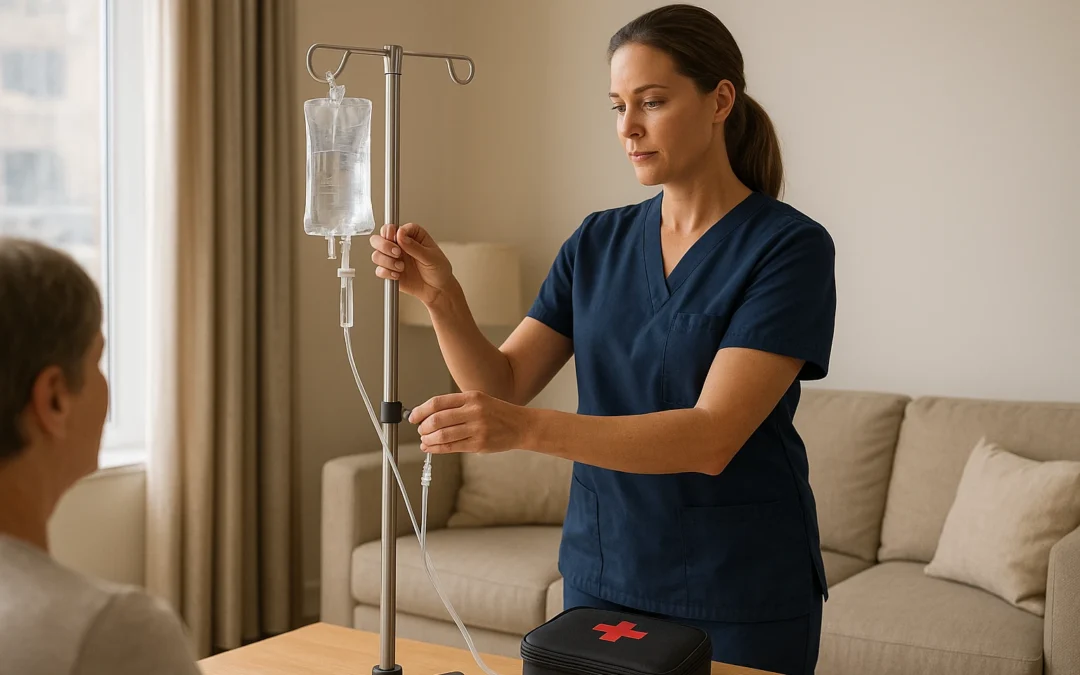
Whether they are managing acute mountain sickness for a traveler in a downtown hotel or rehydrating an athlete post-marathon in Washington Park, they bring the ER’s standard of safety to your sofa.
What Your Nurse Brings to Your Home
Every critical care nurse arrives fully equipped to manage your health safely. Their medical bags include:
- Sterile-field PPE: Ensuring an infection-free insertion site.
- Medical-grade IV catheters: Ranging in sizes to perfectly match your vascular anatomy.
- Comprehensive Emergency Kits: Including vital tools like Epinephrine, antihistamines, and line discontinuation supplies to manage any rare adverse reactions instantly.
The Denver Mobile IV Consumer Safety Audit
Ready to book a treatment? Protect yourself by asking these five vital questions before you let anyone hang a bag of fluids in your home:
- “Can I verify your active Colorado RN License?” (Tip: You can look this up on the DORA website in about 30 seconds).
- “What is your background in critical care (ICU/ED)?”
- “Do you perform a pre-infusion health screening, including listening to lung sounds and checking cardiac history?”
- “Is your compounding pharmacy FDA-registered (503A/503B), and who is your Medical Director?”
- “What specific emergency equipment do you carry in your kit if I have an allergic reaction?”
If a provider cannot answer these questions clearly and confidently, they are not the right fit for your health and safety.
Frequently Asked Questions About Mobile IVs in Denver
Is it safe to have an IV placed in my living room or hotel room?
Yes, but safety is entirely dependent on the person administering it. When performed by a highly vetted, critical care-trained Registered Nurse (ICU/ED RN) who utilizes sterile techniques and conducts proper health screenings, in-home IV therapy is incredibly safe.
Will getting an IV hurt?
While you will feel a tiny pinch during the initial insertion, the process should not be painful. Because critical care nurses use advanced tactile vein mapping instead of blind sticking, they are experts at finding the right vein on the first try, minimizing discomfort and preventing bruising.
Why do you need my medical history just for vitamins and hydration?
IV fluids and vitamins enter your bloodstream immediately. If you have conditions like congestive heart failure, renal dysfunction, or high blood pressure, rapid fluid intake can be dangerous. A thorough health history ensures the nurse can safely tailor the fluid volume and drip rate to your body’s specific needs.
How do I pay for my treatment, and can you use hsa for iv therapy?
Payment is typically handled seamlessly online or at the time of your appointment. Because IV hydration can be classified as a medical service depending on your symptoms, many people wonder, can you use hsa for iv therapy? In many cases, yes. Flexible Spending Accounts (FSA) and Health Savings Accounts (HSA) often cover IV therapies if they are used to treat a medical condition (like dehydration, migraines, or illness). It is always best to check with your specific plan administrator.
What happens if I feel faint or have an allergic reaction during the treatment?
This is exactly why the “sole safety net” principle is so vital. If a rare adverse event occurs, an ICU or ED-trained nurse is uniquely qualified to manage it immediately. They carry emergency medical kits and have the advanced life support training necessary to stabilize you long before a 911 dispatcher could even send an ambulance.
Elevating Your Wellness Journey
Understanding the science of your own body, especially in a unique environment like Denver, is the first step toward optimal wellness. By knowing the physiological impacts of altitude and the critical importance of proper medical credentials, you are now empowered to make the safest, most effective choices for your health.
When you’re ready to experience the difference that true clinical expertise makes, look for the professionals who treat your living room with the exact same reverence, safety, and standard of care as a top-tier hospital room.