

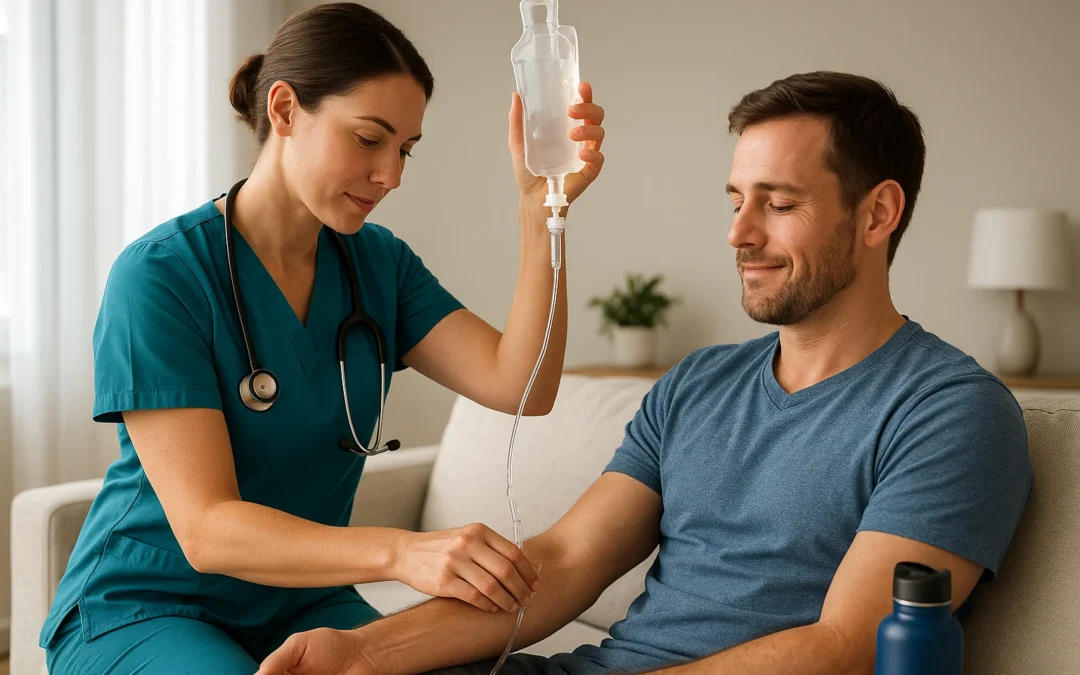
If you’ve spent any time exploring the trails of the Colorado National Monument or pushing your limits on the Lunch Loop, you know that Grand Junction’s high-desert climate demands respect. Between the 4,500-foot elevation, the relentless dry air, and our active local lifestyle, staying properly hydrated is a constant battle.
In recent years, mobile iv therapy has exploded in popularity across the Grand Valley as a quick fix for dehydration, altitude sickness, and fatigue. But as wellness “bars” and pop-up hydration clinics race to offer the cheapest and fastest drips, a critical question is getting lost in the noise:
Is an IV a casual spa treatment, or is it a medical procedure?
When you invite a healthcare provider into your home, office, or hotel room, you are trusting them with your health. In this guide, we are pulling back the curtain on the mobile IV industry to explain why who is holding the needle matters just as much as what is in the bag, and why critical care expertise is the gold standard for your safety.
The Grand Junction Dilemma: Altitude, Dry Air, and the “First-Pass Effect”
Living in the Grand Valley comes with a unique set of environmental challenges. At our altitude, the air is thinner and drier. Every time you exhale, you lose more moisture than you would at sea level. Your body also produces more red blood cells to carry oxygen, which naturally thickens your blood and requires more fluid to keep everything flowing smoothly.
Often, we think the solution is simply to drink more water or take oral vitamin supplements. But here is the biological catch: The First-Pass Effect.
When you swallow a vitamin supplement or drink an electrolyte beverage, it must pass through your digestive tract and be processed by your liver before it ever reaches your bloodstream. By the time your liver is done acting as a filter, you only absorb about 20% of those nutrients. The rest is literally flushed down the toilet.
A mobile iv bypasses the digestive system entirely, delivering fluids, vitamins, and minerals directly into your bloodstream for 100% absorption. But changing your body’s blood volume through an IV is a physiological shift that requires serious medical oversight—which brings us to the most important factor in your care.
Not All Nurses Are Created Equal: The Hierarchy of Care
The medical field uses broad terminology that can be confusing for patients. Many IV providers advertise that their treatments are administered by “medical professionals” or “registered nurses.” While these professionals are dedicated and capable, nursing is a vast field with varying levels of specialized training.
To understand the critical care difference, it helps to look at the hierarchy of care:
- LPN (Licensed Practical Nurse): Provides basic medical care and comfort.
- Standard RN (Registered Nurse): Highly trained to administer medications, assist in surgeries, and manage patient care in various clinical settings.
- Critical Care RN (ICU/ER): These are the nurses who manage life-or-death situations, monitor advanced life support systems, and respond to traumatic medical emergencies.
Intravene’s model is built exclusively around this top tier. The nurses knocking on your door aren’t just wellness practitioners; they are the exact same rapid-response experts who save lives in the Intensive Care Units and Emergency Departments at local facilities like St. Mary’s Medical Center and Community Hospital.
The Anatomy of a Safe Drip: What an ICU Nurse Sees That Others Miss
When a critical care nurse steps into your home to administer iv therapy grand junction, they aren’t just looking for a vein. They are conducting a comprehensive, real-time assessment of your overall hemodynamics (how your blood flows and balances). Here is what sets their approach apart.
The “Vein Whisperer” Advantage
One of the most common reasons people avoid IVs is the fear of needles or a history of being a “hard stick.” When veins are dehydrated, they tend to constrict or “roll,” making them incredibly difficult to access. Standard practitioners might need multiple painful attempts to place an IV, occasionally “blowing” a vein in the process.
ICU nurses are the undisputed masters of vascular access. In the ICU, they regularly place central lines and arterial lines in patients with severely compromised vascular health. They know how to read the topography of your arm, adjust the angle of approach, and successfully access even the most challenging veins on the first try.
Hemodynamic Monitoring and Fluid Management
Intravenous hydration introduces a significant amount of fluid directly into your circulatory system. While this is incredibly restorative, your heart and lungs have to process that sudden increase in volume.
A critical care nurse is trained to listen to your heart and lung sounds and monitor your vitals to ensure your body is handling the fluid perfectly. They know exactly how to adjust the drip rate to prevent fluid overload (edema)—a nuance that standard wellness spas simply aren’t trained to manage. This level of iv safety is what protects you from adverse reactions.
Beyond the Hangover: Advanced Applications of Mobile IVs
While IV therapy is famous for curing Sunday morning hangovers, a critical care approach opens the door for much more advanced, specialized treatments:
- Athletic Recovery: Local cyclists and runners use tailored amino acid and magnesium blends to flush lactic acid after grueling high-altitude workouts.
- Chronic Illness Support: Patients managing conditions like POTS (Postural Orthostatic Tachycardia Syndrome), severe migraines, or chronic fatigue require deep clinical knowledge to ensure treatments don’t conflict with their daily medications.
- Surgical Recovery: Immune-boosting blends containing high-dose Vitamin C and Zinc can help accelerate healing when administered in the sterile comfort of your own home.
The Safety Check List: 5 Questions to Ask Any Provider
Before you let anyone administer an IV in your home, protect yourself by asking these five questions:
- “What is your specific medical background?” (Listen for ER, ICU, or Critical Care experience).
- “Who is your Medical Director?” (There should always be an overseeing physician).
- “What are your emergency protocols?” (They should have immediate, specific answers about anaphylaxis and rapid response).
- “Where do you source your ingredients?” (Only accept FDA-approved, medical-grade pharmacies, not food-grade alternatives).
- “How do you determine my drip rate?” (It should be based on your specific vitals, age, and health history, not a “one size fits all” speed).
Frequently Asked Questions About Mobile IV Care
Are mobile IVs safe?
Yes, when administered by highly trained professionals. The safety of a mobile IV depends entirely on the clinical expertise of the provider. Critical care nurses follow stringent hospital-grade sterilization and monitoring protocols, significantly reducing the risk of infection, allergic reactions, or fluid imbalances.
Why do some IVs hurt more than others?
Pain during an IV usually stems from an inexperienced provider struggling to find a vein, or from certain vitamins (like Vitamin C or Magnesium) being pushed into the bloodstream too rapidly. An ICU-trained nurse knows exactly how to dilute these vitamins and pace the drip to ensure the experience is virtually painless.
If I’m looking for an iv therapy near me, why shouldn’t I just go to the cheapest clinic?
You are paying for the safety margin. Discount IV clinics often operate on a high-volume business model, using less specialized staff to cut costs. When you choose a premium mobile service, you are investing in one-on-one time with a critical care expert who is focused solely on your unique physiological needs, right in the comfort of your living room.
Ready to Experience the Critical Care Difference?
True wellness isn’t just about feeling better in the moment; it’s about trusting the process that gets you there. Whether you are recovering from a long hike, preparing for a busy travel week, or managing complex health needs, you deserve the peace of mind that comes with hospital-level expertise.
When you’re ready to elevate your hydration and health strategy, explore our comprehensive range of customized wellness solutions and discover why Grand Junction locals trust the critical care standard.